TL;DR
- G-P (Globalization Partners) hires remotely across Europe, and most of its European roles are outside engineering: in-country HR, sales and pricing.
- The biggest group is HR: in-country HR specialists in continental European countries, asking for three or more years of HR experience and, often, a second language that matches the clients they support.
- G-P publishes a salary range in most of its European adverts, set per country and in the local currency, plus variable pay.
- Every European location is labelled “(Remote-First)”, and the adverts we read do not ask for previous experience of working remotely.
G-P is an employer of record, which means its whole business is employing people on behalf of other companies, usually in countries where those companies have no legal entity of their own. Someone in Valencia working for a firm in Toronto might technically be a G-P employee, with G-P running the contract, the payroll and the local compliance. Doing that well needs people who know local employment law and can handle an onboarding, a dismissal or a parental-leave question in the right language, and G-P hires those people remotely, across Europe.
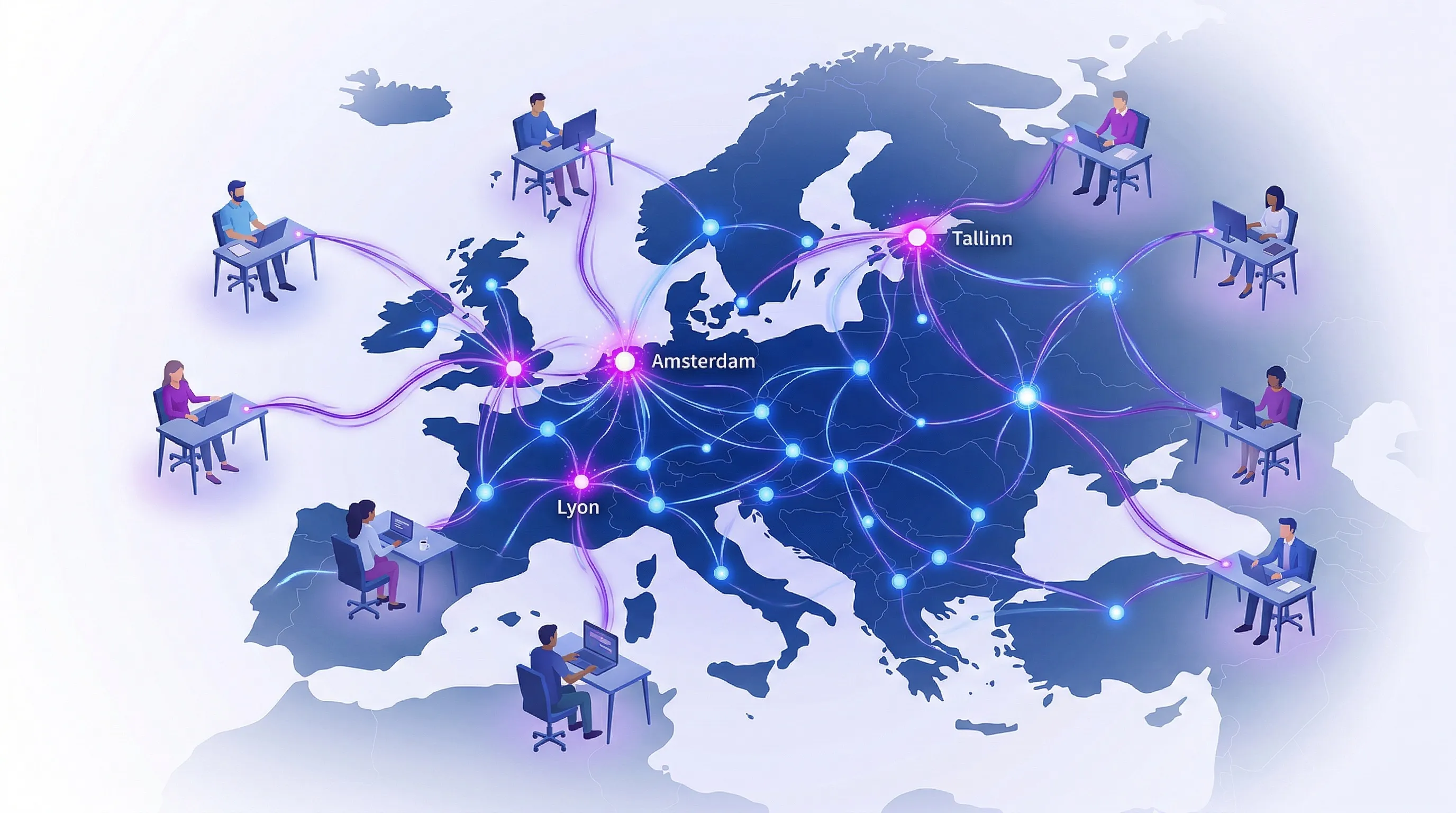
Remote Work Europe tracks G-P’s public job feed on the Connected jobs board, running it through the same filters the board uses: genuinely remote, a European location, posted within the last 90 days, and no speculative “talent community” listings. This profile describes what G-P’s adverts show about how it hires. The live numbers, as we found them on 19 November 2026, are in one dated section near the end.
What does G-P do, and how remote is it?
G-P (Globalization Partners) is an employer of record (EOR) founded in 2012 by Nicole Sahin, who is also its current CEO. It says it supports teams in more than 180 countries through its EOR and contractor products and an AI HR compliance agent called G-P Gia.
What is an employer of record? An employer of record is a company that becomes the legal employer of a worker on behalf of another business. The EOR issues the local employment contract, runs payroll, withholds tax and social security, and carries the employer’s legal obligations in that country, while the client business directs the day-to-day work. It’s one of the main ways a company can hire someone in a European country without setting up a local entity.
G-P’s own language about how it works is consistent. Its careers page describes the company as “globally remote” from the start and as “a global remote-first team”. Its press releases carry the dateline “REMOTE FIRST COMPANY” where most companies would put a city. On the job board, European locations are written the same way, for example “Spain (Remote-First)” or “Czech Republic (Remote-First)”, and the advert texts we read do not mention an office, a hub or a set number of days on site.
If you want the wider context on how EORs fit into European hiring, our guide to how to get hired by a company in a different European country explains the mechanics from the employee’s side. G-P also appears as a provider in our EORs in Europe hub; this profile is about working there, not about using its service.
What kind of G-P remote jobs are there in Europe?
G-P’s European remote jobs fall into four groups: HR and people operations, sales, finance (pricing) and technology. Most are outside engineering.
Several roles are posted once per country, so the number of adverts is usually larger than the number of distinct jobs. If the same role appears in two countries, the job is the same; the location line, and often the pay range, is what differs.
Ireland and the UK carry the widest spread of functions, including sales, pricing and technology. The HR roles are where continental Europe comes in, with in-country HR specialists posted in countries such as Czechia, Poland, Italy, Spain and Romania. Field sales roles have covered markets such as Germany and the Nordics.
The Connected board also leaves off adverts that have been open for months. An advert that has been live for five months may still be hiring, but it may also be an evergreen listing, so treat a very old G-P posting with care.
What do G-P’s HR specialist jobs involve?
The HR specialist roles are in-country HR for G-P’s clients: you become the main HR contact for people employed through G-P in your region, from onboarding to termination. This is the largest family of G-P’s European roles, and the clearest expression of the story here, because the job G-P is hiring for is the job it sells.
The duties listed on G-P’s Southern Europe HR specialist advert are typical of the group: acting as “the primary HR contact for onboarding, lifecycle events, and terminations”, managing “sensitive cases”, building relationships with payroll providers, benefits brokers and HR legal advisers, reviewing employment contracts, guiding clients through performance improvement plans, and acting as the single point of contact for employees’ immigration needs alongside a global mobility team.
None of that is remote-specific work. It’s the work of an HR generalist or HR business partner, the kind of experience people usually build inside an office HR team, a payroll bureau or an employment law practice. The minimum requirement on the HR specialist adverts we read is “3+ years of HR experience”, along with knowledge of the relevant country’s labour law.
G-P’s careers page gives one example of where the role leads. It features Valentina Pedroso, Strategic HR Specialist, who “manages all HR operations for customers in Spain and Portugal”.
Alongside the specialists, G-P has advertised more senior HR delivery roles, leading multi-country onboarding projects for enterprise clients. Those ask for four or more years in implementation, onboarding, project management or operations delivery, ideally in EOR, payroll or HR tech.
For a broader view of this kind of work across European employers, see our guide to remote HR and people ops roles in Europe.
What does G-P pay? Salary ranges in the adverts
G-P states an annual gross base salary range, plus variable pay, in the local currency, in most of its European adverts. Each one adds that ranges are “established using objective market benchmarking data” and that placement within the range “is determined by gender-neutral criteria”. Not every advert carries a range, so check each one.
The same role is priced differently by country. If you’re comparing an offer, compare it with the range for your own location rather than the highest one on the board. Czech, Polish and Romanian roles are priced in local currency.
On variable pay, the adverts say sales roles carry commission and non-sales roles are eligible for an annual bonus tied to individual and company performance, for full-time regular employees.
The ranges each role stated in November 2026 are in the dated section below.
Do I need another language to work at G-P?
For the HR roles, usually yes: most of them name a language beyond English, either as a requirement or a preference. The pattern follows the client markets each role supports rather than where the person lives.
That means a role based in one country can require the language of another. A Southern Europe HR specialist role based in Italy, for example, has asked for Spanish rather than Italian, because it covers Spanish clients. French-speaker roles have focused on French labour law, including portage salarial, and German has been listed as a preference on roles that support German and Austrian clients.
On the sales side, business development adverts have asked for “Professional level English + European language” without naming which one. The finance and technology adverts we read don’t state a language requirement beyond English.
Are G-P’s European roles permanent or fixed-term?
Some of G-P’s European HR specialist roles are one-year fixed-term contracts. Each says, “Please note: this is a 1 year fixed term contract”, and the titles make it visible before you click.
Most of the other adverts don’t describe themselves as fixed-term. The bonus and commission wording applies to “Full-Time Regular Employees”, which is worth asking about at the first call if you’re applying for one of the fixed-term posts.
What do G-P’s adverts say about experience, home office and inclusion?
The adverts we read do not ask for previous experience of working remotely, and do not state a time-zone requirement. What they ask for is experience of the function: three or more years in HR, four or more in implementation or operations delivery, five or more in sales with three in outbound B2B selling for the field sales roles, a minimum of six years for senior sales, and five or more years in corporate finance plus an accounting qualification (full or part) for pricing analysis.
On home working, the adverts themselves are silent. G-P’s careers page says the company offers “flexible work supported by company-wide success principles, including ways to connect and build community, meeting protocols, office setup stipends, and more”. No amount or eligibility rule is published, so ask what the setup stipend covers in your country.
The same benefits line appears across G-P’s European adverts: “generous paid parental leave, flexible time off, spending accounts, medical insurance, dental insurance, vision insurance, sabbatical after 5 years and more”. Because it’s identical everywhere, check which parts apply where you’d be employed.
The adverts also say that “individuals with disabilities are encouraged to apply”, with accommodations available during the interview process through [email protected]. The careers page extends that to “all aspects of the recruitment, assessment, and selection process”.
You can read how Remote Work Europe thinks about remote gateway roles, roles where somebody can bring their experience to a first remote setting, and set what these adverts say against that yourself.
How do I apply for a G-P remote job?
G-P describes a three-step process: apply online with a CV and cover letter, an exploration call with its People Resources team if your experience fits, then interviews it calls “a two-way conversation”. The careers page adds, “We love when candidates come to these conversations with questions.”
A few practical points from the adverts:
- Check the location line first. Each posting names one country, or occasionally a small group of countries. If the role you want is posted in two countries, apply to the one where you live.
- Read the language line before the title. A role’s language follows its clients, not its location.
- Know your local range. Where a range is published, it’s set per country.
- Expect AI to come up. The HR specialist adverts list “Digital Transformation & Process Optimization: Drive automation and AI adoption to streamline HR processes” among the duties, and the field sales adverts ask for hands-on experience with generative AI tools.
If you’re weighing up roles like these from a non-technical background, our non-tech remote careers hub maps the main routes, and our list of remote-first companies that hire in Europe includes other employers profiled in this series, among them fellow EOR Oyster.
G-P remote jobs on the Connected board right now (November 2026)
These figures are a snapshot taken on 19 November 2026 and will change. Connected members see G-P’s current roles every day.
G-P’s public feed listed 64 postings worldwide on 19 November 2026, and 24 of them passed every Connected board filter for Europe-open remote work. Those 24 adverts collapse to 14 distinct roles, 11 of them outside engineering.
Three more European adverts were live but excluded for age, having first been published in early June 2026: an Outbound Account Executive for EMEA and two Senior Director, Head of Architecture postings.
| Role family | Distinct roles | Adverts | Countries |
|---|---|---|---|
| HR and people operations | 6 | 10 | Czechia, Poland, Italy, Spain, Romania, Ireland, UK |
| Sales | 4 | 6 | Ireland, UK, Germany, Denmark, Norway, Sweden |
| Finance (pricing) | 1 | 3 | Ireland, UK (including Northern Ireland) |
| Technology | 3 | 5 | Ireland, UK |
That’s 11 countries in total: Czechia, Denmark, Germany, Ireland, Italy, Norway, Poland, Romania, Spain, Sweden and the United Kingdom.
The HR roles, by country
- HR Specialist, Czechia and Poland: covering EMEA, with German listed as a preferred language and experience of employee lifecycle management in Germany or Austria preferred.
- HR Specialist with German, Romania: the same EMEA brief and the same German preference.
- HR Specialist – Southern Europe, Spain and Italy: both require fluent Spanish and English, with labour-law focus on Spain. The Italy posting asks for Spanish, not Italian.
- HR Specialist – 1 year fixed term, Italy: requires fluent Italian and English.
- HR Specialist – 1 year fixed term (French speaker), Romania and Italy: fluent French and English, with labour-law knowledge focused on France, including portage salarial.
- HR Project Delivery Manager, Ireland and UK: leading multi-country onboarding projects for enterprise clients.
Five of the six HR roles named a language beyond English. Spanish was required for both Southern Europe roles, French for the two French-speaker roles, Italian for the fixed-term Italy role, and German was preferred, not required, for the Czechia, Poland and Romania roles. On the sales side, the language line quoted above came from the Ireland-based Business Development Representative – EMEA.
Three of the 24 European adverts were one-year fixed-term contracts, all HR specialist roles: the Italian-speaking role in Italy, and the French-speaker roles in Italy and Romania. The other 21 did not describe themselves as fixed-term. None of the 24 asked for previous remote experience or stated a time-zone requirement.
Salary ranges stated in the adverts
19 of the 24 European adverts stated an annual gross base salary range, plus variable pay:
| Role | Location | Stated range (annual gross base) |
|---|---|---|
| Business Development Representative – EMEA | Ireland | €33,600–€41,250 |
| HR Specialist – Southern Europe | Spain | €39,200–€48,000 |
| HR Specialist – Southern Europe | Italy | €44,000–€50,000 |
| HR Specialist – 1 year fixed term | Italy | €44,000–€47,000 |
| HR Specialist – 1 year fixed term (French speaker) | Italy | €44,000–€47,000 |
| HR Specialist – 1 year fixed term (French speaker) | Romania | RON 138,400–173,000 |
| HR Specialist with German | Romania | RON 138,000–173,000 |
| HR Specialist | Czechia | CZK 658,400–823,000 |
| HR Specialist | Poland | PLN 124,000–155,000 |
| HR Project Delivery Manager | Ireland | €46,400–€58,000 |
| Sr Sales Executive – GIA | Ireland | €49,500–€62,500 |
| Sr. Pricing Strategy Analyst | Ireland | €65,000–€80,000 |
| Sr. Pricing Strategy Analyst | UK (two adverts) | £61,600–£77,000 |
| AI Engineer I | Ireland | €56,000–€70,000 |
| AI Engineer I | UK | £46,000–£57,000 |
| Senior Application Security Engineer | Ireland | €84,000–€105,000 |
| Senior Application Security Engineer | UK | £72,000–£85,000 |
| Principal/Senior Technical Program Manager | Ireland | €78,000–€116,500 |
We’ve left the Czech, Polish and Romanian figures in the currency of the advert. The five adverts without a range were the UK HR Project Delivery Manager, the UK Sr Sales Executive – GIA, the UK Outbound Account Executive, and the two Outbound Field Account Executive – EMEA postings (Germany, and Denmark, Norway and Sweden).
The Southern Europe HR specialist range started at €39,200 in Spain and €44,000 in Italy, which shows how much the country line matters.
Connected: daily remote job leads for people living in Europe
Connected is Remote Work Europe’s membership for jobseekers: curated remote job leads every day, each one checked by a person, for €15 a month.
G-P’s European roles are tracked on the Connected jobs board alongside hundreds of other employers hiring remotely across Europe, so members see what is open now rather than what was open in November.
Frequently asked questions
Is G-P (Globalization Partners) a remote company? Yes, by its own description. Its careers page calls it “globally remote” and “a global remote-first team”, and its European locations are labelled “(Remote-First)”.
What kind of G-P jobs are open to people in Europe? Mostly non-technical roles: in-country HR specialists across continental Europe, plus sales, pricing and technology roles, many of them based in Ireland and the UK. Counts change as roles open and close, and Connected members see the current list every day.
Does G-P publish salaries? In most European adverts, yes. They state an annual gross base range plus variable pay, set per country and in the local currency.
Can I work for G-P from Spain? Yes, G-P has advertised in-country HR roles based in Spain, which have asked for fluent Spanish and English and three or more years of HR experience. Check the location line on each advert, because each role is posted for named countries.
Do I need to have worked remotely before to apply to G-P? The adverts we read do not ask for it. They ask for experience of the function itself, such as three or more years in HR.
Sources
- G-P job board, Greenhouse public API (
boards-api.greenhouse.io/v1/boards/globalizationpartners/jobs?content=true), 64 postings, retrieved 19 November 2026: https://job-boards.greenhouse.io/globalizationpartners - Individual adverts as linked in the article, retrieved 19 November 2026.
- G-P, About us, retrieved 19 November 2026: https://www.globalization-partners.com/about-us/
- G-P, Careers, retrieved 19 November 2026: https://www.globalization-partners.com/careers/
- G-P news, “G-P Announces the Return of Nicole Sahin, Visionary Founder of the Employer of Record Industry, as CEO”, 14 February 2023: https://www.globalization-partners.com/news/g-p-return-nicole-sahin-founder-ceo/
- G-P news, “Growth Reimagined: G-P Announces Record Customer Growth and Momentum in 2023”, 25 January 2024: https://www.globalization-partners.com/news/gp-announces-record-customer-growth/
The counts and ranges in the dated section are as of 19 November 2026 and will drift as roles open and close.