TL;DR
- At the sixth Cross-Border Coworking Conference in Zadar, coworking founders from across the western Balkans and beyond kept independently describing the same founding moment: somebody whose opinion mattered told them the idea was mad.
- Croatia issues roughly 1,000 to 1,200 digital nomad permits a year while around 5,000 nomads are in the country at any time, so permit counts understate the thing they are meant to measure.
- Remote Work Europe spent two days in that room, and the clearest finding is that an entire industry, with its own vocabulary and its own job titles, has been built in about a decade.
I spent a Tuesday afternoon in Zadar judging coworking spaces. Nine pitches, from four countries, one after another, scored on appeal, value, community, brand and delivery. It is more of that market than most people see in a year, and by the fourth pitch I was thinking less about the spaces and more about the founders. They all had unique brands and characteristics, and picking winners was hard. But there was something important about the creators themselves and the way their stories each echoed one another.
Every one of them had seen a gap where they could make things better by going against the grain, and creating what they needed when it wasn’t immediately available.
What the Cross-Border Coworking Conference actually is
The Cross-Border Coworking Conference is an annual gathering of coworking and remote-work community operators from the western Balkans, now in its sixth edition, held this year in Zadar on 13 and 14 October 2026. It exists because of EU money, and it’s making a real difference to the way a growing cohort of remote workers get things done.
The event sits inside the CODES project, co-funded by the European Union through Interreg IPA Croatia – Bosnia and Herzegovina – Montenegro. The partners whose logos run along the bottom of the conference banner are INTERA Technology Park in Mostar, Tehnopolis in Nikšić, BIT Centar in Tuzla, Sveučilište u Zadru – the University of Zadar – and Grad Zadar, the City of Zadar.
That is a technology park, two innovation centres, a university and a municipality, across three countries, co-funding a conference about coworking. A decade ago that sentence would have needed a paragraph of explanation, and in some meeting rooms it still might. But for me a huge part of the appeal of attending events like this is that everyone around you already “gets it”, and despite their diverse backgrounds and stories, and the different sectors and countries that they originate from, there’s a common base of understanding about the present and future of work in all its fluid flexibility.
Remote Work Europe tracks remote-work policy and practice across more than thirty European jurisdictions, and while I can’t be everywhere at once in order to do that first hand, this is the kind of event where you find out what the map looks like from the inside rather than from a database.
Why every coworking founder has been told they are crazy
The founding story of almost every project presented at CBCC 2026 was somebody credible telling the founder the idea would not work. This was not a theme anyone had planned. It came up in session after session in different ways.
A Swiss pair who converted a long-closed hotel in an alpine village of around 300 people heard it over and over: “You’re crazy. This is probably the one sentence we heard the most when we were pitching the idea.” It came from friends, from family, and from their bank. The bank responded that a 60% occupancy projection was not credible, on the grounds that conventional hotels in the area manage 28%. They now run above 90%, year round, because coworking and tourism are completely different business models.
From Nikšić, on opening Montenegro’s first coworking space in 2018: “more than 99% of people in our town had no idea what co-working is.” The mayor of the Swiss village, before she became the project’s most useful ally, asked whether the founders were “some kind of cult or is it like a hippie thingy”. Jan de Jong was campaigning for a Croatian digital nomad visa in 2020 while borders were shut around the world. He could see the explosion of travel that remote work would demand once unleashed, even while others dreamed of going back to the office.
I have my own version. We left London for Spain during the financial crisis, and the settled assumption among people who cared about us was that we would be back within six months, chastened and broke, presumably to find proper jobs. I had already been working remotely for nine years by then, but it made no difference to the prediction. When people around you have always connected work with the place you go to do it, it’s really hard for them to see any other way, and even after all these years you’re still fighting attitudes and assumptions, or avoiding the conversations when you can’t be bothered with the fight any more.
What a conference like this does, and what no amount of online community replicates, is put all those people in one room at the same time. So many people who were told the same thing by banks, parents and business partners did it anyway, and turned out to be right.
Tamara Kojić, moderating, got to the same place: “Sometimes it takes only one person to get you, and maybe only one person to nod their head at you, and for your whole world to change.”
How coworking creates synergies that cross borders
Coworking spaces function as cross-border infrastructure because the thing they host – remote work – does not respect borders, while almost everything that funds, measures or permits it still does.
The tension runs through the whole event. Jan de Jong, who now runs the Digital Nomad Association Croatia, gave the numbers that make the point better than any argument. Croatia issues roughly 1,000 to 1,200 nomad permits a year, about a hundred a month. His estimate of nomads actually in the country at any moment is around 5,000. Everyone else is European and needs no permit, or is staying under ninety days as a tourist.
Any destination quoting its visa statistics as proof of success is quoting the smallest number available to it, while truly flexible remote workers discreetly come and go, doing their thing just like they always have done. If your laptop is tucked away in a backpack, no one questions your tourist visa at a border anyway.
Kaisu Koskela’s opening keynote supplied the framework that explains why. She separates three mobilities that get lumped together: the workationer, away for a few weeks, holding a return ticket; the digital nomad, moving from place to place on something closer to a round-the-world ticket; and the remote working resident, who has a one-way ticket and is, in her reading, simply a migrant. Her policy conclusion is that a country needs at least three permits, one per type. Most have one, sometimes they label it for somebody else entirely, and in fact almost all the so-called digital nomad visas are for a minimum of one year.
That matters for coworking specifically, because the space is where the three groups physically overlap. It is the only institution in most of these towns that has a workationer, a nomad and a resident in the same room, along with local members who were never going anywhere, maybe a flow of wannabe nomads or those who simply want to connect with ideas beyond their own borders. If knowledge transfer between visitors and locals is going to happen at all – and the research presented at CBCC suggests it does not easily happen spontaneously – a coworking space with existing local members is the obvious place for it.
Our guide to where to base yourself in Croatia as a remote worker covers the practical end of this, and the Croatia digital nomad visa requirements are set out separately.
The vocabulary coworking helped to build
This took me a little while to notice because it’s a world I’ve been inside of for so long. It isn’t always easy to read the label from inside the bottle.
Almost every noun in that conference programme is younger than my youngest child. Coworking. Co-living. Workation. Digital nomad visa. Community manager. Worldschooling. Remote-first. Nomad hub. Place branding for remote workers. These are not new labels on old things – most of them describe arrangements that did not meaningfully exist in 2015, and several describe jobs that nobody held.
Melinda Pappova, a cultural anthropologist and educator with a PhD in cultural studies, delivered a powerful keynote about the worldschooling community – families without a fixed address, planning itineraries around where the other families will be so that their children resume friendships rather than starting new ones. Her finding was that the source of stability has moved from the dwelling to the relationships. There is no official category for those families anywhere, including in the academic vocabulary, and the term “digital nomad families” excludes most of them. Between the grey areas of state education requirements and the judgement of more traditionally minded peers, they live below the radar and show up in no official forecasts. They’ve built their own networks, their own hubs, their own global flow of engaged participants. I had the pleasure of meeting some of them in Obidim, Bulgaria last year.
I have been working remotely since 1999. For most of that time there was no word for what I did that did not require a follow-up sentence. Now there is an industry with its own conference circuit, its own funding instruments, its own job titles and its own unresolved arguments, and it has been built in roughly ten years by people who were told it was a hippie thingy.
What has not kept pace is everything institutional. The clearest finding across four separate sessions, none of which referenced each other, is that the behaviour runs on a one-to-three-month clock while every instrument built to fund, measure or permit it runs on either weeks or years. A rural co-living was ineligible for every available subsidy because tourism grants cap at one to two weeks and relocation grants start at three months, and co-living guests stay in between. Project funding arrives as a twelve-month projection when the work takes three to five years. So the vocabulary got invented, around the ways people wanted to live and work and have the technological infrastructure with which to do so. But the regulatory plumbing and priorities are still in catch-up mode, and may be for some time.
Why commuting to an office to do digital work is the strange choice
Set all of that against what is happening in a great many offices, because the contrast is sharper than it first appears.
Return-to-office mandates frequently relocate remote work rather than reduce it. The economists Natalia Emanuel and Emma Harrington made this case in The Atlantic on 14 October 2026, the day I was on stage in Zadar, and their numbers are worth reflecting on. In a September survey of 1,835 college-educated American workers, more than 70% had at least one teammate who was not in the building on their most recent office day. Roughly half had no fully in-person meetings at all. More than a third had exclusively online ones. Their summary of what the journey buys is the line I keep returning to: the commute purchases “little more than a different background on their video calls”.
The typical American spends 54 minutes a day getting to and from work, and ranks it among their most hated activities. Meanwhile 52% of workers who had meetings on their last office day took at least one of them online while everyone involved was in the same building.
So much for the amazing office culture. All of those people got comfortable with webcams during 2020, if not before. Why would they break up their day by strolling to a slightly larger conference room on another floor when they can talk to their colleagues as naturally and easily from their own cubicle?
Here is the part that makes this more than a complaint about bad policy. Emanuel and Harrington are not arguing that proximity is worthless, in fact they find the opposite. Pairs brainstorming in person generated about 14% more ideas than pairs online in an experiment published in Nature. Face-to-face work increases the feedback people receive on their work by roughly 20%. People do better work together and find it more meaningful. There’s a reason I took a connecting flight to Zadar from the other side of the Mediterranean after all.
But those in-person benefits are fragile in a specific way: a single distant teammate is enough to push the meeting online and strip the value out of everyone else’s journey. Attendance has to be close to complete before the commute pays for itself, and mandates do not deliver complete.
For me this is also a really strong argument as to why hybrid work policies continue to be the worst of all worlds. Not only does it force employees to retain accommodation in expensive commuter belts, while at the same time finding space to cram in a desk somewhere, their in-office activities will often fail the test set out by Emanuel and Harrington anyway – when one person is remote, the meeting is remote. So why on earth not simply acknowledge that the whole team is therefore remote, and let people take the call from wherever makes the most sense to them?
Which is precisely what a conference does deliver, and why I think the coworking sector has stumbled onto something the mandates cannot buy. Everyone in that hall in Zadar had travelled on purpose, at their own or their organisation’s expense, to be in a room where everyone else had also travelled on purpose. Nobody dialled in. There was no one down the corridor on a laptop. The Swiss founders did not win their mayor over by email, and nine coworking pitches in an afternoon told me more than nine websites would have.
So the question is not whether being together works. It is who chooses it, who pays for it, and whether the whole group actually turns up. A village in the Valais running above 90% occupancy all year is proximity people chose, paid for and travelled to. A mandated five-day return to an open-plan floor where half the team is elsewhere is a commute bought at the employee’s expense in time, money and carbon, in exchange for a different background on the same video call.
One of those is an industry being built. The other is a cost being moved from an employer to a workforce, and for what? To satisfy some vague notions about on-site productivity, or because the break clause in that office lease doesn’t come up for another six years anyway.
What this conference did not talk about (and why that’s great)
One honest observation about two good days. Almost every session addressed destinations, operators and policymakers: how to attract, host, fund and retain remote workers. Very little addressed the people being attracted, and whether they can actually do the job.
My own two sessions were the exceptions, with an early-morning remote readiness session that asked what a remote worker has to be able to demonstrate, and the AI workshop reflecting on what the work itself now consists of. The supply side of the market was close to absent from a conference about demand for it. This was the complete opposite of the Nomad Summit Remote Work Edition I hosted in Estonia earlier this year, which was all about actionable strategies to find remote work and do it well, not touching on where you might choose to get it done.
For me this adds weight to the argument that the remote work industry is maturing and differentiating. Pre-COVID, an event about working away from the office was rare enough to be a unifying theme in its own right. Now we have specificity and depth – optionality rather than exclusion. My next two events are both in Türkiye, one of which is at a national government-funded innovation week where future of work themes will embrace corporate trends and planning, and the next is at a chilled-out nomad fest by the sea.
That gap is the one Remote Work Europe exists to fill, and it is why our community product is built around the person looking for the role rather than the place hoping to receive them.
RWE Connected
Hand-picked remote roles open to people living in Europe, curated daily and scam-filtered, plus a community of people making the same move.
Every town in this article wants remote workers to arrive. Connected is for the part nobody at the conference was talking about: actually getting the job that lets you go.
But I love exploring the different solutions people are finding to meet the requirements of diverse and intentional remote workers, as their numbers and needs continue to grow. Once you disconnect work from a place chosen by someone else, true choice emerges, and Europeans are responding to that choice in a wide range of ways. Some will continue to gravitate to larger cities, but not because they have to sit in an office there. Others will be drawn to natural environments, to the coast, to smaller villages and settlements, or to the few places like Bansko that have grown into hubs in their own right. Some will return to family villages they may have left because they saw no opportunity to build a career, while others may be drawn to places that were emptying out – if the right elements are there, and that means more than good broadband. It means community and services and infrastructure for life as well as work.
What six editions of CBCC have actually built
This was the sixth Cross-Border Coworking Conference, and that number is the strongest argument made in two days.
The funded partnership spans three countries – Croatia, Bosnia and Herzegovina and Montenegro – but the room was wider than the funding, as it should be. Serbia was in it, including our own MC. So were Switzerland, the Netherlands, the United States, Slovakia, Hungary and Spain. Getting that many people across that many borders is not a light administrative matter, and the people doing this work are mostly running small spaces in small towns on tight margins, with the community management falling to one person who is already doing three other jobs. INTERA Technology Park, Tehnopolis, BIT Centar, Sveučilište u Zadru and Grad Zadar have built the habit of convening it anyway, six times over now.
Blanka Bradvica’s answer for why Code Hub Mostar outlasted the funding that created it was relevance, community and ownership – and crucially, somebody whose job it is to keep it alive. That applies to this conference as neatly as it does to a space. The legacy panel spent its hour on exactly that question, with the current EU round for the Code Hubs closing in January 2027, and the honest answer was that what survives is never the building. It’s the people that matter every time.
What CBCC produces will not show up cleanly in any output indicator. It is the operator in Nikšić who now knows who to ring in Mostar. It is a founder who was told by her own bank that her occupancy numbers were fantasy standing up in the Duke’s Palace in Zadar and showing them to a room of people who had been told the same thing about theirs. It is Melinda Pappova, Jan de Jong, Mita Carriman and Kaisu Koskela arriving at the same conclusion about reciprocity in four different vocabularies, from anthropology, visa campaigning, marketplace building and academic research, without having compared notes.
Kaisu Koskela’s line about scale is the one I would leave it on, because it describes the conference as accurately as it describes the places:
“Scale can be also measured in the continuity of it. It’s not necessarily the amount of people.”
By that measure CBCC is already working, and the case for the next round makes itself. Six editions in, nobody in that room is still waiting to find out whether remote work is real. They are getting on with building the places where it happens, in towns that most policy conversations about the future of work have never mentioned.
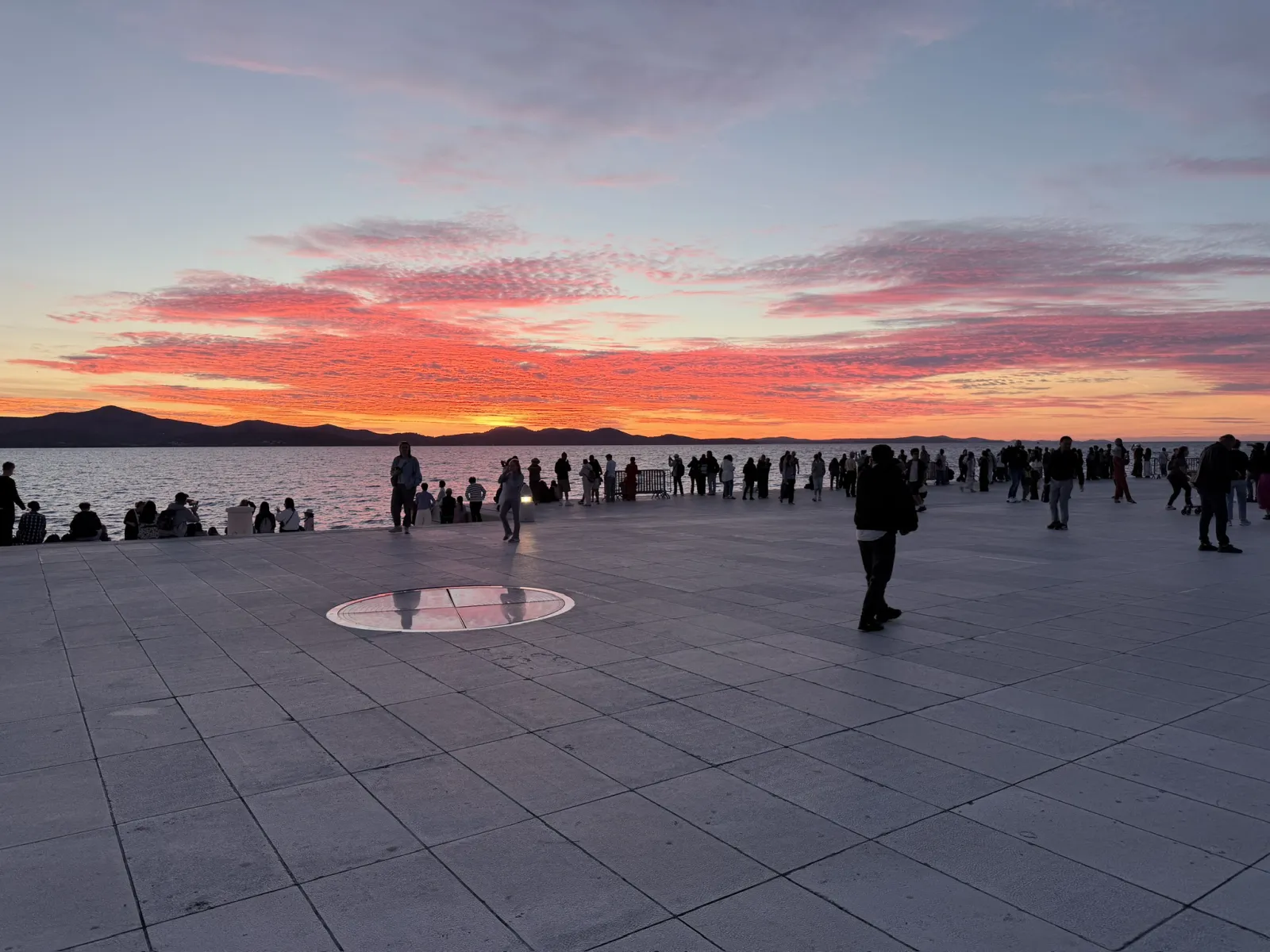
My thanks to Tanja Polegubić, Blanka Bradvica and everybody at INTERA and the City of Zadar for the invitation and for two exceptionally well-run days. I wrote this on my one free morning in Zadar, before finally going to watch the sun go down over the sea organ, which is apparently the correct way to leave this city.
Frequently asked questions
What is cross-border coworking? Cross-border coworking describes coworking spaces and remote-work communities that operate as a connected network across national borders, usually sharing funding, training and referrals. In the western Balkans this is formalised through EU Interreg programmes, where spaces in Croatia, Bosnia and Herzegovina and Montenegro are funded as a single project rather than individually.
Who funds the Cross-Border Coworking Conference? CBCC runs within the CODES project, co-funded by the European Union through Interreg IPA Croatia – Bosnia and Herzegovina – Montenegro. The partners are INTERA Technology Park, Tehnopolis, BIT Centar, the University of Zadar and the City of Zadar.
Do digital nomad visa numbers show how many nomads are in a country? No. Croatia issues roughly 1,000 to 1,200 nomad permits annually while an estimated 5,000 nomads are present at any time, because EU citizens need no permit and stays under ninety days travel as tourism. Permit counts are the smallest available measure of the population they describe.
Why do coworking spaces in small towns open and close so often? Usually funding duration rather than demand. Grants from tourist boards and municipalities are typically awarded against twelve-month projections, while building a working community takes three to five years and depends on retaining a named local community manager the grant cannot fund for that long.
Is remote work emptying or refilling rural Europe? Both arguments were made at CBCC 2026. The panel premise was rural decline, but a counter-observation from the same panel was that young people are increasingly staying in or returning to their villages because remote work makes it viable, leaving only to be educated.
Sources
- CODES project at Code Hub
- Digital Nomad Association Croatia
- Natalia Emanuel and Emma Harrington, “The Rise of In-Office Remote Work”, The Atlantic, 14 October 2026