
TL;DR: A portfolio career is not a collection of unrelated work that happens to pay. It is several income streams held together by one identifiable thing you do, and the people who thrive in one can say what that thing is in a single sentence. Remote Work Europe sees a lot of people build the income and skip the sentence, and that is the difference between a career and a scramble.
The resilience argument for a portfolio career is sound, but it’s not the only important part.
Most people arrive at the idea from the same direction. A restructure, a redundancy, a role that stopped having a future in it. They look at the security a full-time job was supposed to provide, notice it was never really there, and conclude that several clients are safer than one employer.
For somebody who followed a traditional career, it can feel like a trust of many decades has been broken. They built a professional background when a steady path still looked like it was there to follow. Now they find themselves in a world of layoffs by percentage, hearing words like “overqualified” and “overhiring” that did not exist when they started. The reasoning is correct. One employer is one point of failure, and nothing in corporate life is secure any more in the way it was when I started work in the 1990s. My heart aches for those graduating into this world as well as those facing an uncertain future when they’re thrown off the corporate ladder as mature career professionals.
So diversity is critical, but the way people sometimes approach it is wrong. They hear “several income streams” and build exactly that: several income streams, unrelated to each other, each one separately explained, each one requiring a different version of themselves. And then they wonder why the work is exhausting, why none of it compounds, and why nobody ever refers them. “What is it that you do again?”
What is a portfolio career?
A portfolio career is one where your income comes from several sources at once, by design rather than by accident. A typical portfolio might combine consulting work, a part-time or fractional role, some freelance delivery, advisory or board work, and occasional teaching, writing or speaking. Perhaps some passive income products or other flows. The mix shifts over time. That is the point of it: the resilience comes from having diverse sources, and it is built to flex.
It is distinct from freelancing, which usually describes selling one service to many clients, and from having a side hustle, which describes a main thing and a smaller thing. In a portfolio career there is no main thing. There are several real things, and the structure is deliberate.
What makes it a career rather than a set of jobs is that the parts inform each other. The consulting work tells you what to write about. The writing brings in the speaking. The speaking produces the consulting enquiries. When it works, each strand feeds the others and the whole becomes worth more than the sum of its parts.
When it does not work, you have four jobs.
Why portfolio careers are misunderstood
The misunderstanding is that a portfolio is a collection, when it is actually a structure.
A collection is a grab bag. Some consulting here, a bit of contract work there, a course you made once, a retainer that came through a friend. Each piece is legitimate, each one pays, and there is no relationship between them at all.
That arrangement will keep you solvent, and we’ve all been in the situation where we know we’ll take any work we can get because there’s a bill to pay this month. But not only is it exhausting, the real problem is that it will not build you a career, for a specific and practical reason: nobody can refer you.
Referral is the main engine of independent work. People pass on opportunities when they can hold in their head what you do and match it to a problem they have just heard about. If what you do requires three sentences and a caveat, you will not come to mind at the moment somebody needs you. The opportunity goes to the person whose offer fits in a sentence, even when you were better qualified.
This is the part people miss, and it is why “diversify your income” is incomplete advice. Randomly diversifying protects you from losing a source of income, but it doesn’t necessarily help you win the next one.
Does a portfolio career give you more security than a job?
Yes, but not in the way the word security usually means.
A job gives you one predictable income and one catastrophic risk. A portfolio gives you variable income and no single catastrophic risk. If a quarter of your income disappears in a portfolio career, that is a bad quarter and a problem to solve. In a job, losing your income means losing all of it at once, usually with no warning, at a moment you did not choose. These days you might hear about it over Slack or even via a media announcement before it filters down to your department from a decision maker on another continent.
So the honest framing is not that a portfolio career is safer. It is that the risk is distributed differently, and you are the one holding it rather than an employer holding it on your behalf. Some people find that genuinely freeing. Others find it hard to live with, and there is no virtue in pretending otherwise.
What I would say from experience is that the anxiety does not disappear, it changes shape, and you solve for it in different ways.
I first found myself freelancing about a decade ago when a business partnership, which provided employment income for more than 15 years, abruptly broke down. And at that point I was absolutely in that “I’ll do anything” mindset – so I did. At that time people would pay a competent writer to do all sorts of things. I put food on the table through a mixture of ad copy, newsletter writing, product descriptions. You name it – nothing lasted longer than the gig itself, and while I built some great client relationships, they rarely led to referred work because I was often a client’s best-kept secret anyway.
What is the through line in a portfolio career?
The through line is the one thing you do for everybody who pays you, stated in language a stranger would recognise.
It is not your job title, because you probably have several. It is not your sector, because a good portfolio often crosses sectors. It is the underlying capability that every client is actually buying, whatever the format.
It took me a while to draw together the strands of my interests and skills and experiences, and to understand that my years growing and managing remote teams could combine with business storytelling and tech journalism. When I thought I was getting to grips with that, suddenly I could see the writing on the wall for getting paid to churn out words for other people – the B2B stories I was writing about artificial intelligence long pre-dated the consumer tools but it was clear they were coming for my bread and butter soon. I was already consulting with teams considering remote working before 2020 and then fixing what wasn’t working afterwards, so extending my content to address job seekers and career builders was a logical next step, and that ended up in Remote Work Europe as you see it today, which also serves as a platform for my speaking and advisory work.
The paragraph above makes everything sound beautifully planned and orchestrated but the reality was a lot more experimental and iterative and some of the shape only came together in retrospect. That’s what makes my portfolio career unique and what will do the same for yours. The connections aren’t always easy to spot, but if your career has been more of a lucky dip than a coordinated portfolio so far, then it’s worth looking back and trying to identify:
- the skills you used
- the things people valued about you
- the experience that only you have
as you try to put together an identifiable through line for it.
Some real shapes it can take:
- I make complicated technical things understandable to people who have to make decisions about them. That covers consulting, writing, training and speaking without strain.
- I help organisations work out what their customers actually think. That covers research, advisory, workshops and analysis.
- I take over the parts of a business that the founder is bad at. That covers operations consulting, fractional work and interim roles.
- or in my case, I’m a future of work storyteller, helping people do business in a borderless and remote world. though the details of the elevator pitch vary according to audience and situation – that’s the point.
Notice what these have in common. None of them names a deliverable. They all name a capability, which is why they stretch across several formats without becoming vague.
Remember it’s not set in stone either. My LinkedIn headline mentions AI, which it certainly didn’t five years ago. A lot of advice out there suggests you should have a positioning statement before you have any clients, but in practice it tends to arrive around the point where you have enough work to see the pattern in it.
How do you find your through line when the work looks unrelated?
Work backwards from what clients say about you, not forwards from what you want to be.
Three things that genuinely help:
- Look at why people came back. Not what you delivered, but what they said when they returned or referred you. Repeat business is the market telling you what it values, and it is frequently not the thing you thought you were selling.
- Look for the part you would do for free. Not that you ever should (with the exception of voluntary work such as being a trustee), but as a signal. The task you do without resenting it is usually the one you are unusually good at, and clients can tell.
- Ask, even if it seems awkward. Ask three past clients what they would say if a colleague asked them what you do. The answers will be shorter and blunter than your own description, and much closer to usable.
If the answers have nothing in common, that is information too. It may mean the portfolio needs pruning rather than positioning. Not every strand deserves to survive, and dropping one is often what makes the rest cohere.
How do you describe a portfolio career on LinkedIn?
You need one headline, not a list. This is where the through line stops being a philosophical exercise and becomes a practical constraint.
You have one LinkedIn headline. You have one answer to “so what do you do?” at an event. You have one line in a conference programme. In each case the format forces a single statement, and if you do not choose one, the format chooses badly on your behalf and you end up described as whichever strand the other person found easiest to grasp.
So write the headline as the capability, and let the roles sit underneath it. “Research and insight for companies selling to independent workers” holds consulting, writing and advisory work without listing any of them. A headline that reads “Consultant | Writer | Speaker | Advisor” tells a reader you have not decided, and reads as a list of hats rather than a person. And that headline travels further than most people realise. LinkedIn profiles are indexed by Google, so for most professionals it is the first result when somebody searches their name. That single line is often the first thing a prospective client reads about you, before they have decided whether to click anything at all. Put your industry and your specialisms in it.
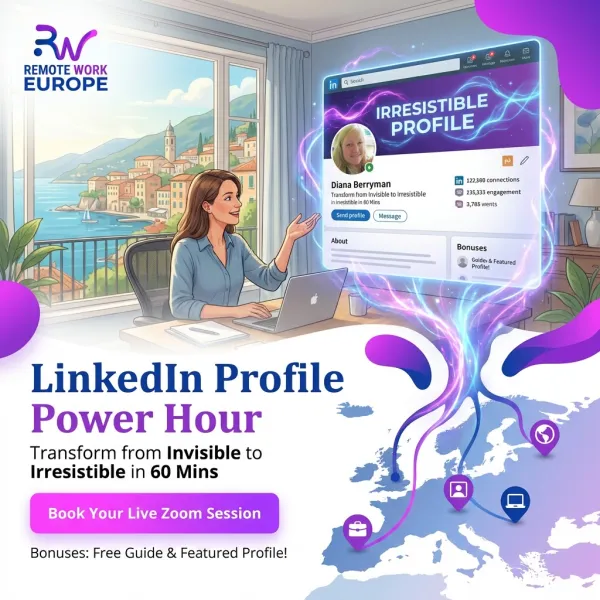
LinkedIn Profile Power Hour
€100 for a live session with Diana Berryman, Remote Work Europe’s head of social media, who has eighteen years in B2B and B2C social communications. She edits your profile while you watch, and the headline is where she starts.
A portfolio career is the hardest kind of profile to write, because you are trying to say several true things in one line. This is the session for getting that line right.
Your personal brand is the infrastructure of a portfolio career. It is not decoration on top of the work, and it is not self-promotion in the uncomfortable sense. It is the thing that makes several separate engagements legible as one career, to clients, to referrers, and eventually to you.
When does a portfolio career stop working?
When one strand becomes the whole thing, and you have not noticed.
This is the most common failure and it rarely feels like it at the time. One client grows. The work is good and it is reliable, so you take more of it. Within a year, seventy per cent of your income comes from one place and it’s like you have an employer again, with none of the protections and all of the dependency.
Spotting it needs nothing more than a spreadsheet and the discipline to look at it quarterly. If any single client is much above a third of your income, you are exposed, and the time to act is while the relationship is going well rather than after it ends. The same applies to formats: a portfolio that has become entirely delivery work, with no writing or speaking feeding the top of it, will stop generating enquiries in about six months and you will not see the cause.
The second failure is subtler. It is when the strands stop informing each other, and you are simply busy. Busy is not the same as compounding, and a portfolio that is not compounding is just a lot of jobs. It means you’re not deepening your personal brand and reputation and it can actually become exhausting switching contexts and specialisms without any sense of connection between them at all.
How do you build flexibility into a portfolio career?
At the margins, deliberately, and usually over years rather than in one decision.
This is the part I think is genuinely undersold. A portfolio built around a through line can flex with your life in a way a job structurally cannot. The proportions can change. In a year when you want to travel, the writing and advisory strands can grow and the delivery work can shrink. In a year when you need predictable money, you can take a fractional role and let the speculative work rest. During illness, caring responsibilities, a move, or any of the things that happen to everybody eventually, the shape can change without the career ending.
That flexibility is not available on day one, and indeed in the early days you may work harder than you ever have in your whole life. This is a good test of whether you’re focusing on the right things. Professional flexibility is built by having more than one strand mature enough to carry weight, which takes time, and by having a through line strong enough that a change in the mix does not confuse the market about what you do.
It is also why this sits so naturally with working remotely. Remote work removed the geographic constraint on who you can work with. A portfolio approach removes the structural constraint on what that work has to look like. Together they give you something closer to genuine control over your working life. If you are still working out where you fit in the remote market, our guide to what ‘remote’ actually means on a job advert is the honest version, and remote gateway roles covers how experienced people get in when the advert seems to want somebody else.
Is consulting the best first strand of a portfolio career?
For a lot of people the first substantial strand is consulting, because it is the most direct way to convert an existing corporate career into independent income. It is also the strand most likely to be mispriced at the start, and the one where the difference between charging for your time and charging for your expertise shows up fastest.
We have written separately about building a remote consulting practice, including which corporate backgrounds translate and what changes when your clients are spread across Europe. If that is the strand you are starting with, Lesley Elder-Aznar’s Get Your First Clients programme takes people from corporate expertise to paying clients in twelve weeks. She has a particularly strong record with women leaving corporate roles, and the programme and her workshops are open to anyone making the move. We recommend her because she built her own consulting business from Spain and teaches the method she uses herself.
Resilience is what makes people build a portfolio in the first place. The through line is what turns it into a career. And if you cannot name yours yet, that is not something to solve before you start – mine only made sense looking backwards, and there is a reasonable chance yours will too.
Frequently asked questions
What is the difference between a portfolio career and freelancing? Freelancing usually means selling one service to many clients. A portfolio career means several different kinds of work running at once, often in different formats and sometimes in different sectors, held together by one underlying capability.
How many income streams should a portfolio career have? There is no correct number, but three to five is common and manageable. Fewer than three and you are exposed to losing one. More than five and most people find the switching cost starts to outweigh the diversification.
Is a portfolio career financially viable long term? Yes, and for many people it out-earns the job they left, because you are paid for expertise rather than time. It takes longer to reach that point than most people expect, and the first year is usually the hardest. Plan for irregular income rather than assuming it will smooth out quickly.
Do I need a personal brand for a portfolio career? You need to be findable and describable. That does not require posting daily or building an audience. It requires one clear statement of what you do, used consistently, so that people can hold it in their heads and pass it on.
Can you have a portfolio career while employed? Yes, and it is often the sensible way to start. Check your employment contract for exclusivity and conflict-of-interest clauses first, and be aware that in some countries the tax and social security position changes once you register as self-employed alongside employment.