TL;DR
- The word “remote” on a job advert describes how the work is done, not where you are allowed to live. Those are different questions, and most adverts only answer the first.
- Of the 773 remote roles Remote Work Europe tracked across 222 employers this week, 584 called themselves remote and 442 were tied to a single country.
- 113 roles flagged as remote named a specific city in the same line.
- Databricks is the worked example: 170 live European vacancies, six of which mention remote at all. Globally the company had 70 remote-flagged roles, 64 of them outside Europe.
- Just 18 of those 773 roles – 2.3% – told the reader where the company can actually employ them. GitLab and NICE Cognigy show what it looks like when someone bothers.
- The question to ask is never “is this remote?” It is “which countries can you employ me in?”
**A job advert that says “Remote” is answering a question about the office. It is not answering a question about your address, or even where the work can be done **
In an advert all these things often get collapsed into one word, and the collapse costs people entire afternoons. You read “Remote”, you picture your own kitchen table or a cool overseas coworking, you spend an hour on a cover letter, and somewhere around the application form a dropdown appears listing four countries and yours is not among them.
Remote Work Europe tracks this pattern across employers’ own career systems, rebuilt every weekday. What follows is what the adverts actually say when you count them rather than read them one at a time.
📅 Every figure in this article is a snapshot taken on 22 September 2026. On that day our board held 773 live roles from 222 employers, and Databricks had 883 vacancies open worldwide. Job boards move daily, ours included, so the specific numbers will have changed by the time you read this. The proportions are the point, and those have been stable for as long as we have been counting.
What does “remote” mean on a job advert?
“Remote” on a job advert means the employer does not require you in an office. It says nothing about which countries that employer is able to pay you in. Those are two separate constraints, decided by two separate parts of a company, and only the first one reliably reaches the advert.
The second constraint is set by where the employer has a legal entity, a payroll arrangement, or a contract with an employer of record. It is a finance and legal question. It rarely gets written down in the job description, because the person writing the job description is usually not the person who knows the answer.
So the location line on a remote advert is doing quiet double duty. Sometimes it means “work from anywhere”. Sometimes it means “we can only run payroll here”. The word looks identical in both cases. It’s frustrating all round, because the recruiter or hiring manager would probably like to engage the best person wherever they are. However, their own compliance and legal formation may make that impossible or simply too difficult and expensive
Why does a remote job advert list a location?
The location field in an applicant tracking system was designed for offices. Greenhouse, Ashby, Lever and the rest were built for a world where a job had an address, and recruiters have been improvising in that field ever since.
That improvisation is why you see strings like this one, taken verbatim from a live posting this week:
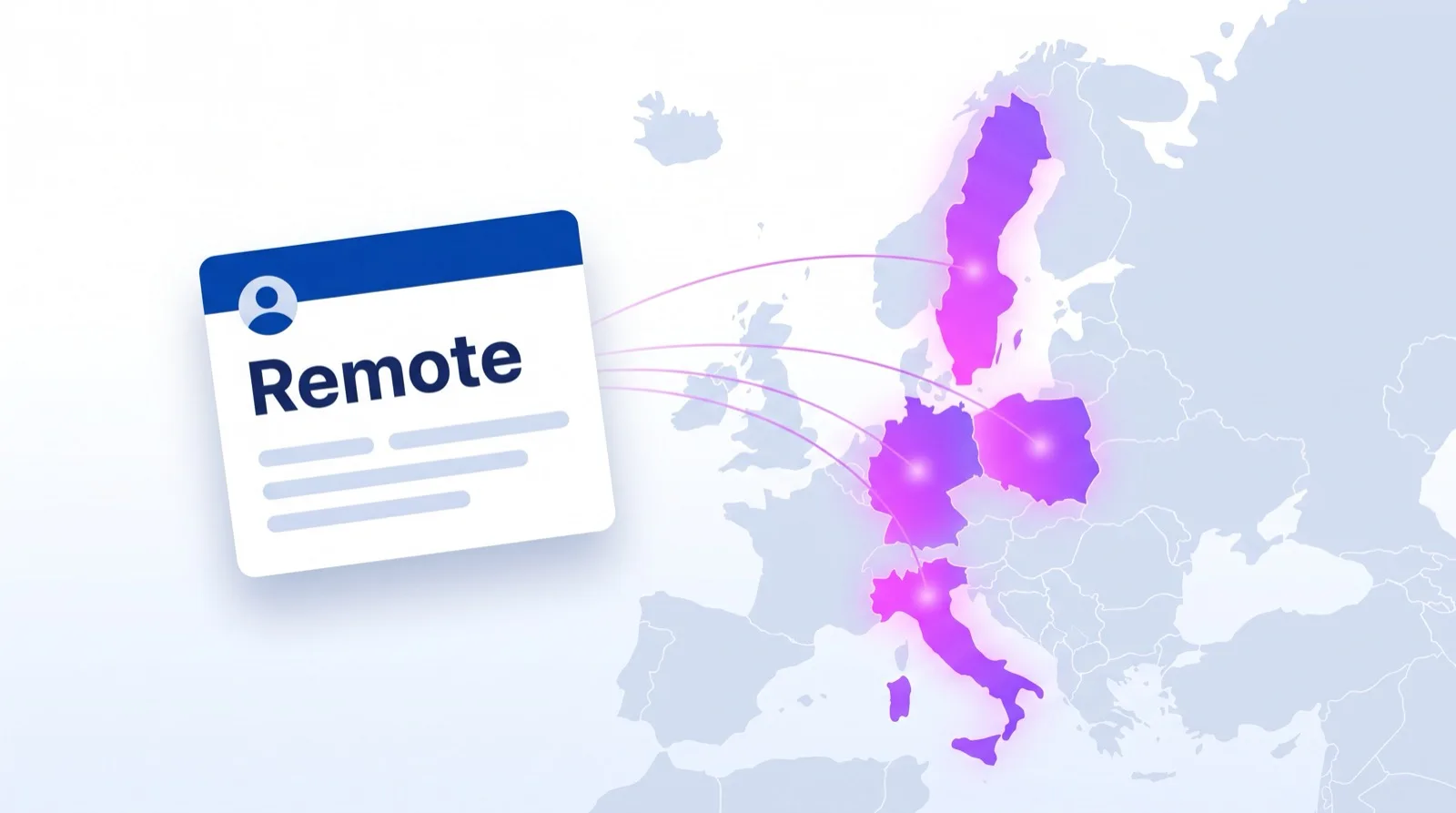
Remote – Milan (Italy), London (UK), Madrid (Spain), Warsaw (Poland)
Four cities, four countries, and the word remote. What the employer means is roughly: you do not have to come in, but we can only put you on a payroll in these four places. What a reader in Lisbon or Dubai sees at a glance is the word remote.
Or this one, from a different employer on the same day:
Amsterdam, Netherlands; Netherlands – Remote
That is a single role, offered either from the Amsterdam office or remotely within the Netherlands. It is a clear and honest listing. It is also indistinguishable, in a list of search results, from a role you could take from anywhere in Europe. Aggregators like LinkedIn and Indeed do a poor-to-indifferent job of sorting on these factors and to be honest it’s hardly surprising
How many remote jobs are actually open to people in Europe?
Databricks makes a good worked example, because the company is large, hires heavily in Europe, and publishes everything through a public applicant tracking system that anyone can count.
On 22 September 2026 Databricks had 883 live vacancies worldwide. Of those, 170 were in Europe – a substantial European operation by any measure, with an EMEA headquarters in London and hiring across Germany, France, the Netherlands and the Nordics.
Six of those 170 European roles mention remote working at all.
| Databricks vacancies, 22 September 2026 | Count |
|---|---|
| Live postings worldwide | 883 |
| Postings in Europe | 170 |
| European postings mentioning remote | 6 |
| Remote-flagged postings worldwide | 70 |
| Remote-flagged postings outside Europe | 64 |
The geography of that remaining 64 is the part worth sitting with. California accounts for 23 of them, Texas 11, Washington 10, New York 10. The company runs a real remote hiring programme. It largely does not extend it to this continent.
And even the six European exceptions repay a closer look. One is filed under “Remote – United Kingdom” and carries the phrase “Leeds based” in its own title. Another reads “Finland; Remote – Denmark; Stockholm, Sweden”, which is one posting covering three countries in three different ways.
📌 A note on what this article is not claiming. Everything above comes from counting Databricks’ own published vacancies. We make no claim about the company’s internal policy, office attendance rules or intentions, because we have not verified those at source. The adverts are the evidence, and the adverts are public.
How common are country restrictions on remote jobs?
It is the pattern, and Remote Work Europe’s own board data shows the shape of it.
Across the 773 roles from 222 employers on the board that day:
- 584 roles – roughly three in four – described themselves as remote
- 442 roles – well over half of everything on the board – were tied to a single country
- 184 stated no country at all, which is its own problem for a reader trying to work out whether they qualify
- 113 roles flagged as remote named a specific city in the same location string
Put plainly: the majority of roles calling themselves remote are simultaneously restricted to one country, and around one in five of them names a town while doing it.
None of this is dishonest on the employer’s part. It is a vocabulary problem meeting a database field. But the cost of it lands entirely on the reader, who cannot tell from a search results page which kind of remote they are looking at.
The four things “Remote – [Country]” can actually mean
When an advert says remote and then names a country, it is usually one of these four. They look the same and they are not the same.
- Remote, and we can employ you anywhere in that country. The genuine article. You need to be tax resident there; the town is yours to choose.
- Remote, but anchored to an office city. The Leeds example. You will not be at a desk every day, but the role assumes you can reach one. Often unwritten. It might mean you’re expected to attend meetings regularly there at your own expense.
- Remote, because that is where our payroll entity is. Nothing to do with the work. The company simply cannot pay someone in your country without setting something up, and will not do so for one hire. An EOR maybe an option for certain roles (see below.)
- Remote, meaning hybrid, because the advert was written by someone using the word loosely. More common than anybody would like. Anything requiring you to attend a fixed location on a regular basis is NOT a remote role. I would argue that attendance more than once or twice a month means it’s hybrid and anything involving being on-site per week is definitely hybrid
Only the first of those is remote in the sense a reader in another country means it.
How to tell what a remote job advert really means before you apply
The signals are readable once you know to look for them, and the check takes about ninety seconds.
- Read the location string in full, not the badge. “Remote” as a tag and “Remote – Denmark; Stockholm, Sweden” as a string tell you completely different things.
- Search the advert for a city name. If one appears anywhere, including in the job title, assume proximity matters until told otherwise.
- Look for the word “eligible”. Phrases like “must be eligible to work in” are about immigration status, not about willingness to hire abroad. They answer a different question again.
- Check the application form before you write anything. The country dropdown is usually the honest version of the location field, and it costs nothing to open.
- Count the employer’s other adverts. If every other vacancy names an office and this one says remote, it is more likely to be an exception than a policy.
Why employers restrict remote roles by country
This part is mechanics rather than malice, and understanding it makes the adverts easier to read.
To employ somebody, a company generally needs a legal presence in that country, or an arrangement with a provider that has one. That means payroll, employer social security contributions, statutory benefits, and compliance with local employment law – which differs in every jurisdiction. Setting that up for a single hire is a real cost and a real ongoing obligation.
So most companies hire remotely within the countries where they already run payroll. A company with entities in the UK, Germany and the Netherlands will hire remotely in the UK, Germany and the Netherlands. Its adverts will say remote, and every one of them will be true.
The alternative route is an employer of record, which employs you locally on the company’s behalf. That is how cross-border remote hiring usually happens when it happens at all, and it is worth understanding if you are applying across borders – we cover the model, the providers, and what to check in our guide to employers of record in Europe.
What a clearly written remote job advert looks like
Almost nobody does this, and the ones who do are unmistakable.
Of the 773 roles on the board on 22 September, 41 mention a legal entity, an employer of record, or a stated limit on where the company can hire. But 23 of those are the EOR providers themselves – Remote.com, Oyster, Deel and their competitors – describing the product they sell rather than their own hiring position.
Strip those out and 18 roles are left. Eight employers. Two point three per cent.
That is the real scarcity here. Not that companies restrict remote hiring, which is normal and lawful, but that so few of them say so where a reader can see it.
An employer that explains it in the advert: NICE Cognigy
NICE Cognigy, hiring a senior account executive in Italy, put this in the job description:
From a live NICE Cognigy job advert, 22 September 2026
As NICE Cognigy currently does not have a legal employing entity in Italy, successful candidates will be employed through an approved Employer of Record (EOR) partner. This arrangement provides local employment compliance, payroll administration, and statutory benefits in accordance with Italian employment regulations, while working exclusively as part of the NICE Cognigy team.
Four sentences. It names the gap, names the mechanism, confirms that local compliance and statutory benefits are covered, and makes clear the person is part of the team rather than held at arm’s length. A reader in Milan knows exactly what they would be signing before they write a word of an application.
An employer that publishes the whole list: GitLab
GitLab publishes the whole thing openly, in a handbook anybody can read. Their employment solutions page lists 18 countries where GitLab holds its own legal entity, each named with the registered company – GitLab Ireland Ltd, GitLab GmbH in Germany, GitLab Iberia S.L. in Spain, GitLab France S.A.S., GitLab UK Ltd, and so on.
It goes further than a list. An asterisk convention marks partial coverage, stated plainly:
From the GitLab handbook, public
In countries with a star (*) hiring is limited to only certain roles. Belgium, Finland, France, New Zealand and Spain carry that star. And the exclusion is written without hedging – GitLab is “not currently hiring in locations that do not have an entity or PEO.”
Entity countries, restricted countries, and the hard no, all in one public document. It is the clearest statement of hiring geography we have found from any employer, and we cover how the rest of their remote model works in our profile of working at GitLab.
An employer that admits the limit exists: Muck Rack
Muck Rack sits between the two, and the compromise is worth naming because most companies could manage it tomorrow:
From a live Muck Rack job advert, 22 September 2026
While we are a fully distributed team, we do have limitations on where we can hire and maintain a list of acceptable working locations based on job function. If we are unable to hire in your current location for the role for which you applied, you will be notified via email.
They do not publish the list. But they tell you a list exists, that it varies by role, and that somebody will write to you either way. That is not the gold standard, and it is still more than 750 of the roles on our board manage, or the vast majority of roles you’ll find advertised in places like LinkedIn.
All three of these examples give you clear signals about how an organisation thinks about distributed teams, leadership, collaboration, and more. In general the signals are very positive, even if they have limitations, because they’re encouraging you not to waste your time on a boundary that won’t shift and they’re showing that their consideration is otherwise wide open.
What should you ask a recruiter about a remote job?
One question, asked early, saves the afternoon:
“Which countries are you able to employ or contract in for this role?”
Not “is this remote?” Everyone says yes to that. The employment question has a short factual answer that a recruiter either knows or can find out in a message, and it is the only answer that decides whether the application is worth writing.
If you are applying from a country the company does not currently operate in, the useful follow-up is whether they use an employer of record. Some do, routinely. Some have never been asked. Others will make a contractor arrangement with you.
Doing that check on every advert is the tedious part, which is why we do it for our own members’ jobs board and publish the country restrictions alongside each role.
Frequently asked questions
Does “remote” on a job advert mean I can work from another country? No. It means the employer does not require you in an office. Whether you can do the job from another country depends on where that employer is able to run payroll, which is a separate question the advert usually does not answer.
Why do remote jobs specify a country at all? Because employing someone creates obligations in the country where they live – payroll, social security, statutory benefits and local employment law. Most companies hire remotely only where they already have a legal entity or a payroll arrangement.
What does “Remote – United Kingdom” mean? Usually that the role is remote within the UK and that you need to be UK tax resident. Check whether the advert also names a city, which often signals that occasional office attendance is expected.
Is a role advertised as remote in four cities actually remote? It is remote from home, within those four countries. It is not open to applicants living elsewhere, even elsewhere in Europe.
How can I find remote roles genuinely open across Europe? Look for adverts that name a region rather than a country, such as “EU” or “Europe”, and check the application form’s country list before applying. Of the 773 roles on Remote Work Europe’s board on 22 September 2026, 184 stated no country restriction at all.
Sources
- Databricks jobs API, Greenhouse – 883 live postings counted 22 September 2026
- Remote Work Europe Connected jobs board – build of 22 September 2026, 773 roles from 222 employers. The counts above can be checked against the live board
- GitLab Employment Solutions handbook – entity list, restriction asterisks and exclusion wording
- Individual job postings quoted verbatim, live on 22 September 2026 – NICE Cognigy (Italy), Muck Rack, GitLab