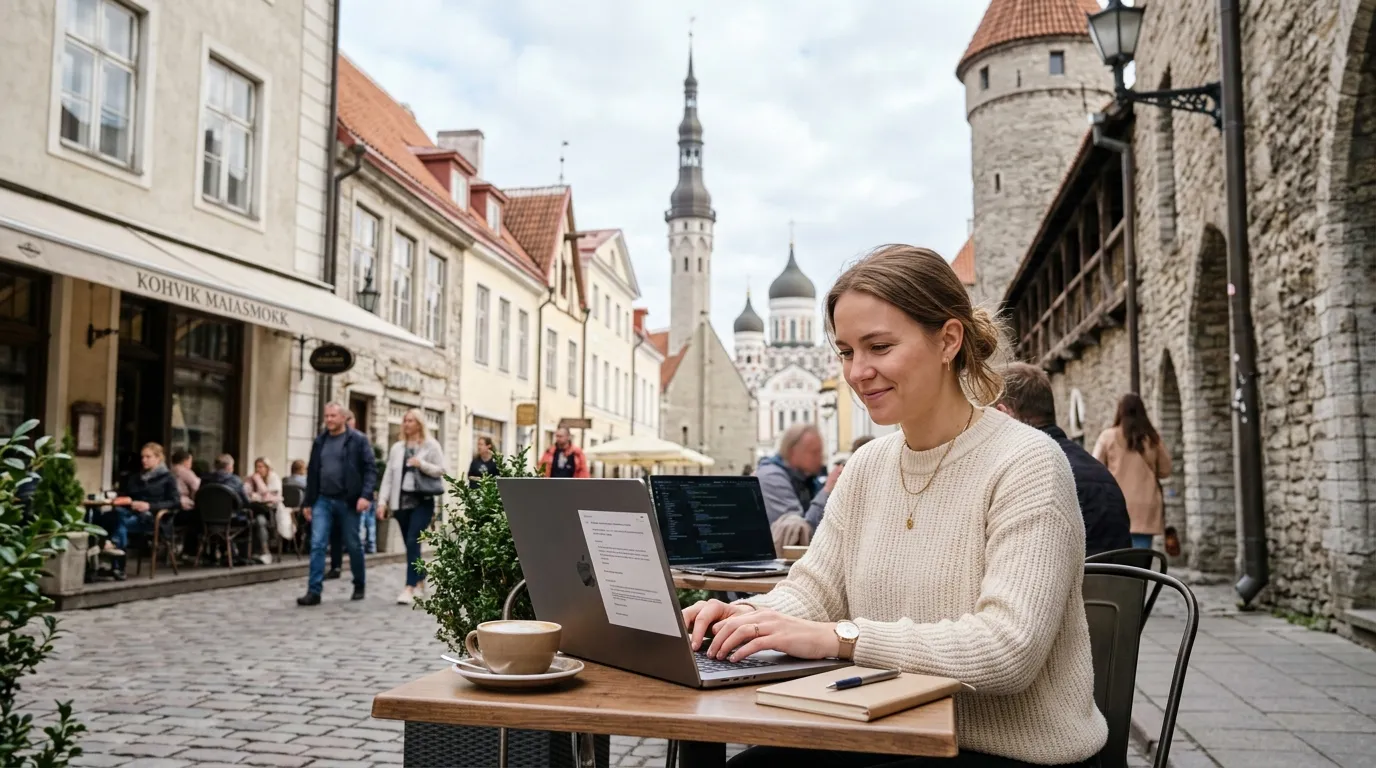
Estonia and Portugal are two of Europe’s most talked-about destinations for digital nomads – but they could hardly be more different. One is a compact Baltic nation that built its entire government on the internet. The other is a sun-drenched Atlantic country with centuries of history and one of Europe’s most established nomad communities.
Both offer pathways for remote workers. Both are in the EU and Schengen Area. But the right choice depends entirely on what you’re optimising for – lifestyle, tax efficiency, long-term residency, or some combination of the three.
Here’s a detailed, practical comparison to help you decide.
The Quick Answer
Estonia suits digital nomads who prioritise tax efficiency, a lean company structure, and digital-first bureaucracy. Portugal suits those who want lifestyle, weather, community, and a clear path to permanent EU residency.
| Factor | Estonia | Portugal |
|---|---|---|
| Visa type | Digital Nomad Visa | D8 Visa (remote work) |
| Duration | Up to 1 year | 1 year (renewable, path to PR) |
| Income requirement | ~€4,500/month (gross) | €3,680/month (4x minimum wage) |
| Corporate tax | 0% on retained profits (OÜ) | Standard Portuguese rates |
| Personal income tax | 22% flat rate (employment) | Progressive 14.5%–48% |
| Cost of living (capital) | €1,800–2,500/month | €2,200–3,000/month |
| Weather | Baltic – cold winters, mild summers | Mediterranean/Atlantic – mild year-round |
| English proficiency | Very high | High in cities, limited rural |
| Path to permanent residency | 5 years | 5 years |
| Path to citizenship | 8 years (restrictive) | 5 years (one of Europe’s fastest) |
Choose Estonia if you want to build a tax-efficient European company and don’t mind dark winters.
Choose Portugal if you want warm weather, an established nomad scene, and the fastest path to EU citizenship.
Digital Nomad Visa Compared
Portugal’s D8 Visa
Portugal’s D8 visa – technically a residence visa for remote workers – has become one of Europe’s most popular routes for digital nomads since its introduction. In 2026, the key requirements are:
- Income threshold: Approximately €3,680 per month (pegged to four times Portugal’s minimum wage, which increased to €920 in January 2026)
- Eligible applicants: Non-EU citizens working remotely for foreign employers or as freelancers with foreign clients
- Initial duration: 1 year temporary residence permit
- Renewal: Renewable for two-year periods
- Path to PR: After 5 years of legal residence
- Path to citizenship: After 5 years – one of the shortest routes in Europe
The D8 application begins at a Portuguese consulate abroad (or through AIMA if you’re already in Portugal on a valid visa). Processing typically takes 2–4 months from consulate submission, though backlogs have been an ongoing frustration. You’ll need proof of income, health insurance, accommodation, a clean criminal record, and a Portuguese tax number (NIF).
Estonia’s Digital Nomad Visa
Estonia launched its digital nomad visa in 2020 – one of the first countries in Europe to do so. It’s designed for location-independent workers who want to live in Estonia temporarily.
- Income threshold: approximately €4,500 per month gross (originally €3,504, raised to reflect updated average wage benchmarks; verify with the Police and Border Guard Board as this figure is periodically adjusted)
- Eligible applicants: Non-EU citizens working remotely, either employed or self-employed
- Duration: Up to 1 year (short-stay type C for 90 days, or long-stay type D for up to 1 year)
- Renewal: Not directly renewable – you must leave and reapply
- Path to PR: Not through the DNV itself; requires switching to a standard temporary residence permit first
The Estonian DNV is processed through the Police and Border Guard Board, either at an Estonian embassy or, for some nationalities, through the e-visa portal. Processing is typically faster than Portugal – around 15–30 days.
Key Differences
The critical distinction: Portugal’s D8 leads somewhere. You can renew it, transition to permanent residency, and ultimately apply for Portuguese (and therefore EU) citizenship. Estonia’s digital nomad visa is a temporary arrangement – useful for a year-long stay, but not a residency pathway in itself.
If your goal is simply to spend a year in Europe legally while working remotely, either visa works. If you’re thinking longer-term, Portugal has a significant structural advantage.
Tax & Company Structure
This is where things get genuinely interesting – and where Estonia has an edge that Portugal can’t match.
Portugal’s Tax Landscape
Portugal’s Non-Habitual Resident (NHR) tax regime, which offered a flat 20% rate on qualifying income, closed to new applicants in 2024. The replacement – the Tax Incentive for Scientific Research and Innovation (IFICI) – is narrower and primarily targets specific professional categories rather than general remote workers.
Without NHR or IFICI, digital nomads who become Portuguese tax residents face standard progressive rates of 14.5% to 48%. Social security contributions add 21.4% for self-employed workers (though there are reduced rates in the first year).
Portugal’s tax position for nomads has, frankly, become less attractive since the end of NHR. It’s still workable, but the days of it being a tax haven for remote workers are over.
Estonia’s Tax Advantage
Estonia’s corporate tax system is genuinely unusual in Europe. An Estonian private limited company (OÜ – osaühing) pays:
- 0% corporate tax on retained profits – money kept in the company is not taxed
- 22% (effectively 22/78) tax on distributed profits – you only pay when you take money out
- 0% on reinvested profits – ideal for growing a business
For freelancers and contractors, this means you can build up reserves, reinvest in your business, and manage your personal tax liability by controlling when and how much you distribute. It’s a structure that rewards long-term thinking. (For a full breakdown of rates, worked examples, and common mistakes, see our Estonia tax guide for digital nomads.)
Personal income tax in Estonia is a flat 22% (increased from 20% in January 2025), and social security is 33% (paid by the employer, which is your own company if you’re self-employed through an OÜ).
e-Residency: Run an Estonian Company from Anywhere
Here’s where Estonia plays its trump card. You don’t actually need to live in Estonia to benefit from its business environment.
Estonia’s e-Residency programme – launched in 2014 and now used by over 100,000 people worldwide – lets you register and manage an Estonian company entirely online. You get a digital ID, access to Estonian business banking, and the ability to file taxes, sign documents, and manage your company from wherever you happen to be.
This means you can live in Portugal (or Spain, or anywhere else) while running a lean, tax-efficient Estonian company. Many digital nomads do exactly this.
Double Taxation: The Bit People Get Wrong
Running an Estonian company while living in another EU country is legal and common. But it doesn’t mean you escape tax in your country of residence. If you’re a Portuguese tax resident, Portugal will tax your worldwide income – including distributions from your Estonian company.
The benefit isn’t tax evasion; it’s tax structure. By retaining profits in your Estonian OÜ and only distributing what you need, you can manage your personal tax exposure while keeping your business finances clean and European.
Estonia and Portugal have a double taxation agreement, which prevents the same income being taxed twice. But you’ll need a tax advisor who understands both jurisdictions. This is not a DIY exercise.
Cost of Living
Real monthly budgets for a single remote worker in each capital, based on 2026 figures:
| Expense | Tallinn | Lisbon |
|---|---|---|
| Rent (1-bed, central) | €700–1,000 | €1,000–1,500 |
| Rent (1-bed, outside centre) | €500–700 | €700–1,000 |
| Utilities | €150–200 | €100–150 |
| Groceries | €250–350 | €250–350 |
| Eating out (per meal) | €10–15 | €10–18 |
| Public transport (monthly) | Free (Tallinn residents) | €40 |
| Coworking (hot desk) | €150–250 | €150–300 |
| Health insurance (private) | €80–150 | €50–120 |
| Total estimate | €1,800–2,500 | €2,200–3,000 |
Tallinn is notably cheaper for rent – and its free public transport for registered residents is a genuine perk. Lisbon’s rental market has been under significant pressure for years, and while government rent controls were introduced in 2024, prices in central areas remain high by Southern European standards.
Outside the capitals, both countries become considerably cheaper. Porto in Portugal and Tartu in Estonia offer lower living costs with good infrastructure and growing nomad-friendly scenes.
Value verdict: Estonia offers better value for money in most categories. Portugal’s higher costs buy you warmer weather, a larger international community, and arguably a richer day-to-day lifestyle.
Lifestyle & Practical Factors
Weather
There’s no sugarcoating this. Estonia has long, dark winters. From November to February, you’ll see very little daylight – Tallinn gets roughly six hours of daylight in December. Temperatures regularly drop below freezing. Summer, on the other hand, is beautiful: long white nights, 18-hour days, and mild temperatures around 20°C.
Portugal is the opposite. Lisbon gets around 300 days of sunshine per year. Winters are mild (10–15°C), summers are hot (30°C+), and you’re never far from the coast. If weather matters to your wellbeing and productivity, this is not a trivial difference.
Language
Both countries are surprisingly accessible for English speakers. Estonia has very high English proficiency – particularly among younger people and in business settings. You can navigate daily life in Tallinn without learning Estonian, though the language itself (Finno-Ugric, related to Finnish) is famously difficult.
Portugal’s urban centres – Lisbon, Porto, the Algarve – are English-friendly, particularly in tourist and tech sectors. Portuguese is a Romance language and more learnable for English speakers, which matters if you plan to stay long-term.
Internet and Digital Infrastructure
Estonia wins here, and it isn’t close. The country that invented Skype, introduced e-Residency, and runs government services on blockchain has some of the best digital infrastructure in the world. Free public Wi-Fi is everywhere. Average broadband speeds consistently rank in Europe’s top five.
Portugal has good internet – average speeds have improved significantly in recent years – but it doesn’t match Estonia’s digital-first culture. If you need bulletproof connectivity and government services that actually work online, Estonia is in a different league.
Community and Nomad Scene
Portugal has the larger, more established digital nomad community. Lisbon, Porto, the Algarve, and Madeira (which ran a dedicated Digital Nomad Village) have been attracting remote workers for years. Coworking spaces, meetups, and networking events are abundant. You won’t struggle to find your people.
Estonia’s nomad community is smaller but growing. Tallinn has a tight-knit international community, strong in tech and startups. The e-Residency programme also creates a global community of Estonian company owners who meet at events worldwide. It’s less “digital nomad beach vibes” and more “serious founders building things.”
Schengen and EU Access
Both countries are EU and Schengen members, so once you have a residence permit in either, you can travel freely across the Schengen Area. From Tallinn, you’re a short ferry from Helsinki and a short flight from anywhere in Northern Europe. From Lisbon, you’re well-connected to the rest of Western and Southern Europe, plus direct flights to the Americas and Africa.
The e-Residency Wild Card
Here’s the combination that nobody else talks about properly: Estonian e-Residency plus Portuguese residence.
The idea is straightforward. You live in Portugal – enjoying the weather, the food, and the path to EU citizenship. But your business runs through an Estonian OÜ – benefiting from 0% retained profits tax, clean European invoicing, and a digital-first company administration.
Service providers like Xolo and 1Office handle the compliance side: accounting, tax filing, annual reports, and VAT registration. You manage everything through a browser.
When This Makes Sense
- You’re a freelancer or contractor earning from multiple international clients
- You want a European company structure without the bureaucracy of setting one up in Portugal
- You plan to reinvest a significant portion of your earnings rather than distributing everything
- You value the ability to manage your company entirely online
When It Doesn’t
- Your income is straightforward employment with a single employer – a company structure adds unnecessary complexity
- You earn below €50,000 annually – the service provider fees (€79–200/month) and accounting costs may outweigh the structural benefits
- You want to work with Portuguese clients – this creates permanent establishment risks that complicate the arrangement
- You don’t want to deal with two-country tax compliance
2026 VAT Considerations
If your Estonian company provides B2C digital services to customers in the EU, you’ll need to handle VAT under the One-Stop Shop (OSS) scheme, registering in one EU country and reporting VAT across all member states. Estonia’s Tax and Customs Board handles this smoothly through their online portal.
For B2B services, the reverse charge mechanism applies – your business clients handle the VAT in their own country. This is standard across the EU and works the same whether your company is in Estonia or Portugal.
The Verdict
Choose Portugal if…
- Weather and lifestyle are high priorities
- You want a clear, well-trodden path to permanent EU residency and citizenship
- You prefer a large, established international community
- You’re comfortable with higher living costs for a Mediterranean quality of life
- Your work situation is straightforward employment or you’re happy operating as a freelancer under Portuguese tax rules
Choose Estonia if…
- Tax efficiency and company structure matter more than weather
- You’re building a business and want to retain and reinvest profits
- You value digital-first government services and minimal bureaucracy
- You’re comfortable with dark winters and a smaller expat community
- You want a European company that you can manage from anywhere
Consider both if…
- You want to live in Portugal but run your business through Estonia
- You’re a freelancer earning from international clients and want structural tax efficiency
- You’re playing a long game – Portuguese residency for the lifestyle and citizenship, Estonian company for the business
The “Estonian company, Portuguese life” combination is one of the smartest moves available to European digital nomads in 2026. It takes some setting up and ongoing compliance, but for the right person – typically a freelancer or small business owner earning €50,000+ from international clients – it offers the best of both worlds.
Neither country is objectively “better.” They solve different problems. The question isn’t which is best – it’s which is best for you.
Go deeper: Read our Estonia country guide and Portugal country guide for visa details, cost of living, and practical tips. For the tax specifics, see Estonia Tax Guide for Digital Nomads 2026 and Is Estonian e-Residency Still Worth It in 2026?
This article is for informational purposes and does not constitute legal or tax advice. Requirements, tax rates, and visa rules may change. Always consult a qualified immigration lawyer and tax advisor for guidance specific to your situation. Last updated: March 2026.
Sources
- Estonia Police and Border Guard Board: Digital Nomad Visa requirements
- Portugal SEF/AIMA: D8 Visa guidelines
- Estonian Tax and Customs Board: Corporate taxation
- e-Residency.gov.ee: Programme details and company formation
- Numbeo and Expatistan: Cost of living data, 2026
- EU VAT One-Stop Shop Regulation (EU) 2019/1995