What last year’s startup summit taught me – and why remote workers in Galicia should pay attention
Remote Work Europe maintains updated guides on the rules covered here, cross-referenced against official government publications.
Last year I walked into The Way Startup Summit not entirely sure what I was walking into. It was my first time inside Galicia’s formal startup ecosystem – and I’ll admit, I went in with one eye open. After years in human rights advocacy, nonprofit consulting, and now building a community platform for foreigners integrating into Galician life, I’ve sat in enough rooms where “innovation” floats pleasantly above everyone’s heads without landing anywhere near the ground. This was not that room.
What struck me wasn’t the energy, though there was plenty of it, nor the setting – the Palacio de la Oliva in Vigo, though Galicia has a way of making things feel cinematic without trying. It was the substance underneath. Founders, investors, and ecosystem builders were talking about sustainability, rural revitalisation, cultural preservation, accessibility, care infrastructure – real challenges with local stakes and global ambitions. My conclusion by the end of it: here, business isn’t just about profit, it’s about purpose. And that framing is not decorative. It shapes what gets funded, what gets built, and who ends up in the room. The next edition is on 6-8 May, and if you’re working remotely in Galicia – or thinking about it – I want to make the case that you should be there.
How remote workers arrive in Galicia
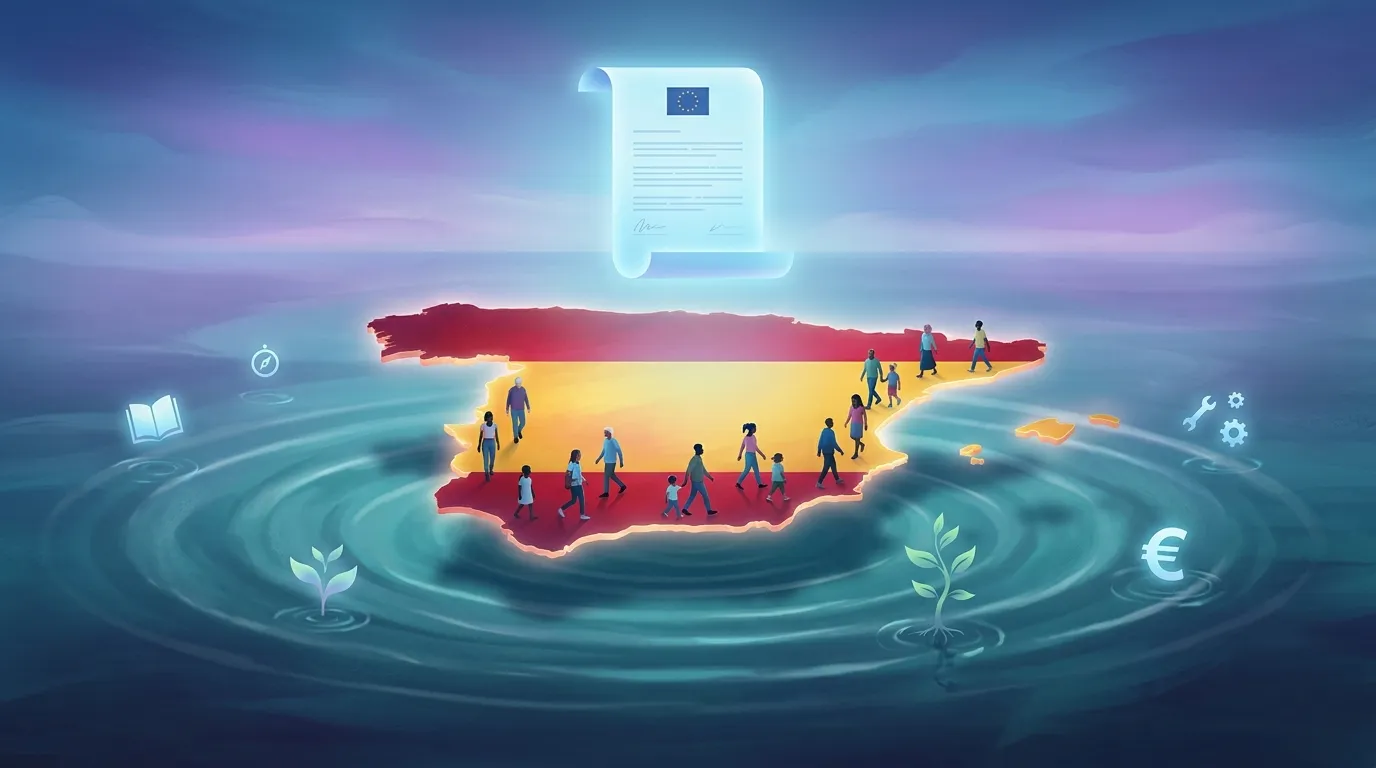
People arrive in Galicia by many routes. Some have come through Spain’s Digital Nomad Visa, launched in January 2023 under the Startup Act and ranked the best in Europe by Global Citizen Solutions in 2025. Others are EU citizens who need no visa framework at all. Many have been here for years, building lives and careers long before remote work became a policy conversation. What these people share is not a visa category – it’s a situation: working online, often for employers or clients elsewhere, in a place that has more going on economically than most of them realise. That gap between what remote workers know about Galicia and what is actually happening here is worth closing, because the opportunities it obscures are real.
An economy with more depth than you think
Galicia accounts for approximately half of Spain’s entire fishing fleet by vessel count, making it the most important fishing region not just in Spain but in the European Union. More than 95% of Spain’s mussel production happens off its coast, and the region generates 67.8% of total national aquaculture volume – figures that reflect not a cottage industry but a major food system carrying active innovation pressure across sustainability, digitalisation, and supply chain management.
The automotive picture is equally concrete. The Stellantis plant in Vigo celebrated its 17-millionth vehicle in March 2026, shipping products to over 70 markets worldwide while producing both electric and combustion engine vehicles on the same lines – and it has been doing electric since 1995. The broader Galician automotive cluster, CEAGA, holds the distinction of being the first automotive and mobility cluster in Europe to earn the Gold Label from the European Secretariat for Cluster Assessment.
And then there are the sectors that rarely make it into the lifestyle pieces about Galicia at all. Alén Space, a spin-off from the University of Vigo and now part of the GMV Group, has spent over fifteen years building nanosatellites and has collaborated with the European Space Agency, the Spanish Air and Space Force, and organisations across three continents. It also organises New Space España, a national congress held in Vigo, which in its 2024 edition drew over 270 attendees and showcased Galician space startups Kreios Space and Valar Space – both graduates of the Xunta de Galicia’s BFAero aerospace accelerator – alongside the University of Vigo’s own SpaceLab project.
On the defence side, construction began in January 2026 on Spain’s first gallium nitride chip factory in Vigo, led by Indra Group in partnership with the University of Vigo and Galicia’s telecommunications research centre GRADIANT. Budgeted at over €9 million, the facility is designed to supply advanced components for defence and aerospace systems – precisely the kind of deep-tech infrastructure that is drawing record investment across Europe. Venture funding in global defence tech reached over $49 billion in 2025, its highest level ever, with European defence equity funding rising sharply year on year.
The region is not building a startup ecosystem from scratch. It is building one from something – and in some sectors, it has been building quietly for a very long time. For a remote worker with relevant skills, that is not a curiosity. It is an opportunity.
The isolation problem nobody sells you a solution for
Remote work can be profoundly isolating – not in theory, but in practice, in bodies, in the accumulation of days that blur together without shared reference points. I hear this regularly from people who have moved to Galicia and built their professional lives online. The logistical case for the move made complete sense: the work travels, the cost of living is better, the nature is extraordinary. But the scaffolding that used to hold a life together – colleagues down the hall, a neighbourhood you understood, casual professional encounters that didn’t have to be scheduled – that scaffolding doesn’t automatically rebuild itself in a new place. You can live in Galicia, work for a company in Berlin, and still be, in a meaningful sense, nowhere. Present physically, absent relationally. This is the gap nobody sells you a solution for, and I’d argue it’s the defining challenge of location-independent work right now – not the productivity tools, not the visa paperwork, not the time zones.
What The Way Startup Summit modelled
A startup summit is a specific room, and it is not for everyone. But what The Way modelled was something universally applicable: the difference between attending and belonging, between being in a room and being part of what the room is building. The people I met weren’t networking in the extractive sense – they were comparing notes, disagreeing, following up. The ecosystem is small enough that trust travels fast, and large enough that there’s real intellectual diversity in the mix. That kind of environment doesn’t happen by accident. It happens when people decide to show up repeatedly, specifically, with something to contribute.
Where your skills meet real local stakes
If you are working remotely in Galicia, the smartest professional move you can make is not finding the best co-working space, though that matters. It’s locating yourself in a community where your work intersects with real local stakes. What does Galicia’s fishing sector need that it doesn’t yet know how to do digitally? What problems does the automotive supply chain have that a remote UX designer, data engineer, or sustainability consultant could help solve? What are the space tech startups here building, and where do your skills fit? These questions have answers, and finding them requires being in the room.
The Way Startup Summit returns May 2026
The Way Startup Summit returns on 6-8 May at the Palacio de la Oliva in Vigo. One thing worth stating plainly: the event runs in Spanish, and you may hear Galician too. That is not a barrier – it is part of the texture of being genuinely embedded in a regional ecosystem rather than passing through it. Come prepared, bring curiosity, and lean on the people around you. Members of the LiveGalicia Galipreneur network will be in attendance, and we’ll be finding one another along the way. If you want to stay in the loop about where we’re gathering, join the conversation in our Galipreneur Community before the event. I went last year as an outsider to this ecosystem and left with a completely different understanding of what is being built here, and by whom.
Freedom without connection isn’t enough
For many people, remote work has delivered on its promise of freedom. But freedom without connection has a way of curdling into something that looks a lot like loneliness dressed up as autonomy. Galicia is offering something more interesting than a backdrop for your Zoom calls – it is offering, for people willing to look up from their screens, a regional moment. A place genuinely in the middle of figuring out what it wants to be economically, demographically, and culturally. The question for remote workers who have landed here is not just whether you can make this work logistically. It’s whether you are willing to become part of what is being built. Those are different questions, and the second one is harder. It’s also the one worth asking – starting, if you’re ready, this May.
For more on remote work in Spain, see our Spain country guide and our guide to Spain’s Digital Nomad Visa.