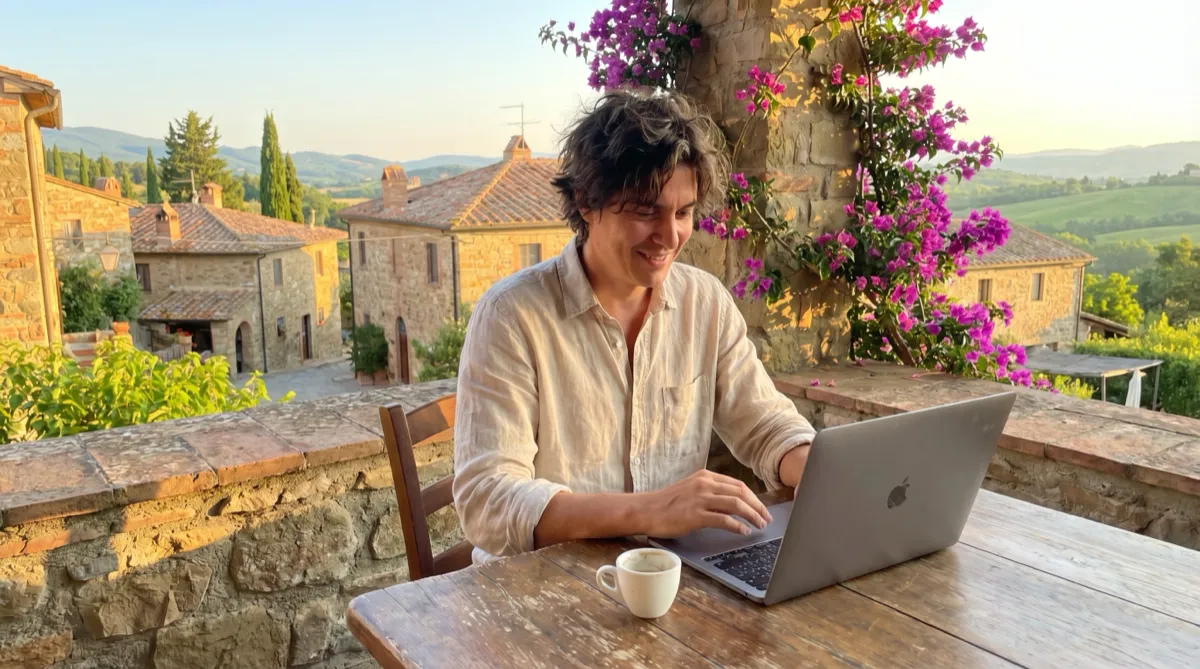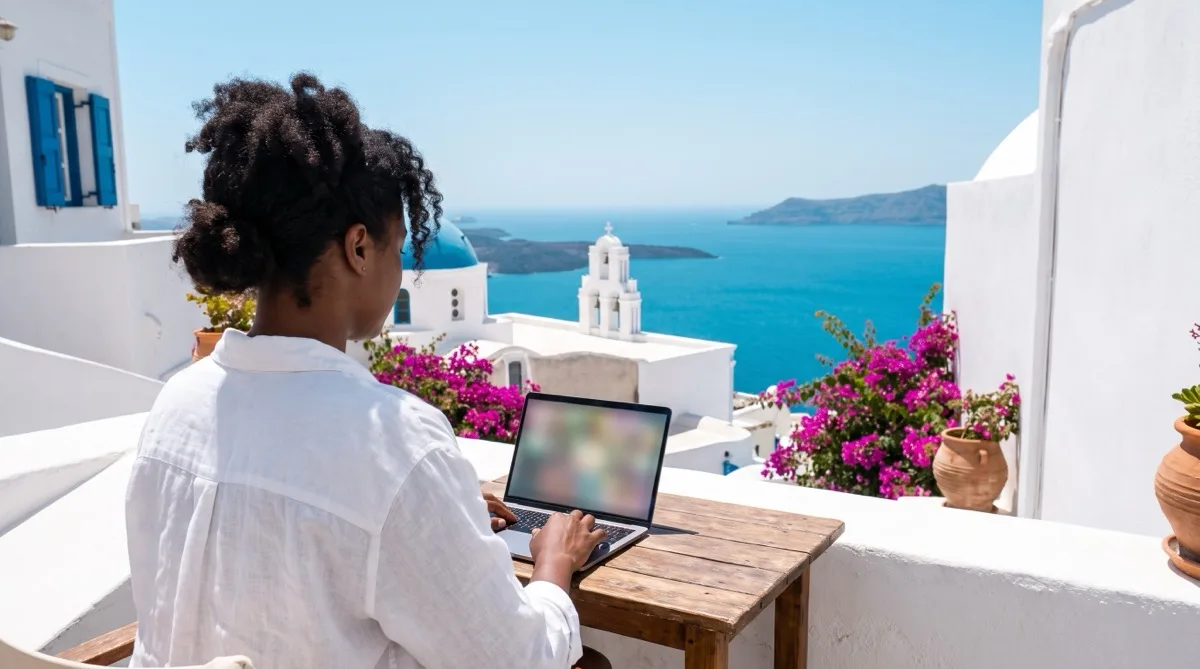
The genre, as it currently stands
Remote Work Europe tracks European remote-work, freelancing, and digital-nomad policy changes and calibrates this kind of update against what Connected members report seeing on the ground.
If you’ve spent any time in the remote-work and digital-nomad corners of the internet recently, you’ll know the shape of the content already.
There’s the YouTube video comparing Beckham Law in Spain with NHR 2.0 in Portugal and the Greek non-dom regime. There’s the Twitter thread of someone who relocated to Cyprus and cut their effective rate to 12.5%. There’s the slick-templated PDF with a colour-coded scoring matrix of European digital nomad visas. There’s the LinkedIn carousel telling you which seven countries you can be tax-resident in for under 90 days. There’s the influencer whose entire feed is a rotation between Lisbon, Tbilisi, and Bali, each tagged with a residency-status update.
I have nothing against any of this, in itself. Tax planning is a legitimate part of running a serious business across borders. Visa structures matter, and the cost of getting the structure wrong is real, and the people producing this content are often genuinely useful guides through what is, in fact, a complicated terrain.
But somewhere along the way, the order of the questions has slipped.
For some, the optimisation has stopped being a tool for sustaining a life, and become the entire goal of the life. The question “where would I most like to live?” has been replaced by “where can I most efficiently extract income?” – and those are very different questions with very different answers.
This piece is about the difference.
What the optimisation frame can’t deliver
Here’s what visa-hopping doesn’t give you. (I say this as someone who has lived in different European countries, who runs a portfolio of activities across more jurisdictions than I’d like, and who has had every conversation about “what if we moved everything to…” at least twice.)
It doesn’t give you the friendships that take years of coffees and mountain walks to deepen into something truly meaningful.
It doesn’t give you the doctor who knows your history, the organic grocer who saves some of the fresh figs for you, the school gate where four other parents will quietly cover for you if your morning falls apart.
It doesn’t give you a neighbour who notices when your shutters haven’t opened by ten o’clock, and who also happens to be a nurse who pops around after his shift to do your daughter’s post-op injection course so she doesn’t suffer further at the hands of her amateur mother.
It doesn’t give you the slow accumulation of references and in-jokes and shared seasons that make a place start to feel like yours rather than somewhere you’re staying.
These things compound. They are also extremely hard to see when you don’t yet have them, because their absence presents as a vague low-level loneliness that the next dopamine-rich destination can mask for a while. The Instagram-friendly version of mobility looks dazzling. But I know that the lived version, after about three years of it for most people, starts to feel like running on a treadmill that’s been gradually tilted upwards.
I’ve watched friends do this for long enough to be sure of one thing: the optimisation never feels like it’s enough. There’s always a country with a slightly better rate. There’s always someone on Insta who’s just cracked a more efficient structure. The arbitrage is open-ended by design – once you’re playing that game, it isn’t easy to stop.
The shift that’s happening
What I notice, especially when talking to remote workers in their thirties, forties, and fifties, is that something has changed in the last couple of years.
The 2014-2018 generation of digital nomads grew up, partnered up, in many cases had children. Their parents got older. The economics of full mobility – the cheap flights, the visa fluidity, the assumption that you could simply pick the next stop – also got harder, partly through tightening regulation and partly through ordinary life. The Instagram-friendly version of the lifestyle has not always survived contact with the subsequent decades of adult life intact, and sometimes early intentions to world-school and travel hit a reality check – a child with special needs, an unwanted career reset, or a geopolitical twist.
What’s emerging in its place isn’t a return to office work. It’s something more interesting: people choosing a place to actually live, deliberately, and then arranging the rest of their lives around that choice.
This shift has a name worth using. We’ve moved from digital nomad – the identity organised around mobility – to intentional remote worker – the identity organised around a deliberate choice of home, made possible by remote work but not defined by it.
That word intentional is the load-bearing one. The choice of where to live is no longer something you make because you happen to be born there, or because your employer is in a certain postcode. You actively choose. And the choice deserves more thought than which country has the most generous tax break this year.
The skill underneath the choice: self-awareness
Before we get to the practical questions, the meta-question.
The skill that makes this kind of intentional choice possible isn’t research, or spreadsheet discipline, or even the willingness to commit. It’s self-awareness. Specifically, an honest read on what your own nervous system, body, and temperament actually need to function – not what looks good on a moodboard.
My private limited company has lived happily in the Baltic business climate for more than eight years, whereas I know that personally I literally could not survive an Estonian winter. The combination of latitude, light, and cold would unravel me by mid-January, and I’d be useless to anyone for months. I’d have to hole up in the sauna until at least May. Someone else I know came to find her long-dreamed-of Spanish summer genuinely oppressive – the heat she’d basked in happily on holidays in the dreaming phase became, in lived reality, a three-month suspension of her ability to think and work and live – so she’s now back in the UK and enjoying shoulder-season visits. Neither of us is wrong. We just want different things from a year.
If you don’t know yourself well enough to answer “what kind of climate, pace, food, and rhythm actually suits me?” with specifics, no amount of tax planning will save you from getting the home choice wrong. And the home choice is the one that, if you get it right, makes everything else easier.
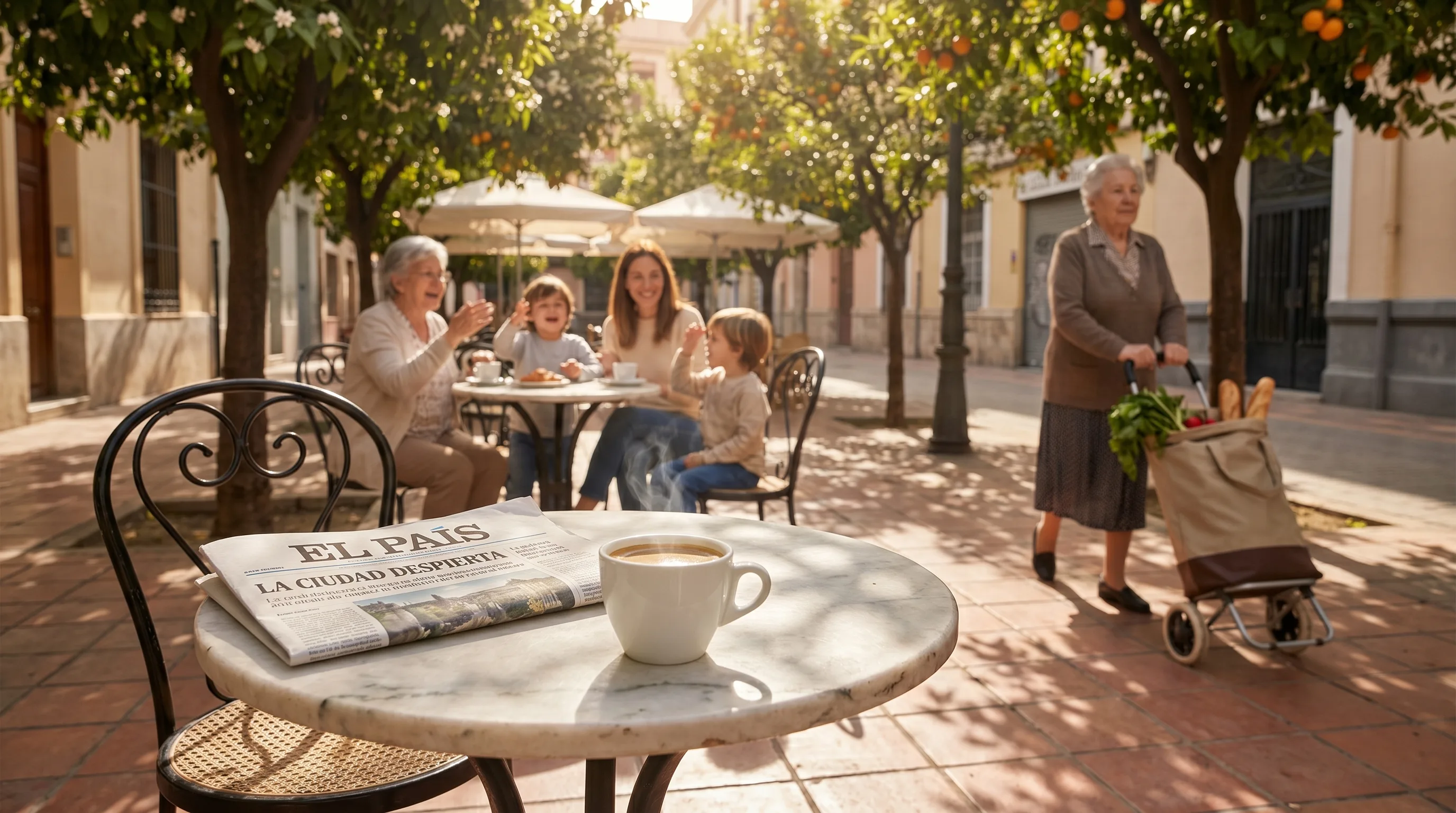
Then you need to think about the culture, the social climate as well as the meteorological one. At times, Spain drives me absolutely crazy with the bureaucracy and the administration and the shrugging attitude that often accompanies the very idea of fixing any of this – “¡es lo que es!” Then I step out of whichever government office I’ve been queuing in all morning and go and sit down at a pavement café, inhaling the aroma of my americano. I look up at the sunlight filtering through the orange blossom, I see three generations of a family bickering amiably at the next table, I watch the abuela shuffling home from the market with her trolley full of fresh produce, and there’s nowhere I’d rather be anywhere in the world.
This is the thing the digital-nomad content can’t really teach, because it’s not generalisable. It’s not “the answer is Lisbon” or “the answer is Berlin.” It’s you, knowing what you need, and then choosing accordingly.
The questions that actually matter
If you’re at the point in your remote-work life where you’re asking “where should I be?” – and the answer is no longer “wherever the company HQ is” – here are the questions I’d put before “what’s the tax position?”
What climate matches your nervous system? Some people are happiest under grey northern skies; others can’t function without ten hours of sunlight a day. This is a real biological variable, not a lifestyle preference, and it doesn’t yield to discipline.
What food culture do you want to live inside for the next twenty years? Not as a tourist. As someone whose Tuesday-night dinner is shaped by it. What’s in your fridge by default if you stop fighting the ‘shoulds’ in your head?
What does the local language sound like to you? Not whether you “could learn it” in some abstract sense – most people can. Whether you can imagine speaking it badly, in public, with strangers, for the years it takes most adults to reach genuine fluency. The willingness to be linguistically humble in public is the bottleneck for actual belonging, more than aptitude (and heads up – if you’ve ever made your living writing words, you’re going to find this conscious incompetence very challenging).
What’s the pace? European countries differ enormously on this. Some places will give you a Mediterranean afternoon, a long lunch, and an unhurried evening. Others run on a Northern European clock that respects your schedule but doesn’t soften it. Neither is right; you have a preference and you should know it.
Where do your professional networks live, online or off? A place can be perfect on paper and isolating if there’s no one near you doing the kind of work you do.
How close do you need to be to ageing parents? This is the question almost no nomad content addresses, and it bites hardest as you grow into your most productive work years, often in conjunction with big-time parenting commitments. Two flight connections away is a different reality from one.
What’s the healthcare system actually like in the place, not on paper but in practice? Talk to actual residents who’ve used it. How do the private insurance and public systems work together? What does emergency response look like in reality? And if applicable to you, how about school, including further and higher education?
Where do you want your children, if you have or might have them, to grow up? What languages will they speak with their friends? What memories will they create? What cultural identity might they develop that could differ from your own?
If you’re partnered, what’s the answer that works for both of you and not just one?
The answers to these questions are not the same for any two people. That’s the point. The tax structure is a much narrower question, and a much more solvable one, once the home question is settled.
Why this shift is happening now
There’s a specific reason this conversation is opening up in 2026, and it’s worth naming.
For most of the history of work, location and income were tightly coupled. If you wanted to earn at New York rates, you lived in New York or somewhere that accepted New York money. If you wanted to live in a Galician fishing village, you accepted that the income ceiling came with the postcode. The economics of remote work always promised to break this link, but the link was actually pretty resilient – until quite recently.
What’s changed in the past two years is that the tooling has caught up. AI has made it possible for small businesses, freelancers, and solo operators to deliver work at a level that used to require either a team or a metropolitan address. The marketing copywriter in a rural Latvian town can now serve clients in California, with an output quality that’s competitive with a London agency, because she has Claude as a second brain and Solopreneur Superpowers as a working app environment, along with a stack of operator tools that didn’t exist three years ago.
That changes the economics of staying put. It used to be that choosing a low-cost European location meant accepting a low-cost income alongside it. That trade is gone. You can now choose where you want to actually live, on the criteria that matter for actually living, and then earn globally from there – without sacrificing what you used to have to sacrifice.
The flip side: when staying somewhere becomes economically viable, the case for not staying somewhere weakens. The visa-hop loses its core financial justification. What you’re left with, if you’re still moving every six months, is the lifestyle aesthetic rather than the lifestyle economics. And the aesthetic, in my experience, doesn’t sustain a life.
What the optimisations are actually for
I want to be very clear about something: I’m not arguing against tax structuring, visa planning, or running your affairs efficiently across jurisdictions.
I file in three countries. I am an Estonian e-resident with a Tallinn-registered OÜ. I am a Spanish autónoma. I retain UK Self Assessment obligations on certain income because of an inheritance anomaly. My tax life is, by any reasonable measure, optimised across borders.
But every one of those optimisations is in service of staying in Spain. I chose Spain – for the light, for the food, for what it does to my children’s childhoods, for what it doesn’t ask of me on a Sunday morning. I expect to retire here one day, unless there are very unexpected changes in my life. The tax structure exists because I’m here. I’m not here because of the tax structure.
That’s the order I’d put back into the conversation.
Optimise as much as you want. Use the visas, the structures, the residencies, the schemes. They’re tools. But they’re tools for sustaining a chosen home, not substitutes for the choice. And if you find yourself looking at a country only because of the rate, ask whether you’d actually like to be there in February with a head cold and nobody to call.
The grown-up question
The single most useful question I’ve heard a remote worker ask, in the last couple of years, came from someone I met at a conference in Tallinn. She’d done four years of nomadic life, two years in Lisbon, one in Mexico City. She’d run the numbers on six European residency programmes. She had the slick personal-finance setup. And she said:
“I keep optimising my life. I haven’t yet chosen where I want to live it.”
That’s the question.
The optimisations will still be there once you’ve answered it. They’ll be much easier to make. And they’ll be in the service of something – a home you’ve chosen – rather than the thing itself.
It’s a quieter version of the remote-work story than the one the genre currently sells. It has fewer beach photos and more boring weeknight dinners. It also tends to result in people who are, in my completely unscientific experience, considerably happier than the version six countries deep into the residency-optimisation game.
The shift from digital nomad to intentional remote worker is a shift in what the question is. Where do you want to feel at home? Choose that. Then sort out everything else around it.
That’s the order. And it’s a more grown-up way of thinking about remote work than the genre’s current default.
A note on Connected
If you’ve chosen your patch and want to optimise the work side without optimising the location, Diana hand-picks European-friendly remote roles every week for Connected. The roles that work cleanly from wherever you’ve already chosen to belong get flagged specifically.
Maya Middlemiss is the founder of Remote Work Europe. She lives in Valencia, files in three countries, and is not going anywhere. Her recent LinkedIn piece on why the Spanish tax return wins the prize every year covers the optimised-but-still-Spain version of the same argument.