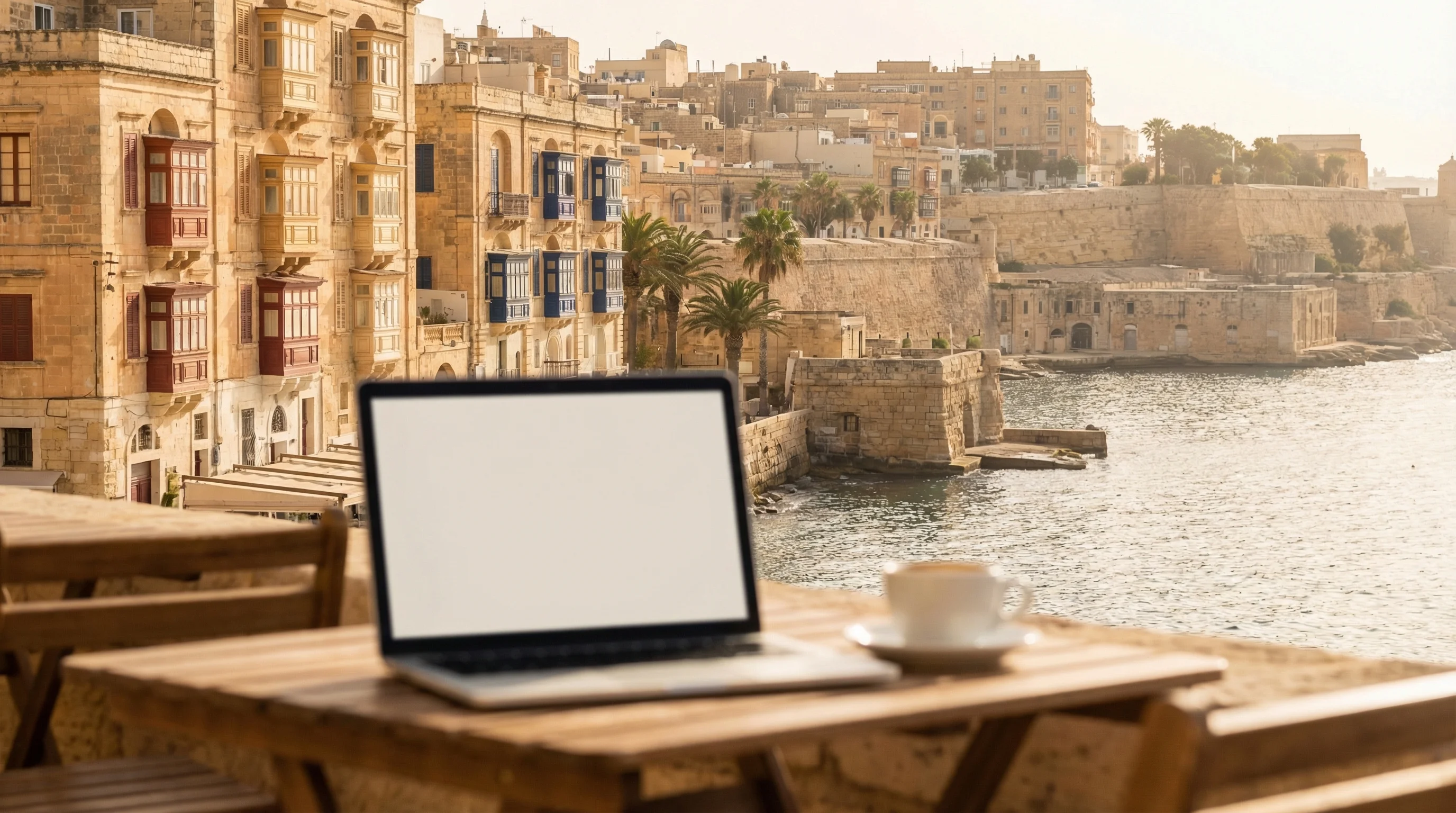
Malta has been quietly positioning itself as one of the most compelling destinations for remote workers in the Mediterranean – and its Nomad Residence Permit is a big part of the reason why.
At Remote Work Europe we treat tax and compliance guidance as audit-critical and check every figure against the source authority before it goes live.
If you’re a non-EU citizen working remotely for a company or clients outside Malta, the Nomad Residence Permit lets you live legally on the island for up to three years – with a favourable flat tax rate that’s hard to find elsewhere in Europe. Add in English as an official language, year-round sunshine, and one of the safest countries on the continent, and it’s easy to see why Malta keeps climbing the lists.
Here’s what you need to know about the programme in 2026.
Who is the Malta Nomad Residence Permit for?
The Nomad Residence Permit is aimed at third-country nationals (people from outside the EU/EEA) who work remotely using technology and earn their income from sources outside Malta. That includes:
- Remote employees of companies registered outside Malta
- Freelancers and independent contractors with international clients
- Business owners whose company is registered in another country
Who doesn’t need it: EU/EEA and Swiss nationals can live and work in Malta under EU free movement rules. You don’t need a special visa – just register your stay if you’re there longer than three months.
Who it’s not for: Anyone seeking local employment in Malta, or working for Maltese companies or clients. The permit is strictly for remote work with foreign-sourced income.
Key requirements at a glance
| Requirement | Details |
|---|---|
| Minimum income | €3,500/month (gross) (~€42,000/year) |
| Proof period | Last 12 months of income evidence |
| Work arrangement | Remote work for employer/clients outside Malta |
| Health insurance | Comprehensive private insurance covering Malta |
| Accommodation | Proof of rental or property ownership in Malta |
| Duration | Up to 1 year, renewable for up to 4 years total |
| Eligible nationalities | Non-EU/EEA citizens |
Income requirements
To qualify for Malta’s Nomad Residence Permit, you need to demonstrate a minimum gross annual income of €42,000 – equivalent to approximately €3,500 per month. This threshold was updated in recent programme revisions.
You’ll need to provide evidence covering the last 12 months, which can include:
- Employment contracts showing salary and remote work arrangement
- Payslips from the previous 12 months
- Bank statements demonstrating regular income
- Freelance contracts, invoices, and client agreements
- Company registration documents if you’re a business owner
The threshold is per applicant – if you’re applying with a spouse or partner, only the primary applicant needs to meet the income requirement, though you’ll need to demonstrate sufficient means to support dependants.
Compared to other Mediterranean digital nomad visa income requirements, Malta’s threshold sits in the mid-range – lower than Portugal’s former programme but broadly in line with Croatia and Greece.
Required documents
Gather these before you start your application:
- Valid passport – with at least 12 months’ validity remaining
- Passport-size photographs – recent, biometric standard
- Proof of remote work – employment contract or freelance agreements confirming you work remotely for a foreign entity
- Proof of income – 12 months of payslips, bank statements, or tax returns meeting the €2,700/month threshold
- Criminal background check – police clearance certificate from your country of origin or residence, apostilled or legalised
- Health insurance – comprehensive private health insurance policy valid in Malta for the duration of your stay
- Proof of accommodation – signed rental agreement, property deed, or booking confirmation for your Malta address
- CV or résumé – outlining your professional background and current remote role
- Application form – completed and signed, available from Residency Malta Agency
Important: Some documents may need to be translated into English or Maltese by a certified translator. Since English is an official language in Malta, this is typically less of a burden than in other Mediterranean countries – most of your documents will likely already be in English.
How to apply
Malta’s Nomad Residence Permit is administered by the Residency Malta Agency (RMA). The application process is straightforward compared to many European alternatives.
Step by step
- Prepare your documents – gather everything listed above, ensuring translations and apostilles are complete
- Submit online – applications are made through the Residency Malta Agency’s online portal
- Pay the application fee – €300 for the initial application
- Wait for processing – the RMA reviews your documentation and may request additional information
- Receive your decision – successful applicants receive authorisation to collect their residence permit
- Collect your permit – visit the relevant office in Malta to provide biometrics and collect your residence card
Processing time
The RMA aims to process applications within 4 to 6 weeks, though this can vary depending on volume and the completeness of your documentation. Applications with missing or unclear documents will take longer.
If you’re already in Malta on a visa-free or tourist stay, make sure you submit your application well before your authorised stay expires.
Renewal
The initial permit is valid for one year. You can renew it up to three more times, for a maximum of four years total. Renewal requires demonstrating that you still meet the income and employment requirements.
After four years, you’d need to explore other residency options if you want to stay permanently – the Nomad Residence Permit doesn’t lead directly to permanent residency or citizenship.
Costs
| Item | Approximate cost |
|---|---|
| Application fee | €300 |
| Residence card issuance | €100 |
| Criminal background check | €20–60 (varies by country) |
| Document apostilles | €20–50 per document |
| Translations (if needed) | €30–50 per document |
| Health insurance (annual) | €400–1,200 |
| Total initial costs | €500–1,500 |
The application fee is non-refundable, so make sure your documentation is complete before you submit.
Tax treatment – Malta’s distinctive approach
This is where Malta’s programme gets interesting – and where it differs meaningfully from other Mediterranean digital nomad visas.
First year: tax exemption
During your first year on the Nomad Residence Permit, your foreign-sourced income is exempt from Maltese income tax. This puts Malta in the same league as Croatia and Greece for that initial period.
Second and third year: 10% flat rate
From the second year onwards, Nomad Residence Permit holders pay a flat 10% tax on income remitted to Malta. This is considerably lower than Malta’s standard progressive rates, which can reach 35% for residents.
The key distinction here is “remitted to Malta” – Malta operates a remittance-based tax system for non-domiciled residents. Income that stays outside Malta is not taxed in Malta. Only the income you bring into the country (to pay rent, living expenses, and so on) is subject to the 10% rate.
What this means in practice
- Year one: no Maltese tax on your foreign income
- Years two and three: 10% on income remitted to Malta
- Income kept outside Malta: not taxed by Malta
- You remain liable for taxes in your home country or country of tax residency
- US citizens must continue filing US taxes regardless of where they live
- Social security obligations depend on your specific situation – see our guide to A1 certificates and social security in Europe
This is a significant benefit, but it’s not a loophole. Get professional tax advice for your specific circumstances, particularly around double taxation agreements and social security contributions.
Cost of living in Malta
Malta is more affordable than many people expect for a Mediterranean island – though it’s not the cheapest option in the region.
| Expense | Monthly estimate |
|---|---|
| One-bedroom apartment (Sliema/St Julian’s) | €900–€1,400 |
| One-bedroom apartment (other areas) | €600–€900 |
| Utilities (electricity, water, internet) | €100–€150 |
| Groceries | €250–€350 |
| Eating out (moderate) | €200–€400 |
| Public transport (monthly pass) | €26 |
| Coworking space | €150–€300 |
| Total (comfortable lifestyle) | €1,400–€2,500 |
The most popular areas for remote workers – Sliema, St Julian’s, and Valletta – command premium rents. Moving slightly inland or to the south of the island can reduce your housing costs by 30–40%, and give you some breathing space if you are close to the minimum required income.
Gozo, Malta’s quieter sister island, is even more affordable and increasingly popular with remote workers who prefer a slower pace. Ferry connections to the main island are regular, and the Gozo tunnel project (if it ever materialises) would change the dynamic further.
Healthcare
Malta has a well-regarded public healthcare system, and the country ranks highly in global healthcare indices. However, Nomad Residence Permit holders are required to have private health insurance – you won’t have automatic access to the public system.
Private healthcare in Malta is affordable by European standards. A consultation with a GP typically costs €20–40, and specialist visits run €50–100. Private health insurance policies suitable for the visa start from around €400–500/year for basic coverage, rising to €1,200+ for comprehensive plans.
Several international insurers popular with digital nomads (SafetyWing, Genki, Cigna Global) are accepted, but confirm with the RMA that your specific policy meets their requirements before you apply.
Coworking and connectivity
Malta punches above its weight for coworking infrastructure, particularly given its small size.
Spaces and WeWork both operate in Malta, alongside local options like SOHO Office Space, The Vault, and 230 Works in Sliema. Prices range from €150–300/month for hot desks to €400+ for dedicated desks.
Internet connectivity is generally solid – fibre broadband is widely available in urban areas, with speeds of 100–500 Mbps common. Mobile data coverage is excellent across both Malta and Gozo.
English is one of Malta’s two official languages, which removes the language barrier that complicates remote work in many other European countries. Government services, banking, contracts – everything works in English, which makes the admin side of settling in considerably smoother.
How Malta compares to other Mediterranean digital nomad visas
If you’re weighing up Mediterranean options, here’s how Malta stacks up against the main alternatives.
| Feature | Malta | Croatia | Spain | Italy | Greece |
|---|---|---|---|---|---|
| Duration | Up to 4 years | Up to 18 months | Up to 5 years | Up to 1 year (renewable) | Up to 2 years |
| Income threshold | €3,500/month | €3,622.50/month | ~€2,849/month | ~€2,333/month | €3,500/month |
| Tax treatment | Year 1 exempt, then 10% | Fully exempt | Standard Spanish tax (24%+) | 7% flat rate (some regions) | 50% reduction for 7 years |
| Language | English official | Croatian (limited English in admin) | Spanish required for most admin | Italian required | Greek required |
| Schengen access | Yes | Yes | Yes | Yes | Yes |
| Renewable | Yes (up to 4 years) | No (6-month cooling off) | Yes | Yes | Yes |
Key differences worth noting
vs Croatia: Croatia offers full tax exemption but only for up to 18 months with no renewal – you have to leave and wait six months before reapplying. Malta gives you up to three years of continuity, with favourable (if not zero) taxation from year two. If you want a longer-term Mediterranean base, Malta wins on duration. For a more detailed comparison, see our Croatia digital nomad visa guide.
vs Spain: Spain’s digital nomad visa has the longest potential duration (five years), but the tax treatment is significantly less favourable – you’ll pay Spanish income tax at a flat 24% rate under the Beckham Law, or potentially higher under standard rules. Spain also has far more complex bureaucracy and longer processing times. See our Spain digital nomad visa guide for the full picture.
vs Italy: Italy’s digital nomad visa is newer and still finding its feet, with a 7% flat tax rate available in certain southern regions. The language barrier is real for day-to-day life, though. Our Italy guide covers the details.
vs Greece: Greece offers a generous 50% tax reduction for seven years, which can be very attractive at higher income levels. But the income threshold is higher, and the bureaucracy can be challenging.
Malta’s combination of English language, four-year duration, and a tax rate that starts at zero and never exceeds 10% makes it uniquely competitive – particularly for those who want stability and simplicity.
Practical tips for making it work
Apply early. Processing takes 4–6 weeks on average, and you don’t want to be chasing paperwork while your tourist visa expires. Start gathering documents at least two months before you plan to arrive.
Budget for the transition. Between flights, a deposit on accommodation, health insurance, and application fees, expect to spend €2,000–4,000 before you settle in. Have a financial buffer beyond the minimum income requirement.
Choose your area carefully. Sliema and St Julian’s have the best infrastructure for remote workers, but they’re also the most expensive and tourist-heavy. Valletta offers culture and character at slightly lower prices. Gozo suits those who want space and quiet. Don’t commit to a long lease before you’ve explored.
Get a Maltese phone number early. You’ll need it for banking, government services, and two-factor authentication. eSIMs from local providers (Epic, GO, Melita) work well and are inexpensive.
Use Malta as a European base. With Schengen membership and an international airport with connections across Europe, Malta is a strong launching point for exploring the continent. Weekend trips to Sicily, Barcelona, or Athens are quick and affordable.
Don’t neglect digital security. Working from cafes and coworking spaces in a tourist-heavy country means shared networks. Use a VPN, enable two-factor authentication on everything, and keep your work devices secure. You’ll plug those devices in with a British 3-pin by the way – something that has caught out the Remote Work Europe team before!
Plan for summer. Malta gets seriously hot in July and August (35°C+), and the islands get very crowded with tourists. Air conditioning is essential, and electricity bills will spike. Many long-term residents plan their travel for the peak summer months.
Frequently asked questions
Can I bring my family on the Nomad Residence Permit?
Yes. Spouses, partners, and dependent children can apply as dependants. You’ll need to demonstrate sufficient income to support them, and each family member will need their own health insurance. Dependants receive their own residence permits and can live in Malta for the same duration.
Do I need to rent accommodation before I apply?
You need proof of accommodation as part of your application. This can be a signed rental contract, a property deed if you own property in Malta, or a booking confirmation for your initial accommodation. Many applicants secure a short-term rental first and then find a longer-term place after arriving.
Can I work for a Maltese company on this permit?
No. The Nomad Residence Permit is exclusively for remote workers earning income from sources outside Malta. If you want to work for a Maltese employer, you’ll need a standard work permit.
Is there a minimum stay requirement?
There’s no strict minimum number of days you must be physically present in Malta. However, the permit is designed for people who genuinely live in Malta – if you spend most of your time elsewhere, you may face questions at renewal.
Can the Nomad Residence Permit lead to permanent residency?
Not directly. After your maximum three years, you’d need to switch to a different residency programme if you want to stay. Malta offers several other residency options, including the Global Residence Programme and the Malta Permanent Residence Programme, though these have their own requirements and costs.
What happens if my income drops below the threshold?
If your income falls below €3,500/month during your permit period, you could face issues at renewal. It’s not typically monitored month by month during the permit’s validity, but you’ll need to demonstrate you still meet the requirements when you apply to renew.
Do I need to open a Maltese bank account?
It’s not a formal requirement, but it’s highly practical. You’ll need a local bank account for paying rent, utilities, and everyday expenses. Opening a bank account in Malta as a non-resident can take several weeks, so start the process early. Having a Maltese IBAN also makes the remittance-based tax system easier to manage.
Bottom line on the Malta Nomad Residence Permit
Malta’s Nomad Residence Permit won’t suit everyone. It’s a small island – genuinely small – and that can feel limiting after a while. Summer heat is intense, the rental market is competitive, and car traffic can be maddening.
But for remote workers who value English-language accessibility, tax efficiency, safety, and a European base with Schengen access, Malta is genuinely hard to beat. The three-year maximum duration gives you time to settle in properly, the tax treatment is among the most favourable in Europe, and the practical barriers to entry are lower than in most competing programmes.
If you’re weighing up your options, take the time to compare it properly with the alternatives. But don’t overlook this small island – it’s been punching above its weight for centuries, and its digital nomad offering is no exception.
This article provides general information about Malta’s Nomad Residence Permit. It does not constitute legal or tax advice. Immigration and tax rules depend on individual circumstances – always consult a qualified advisor for your specific situation.
Last reviewed: March 2026. Requirements and tax treatment are subject to change. Check the Residency Malta Agency website for the latest information.