TL;DR
- All 81 of Chainguard’s live adverts are fully remote. Not one states an attendance requirement, and no advert names a physical office.
- 21 of the 81 are open in Europe, weighted towards UK engineering and country-level sales.
- Remote means remote within one named country. Several adverts spell the country out in the body, in bold.
- Visas, work permits and right to work are not mentioned anywhere across the 81 adverts. That is silence, not permission.
Chainguard’s Greenhouse board carried 81 live adverts on 7 September 2026, and every single one of them was tagged as remote. Not “remote-friendly”, not “remote with two days in the office”. The location field on all 81 reads as a country or region followed by the word Remote, and there is no physical office address anywhere on the careers site.
That makes Chainguard one of the cleaner examples of the model. The important question for anyone reading from Europe is not whether the company is remote. It is how many of those 81 doors are actually open to you, and what you have to be to walk through one.
Is Chainguard really fully remote?
Its own words, repeated in the benefits block of all 81 adverts, are these:
Flexible & Remote-First Culture: Work remotely with team meetup opportunities, bi-annual destination summits, and a monthly stipend for coworking spaces, phone and internet costs.
The careers site adds: “We’re a fully remote team, but we stay closely connected.”
We scanned every advert for the phrases that usually give a hybrid policy away. “Days a week” appears zero times. “In the office” appears once, in an Executive Business Partner advert describing the duty of supporting culture-building initiatives, not an attendance rule. The word “sponsorship” appears twice, both times inside a partner sales framework where it means executive sponsorship of a commercial relationship.
One detail worth naming honestly: Chainguard’s Greenhouse office list does include a container called “Hybrid – NYC”. No live advert is tagged to it. The list is a piece of internal plumbing, and on the day we checked, nothing was hanging from that particular hook.
Which Chainguard roles are open in Europe?
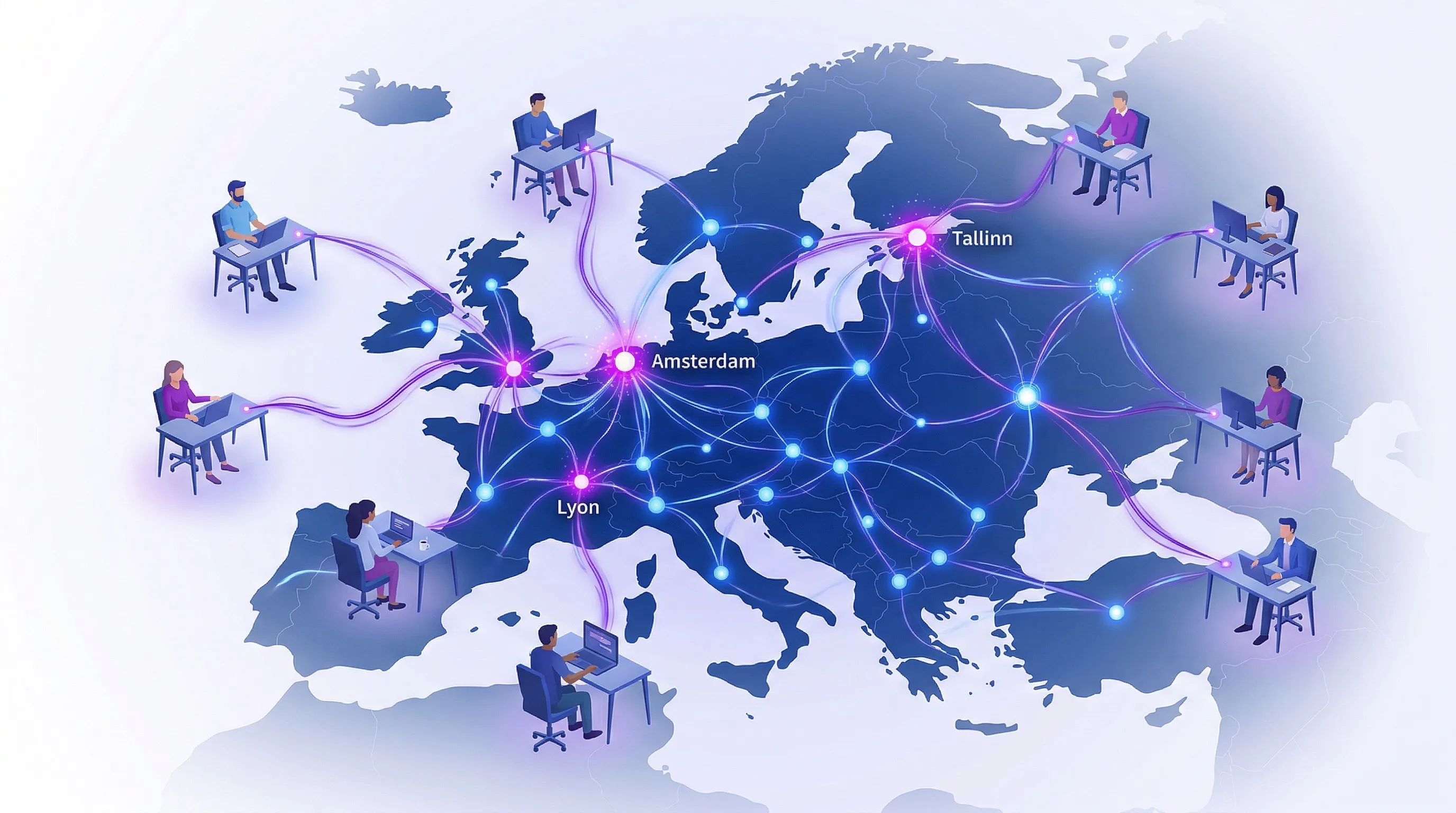
Twenty-one of the 81 adverts sit in a European country. The distribution is lopsided, and in a way that tells you what Chainguard is doing here.
| Location tag | Live adverts |
|---|---|
| United Kingdom | 9 |
| Germany | 4 |
| Netherlands | 2 |
| France | 2 |
| Denmark | 1 |
| Sweden | 1 |
| France and Germany (one advert, both tags) | 1 |
| Europe, UK and US (one advert, three tags) | 1 |
| Total European adverts | 21 |
The remaining 60 sit outside Europe, with roughly 49 in the United States and the rest across Canada, India, Singapore and Brazil.
Within those 21, the pattern splits two ways. The UK carries the engineering: Software Engineer (Libraries Platform), Staff Software Engineer (Customer Platform), Staff Software Engineer (Repositories), Senior Product Security Engineer, Staff Vulnerability Management Engineer, and a Senior Solutions Architect for EMEA. Everything on the continent is commercial and territory-shaped: Enterprise Account Executive for DACH, for Benelux, for the Nordics, for Denmark, a Regional Director of Sales for Central Europe, Customer Success Managers, and partner roles in France.
If you are a software engineer outside the UK, the realistic count of open doors is very small. If you sell security software into a European territory, it is one of the better boards to be watching.
Can I apply from anywhere in Europe?
No, and Chainguard is unusually direct about it. The country restriction sits in the body of the advert, not buried in a footer. Two live examples:
- Enterprise Sales Engineer – France: “Must be located in the UK or France”
- Senior Manager, Customer Success Management – EMEA/APJ: “Currently located in the United Kingdom”
This is the pattern across most genuinely distributed employers, and it is the single thing that catches people out. Remote-first almost never means “work from wherever you fancy”. It means the company has a legal entity or an employment arrangement in a specific list of countries, and you have to be standing in one of them. Our guide to remote-first companies that actually hire in Europe covers why that constraint exists and how to read it quickly.
Does Chainguard sponsor visas?
We do not know, and neither does anyone reading the adverts.
Across all 81 live adverts, the words visa, work authorisation, work permit and right to work appear zero times. Not once, in either direction. There is no sponsorship offer and no refusal.
This matters because the absence is not a signal. Some employers state a sponsorship position in every advert; some state a refusal. Chainguard states neither, which means the question has to be asked directly at first contact rather than assumed either way. If your application depends on sponsorship, treat it as an open question and raise it early. We cover how to read that silence in employers open to remote hiring across Europe.
Does Chainguard publish salaries?
Sometimes, and the geography of when it does is revealing. Forty-five of the 81 adverts carry a pay figure. Only three of the 21 European adverts do.
| Role | Published figure |
|---|---|
| Senior Manager, Customer Success Management – EMEA/APJ (UK) | “up to £150,000 base salary + bonus (depending on experience)“ |
| Software Engineer (Libraries Platform) (UK) | £89,807 – £105,393 GBP |
| Senior Software Engineer (AI CICD) (Europe/UK/US) | $157,000 – $184,000 USD |
Most of the published figures sit on US adverts, where several states require pay disclosure by law. The European adverts mostly stay silent. If salary transparency matters to you, assume you will have to raise the number yourself in the first conversation.
Are there timezone or language requirements?
Timezone requirements exist on Chainguard’s board, but they are all American. Five adverts state one, and every one is a US role: “Must be located in EST or CST time zone”, “Located in the Eastern Time Zone”, “Located in the Central Time Zone”, “Located in the Pacific Time Zone”.
Not one European advert states a timezone requirement. That is a meaningful difference from employers who hire in Europe but expect US overlap hours.
On language, no European advert states a requirement either, which is genuinely surprising given that the roles cover DACH, Benelux, the Nordics and France. A German territory sales role that does not ask for German in writing may still expect it in practice, so it is worth asking rather than inferring.
Frequently asked questions
Is Chainguard hiring in Europe right now? Yes. Twenty-one of its 81 live adverts on 7 September 2026 were tagged to a European country, with the UK accounting for nine of them.
Can I work for Chainguard from Spain, Italy or Portugal? Not on the roles live on 7 September 2026. The European country tags in use were the UK, Germany, France, the Netherlands, Denmark and Sweden. Chainguard’s Greenhouse office list does contain Spain, Italy, Ireland, Poland, Switzerland, Austria and Slovenia as remote containers, so those countries have been used before and may be used again.
Does Chainguard employ people or engage them as contractors? We could not determine this. The adverts carry no worker-type field and the public board gives no indication either way. Ask before you get to offer stage.
Will I have to move for a Chainguard job? No, but you may already need to be in the right country. The company runs no offices, and the roles are remote within a named country rather than remote in general.
How often does the team meet in person? The benefits line in every advert refers to “team meetup opportunities” and “bi-annual destination summits”, which suggests two company gatherings a year plus team-level meetings.
Sources
- Chainguard job board (Greenhouse, board slug
chainguard), 81 live adverts, retrieved 7 September 2026: https://job-boards.greenhouse.io/chainguard - Chainguard careers page, retrieved 7 September 2026: https://www.chainguard.dev/careers
- Advert body text quoted above retrieved from the Greenhouse public board API, 7 September 2026.
All counts in this article are as at 7 September 2026 and will drift as roles open and close.