Extreme heat is now a structural feature of European summers, not a once-a-decade freak event, and remote work is one of the few personal-infrastructure choices that meaningfully mitigates it. This guide is the keystone playbook: the climate case for working from home in heatwaves, the Spanish abuelas cooling routine (persianas, timed cross-ventilation, fans before AC), how to manage your electricity bill on Spain’s PVPC tariff bands, and the clinical and legal points at which you stop work entirely. Re-shareable every European summer.
Extreme heat is no longer a freak event we ride out once a decade and forget about. It is a structural feature of European summers now, arriving earlier, lasting longer, and pushing further north every year. If you work from home, this affects everything from your electricity bill to your safety planning, and it deserves a proper guide rather than the recycled “stay hydrated” listicles that do the rounds every June.
This is that guide. It is also, deliberately, a defence of remote work as a serious climate-adaptation tool, not just a lifestyle preference – because the conversation in 2026 is still wildly out of step with the physical reality outside our windows.
The climate case for working from home
Remote work is one of the few things individual workers can do that meaningfully shifts their carbon footprint, and the numbers are not trivial. A 2023 study in PNAS found that fully remote workers in the United States produced around 54 per cent less carbon than fully in-office workers, even after accounting for residential energy use and non-commute travel; hybrid workers saw roughly a 40 per cent reduction once they were home at least two days a week. The European picture is harder to pin to a single headline figure because our transport mix is greener to start with, but the direction is identical.
That is the mitigation case. The adaptation case is more urgent and gets less airtime. When the mercury sits stubbornly above 38 degrees for a week, the daily commute stops being merely unpleasant and becomes genuinely hazardous: rail tracks buckle and trains run at restricted speeds; older buses without air conditioning turn into rolling saunas; rush-hour metros become public-health incidents in waiting, particularly for older commuters, pregnant workers, and anyone with cardiovascular conditions. None of this is hypothetical; it is what last summer looked like across Madrid, Athens, Rome, and increasingly even in Paris and London.
Working from home on the days the warnings are out is not skiving; it is a sensible piece of personal infrastructure. Anyone arguing for blanket return-to-office mandates in the face of escalating European heat really needs to pay attention to the public-health situation as it stands today in the era of climate breakdown.
There is a regulatory current running the same way. Spain’s Real Decreto-Ley 4/2023, passed in May 2023, requires employers to adapt working conditions, including reducing or shifting the working day, when AEMET or a regional weather authority issues an orange or red heat warning and other preventive measures cannot guarantee worker safety. The original framing was aimed at outdoor sectors, but the law extended coverage to workplaces previously excluded from RD 486/1997. At EU level Directive 89/391/EEC, the OSH Framework Directive, places a general duty on employers to assess all risks to worker health; EU-OSHA has confirmed heat sits within that duty, though there is no dedicated EU heat directive yet, and unions including the ETUI have been pushing for one. Expect that gap to close over the next few summers.
Half the job is staying safe and effective at home
Now you need home to actually be the better workplace, because working from home in a heatwave is its own skill set, and the homes most of us live in were not designed for the climate we now have.
Flex your work hours
Siestas were invented for a reason. If you possibly can, adapt your working hours to make the most of the cool window that happens shortly after dawn. At the very least get your domestic errands and housework done. Lots of workplaces in Southern Europe follow this rhythm already, but if you work flexibly for yourself, consider this dimension of flexible working, and put it to work for you. The more your work becomes asynchronous and results-oriented, the greater flexibility you will have so always work towards this as a goal.
The heat coming out of your own kit
A laptop on a video call, an external monitor, a dock, a charging phone, and a powered hub all dump heat into the room you are sitting in. Older machines run hotter under the same load, and once a laptop’s internal temperature crosses its throttling threshold it deliberately slows the processor to protect itself, which means longer render times, choppier calls, and you working harder for the same output. It is a silent productivity tax across the board, and all your batteries and booster packs are draining faster too, both in their daily cycles and actual product life.
The solutions are practical: Unplug what you are not actively using; close browser tabs and apps that keep the fan spinning; lift the laptop onto a stand so air can move underneath it; and schedule heavy-load tasks (video editing, long calls, large file syncs) for cooler hours. A tablet for reading and admin runs significantly cooler than a laptop doing the same job, and is worth keeping to hand.
The Spanish abuelas playbook
I’ve been working remotely since 1999, and I live in the Valencia region where summer afternoons routinely top 38 degrees. The local grandmas have managed this without air conditioning for generations, and most northern European homes can adopt a version of their playbook.
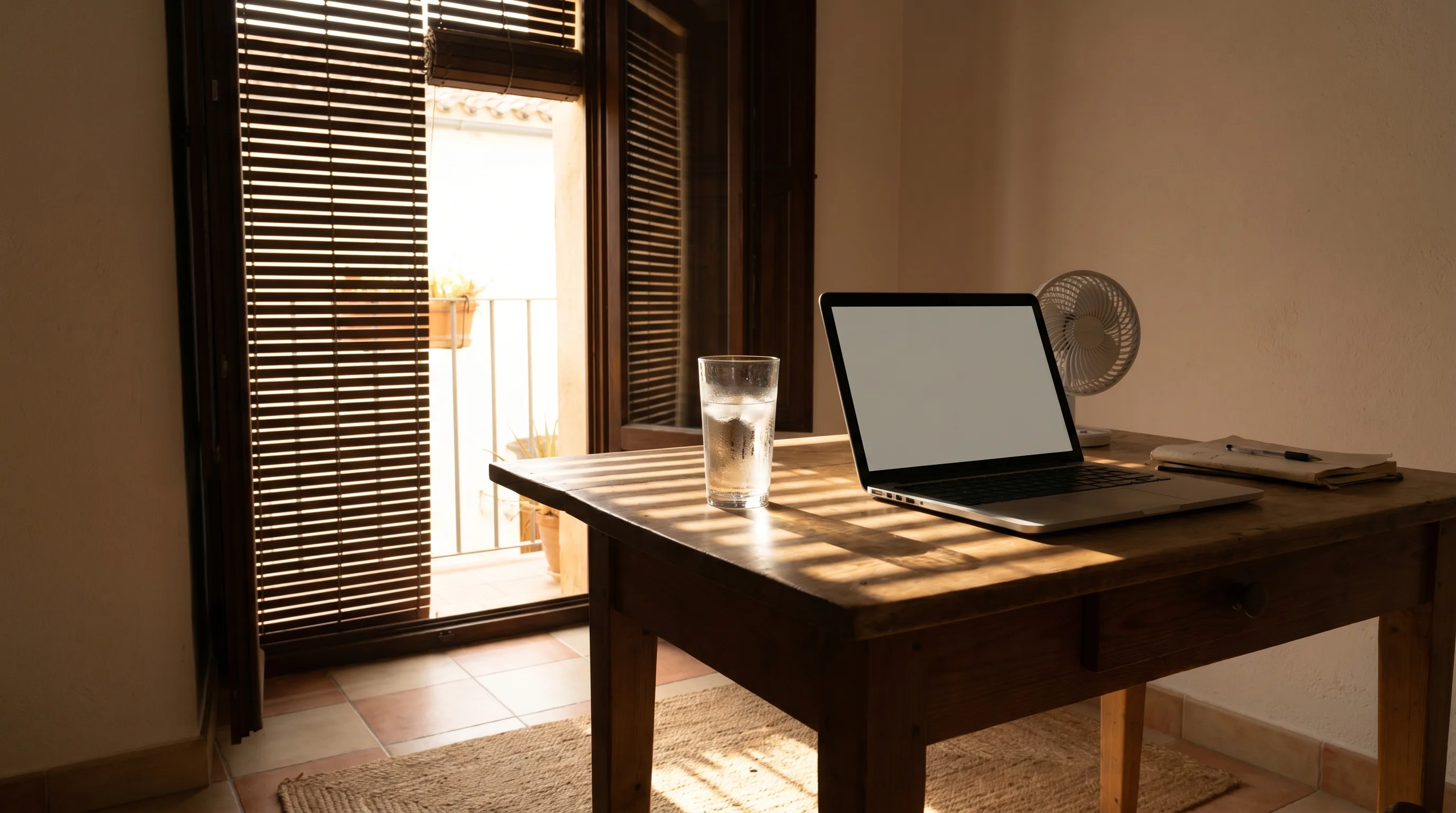
The single biggest move is persianas, the external slatted blinds that sit on the outside of Spanish windows. Close them before the sun hits, ideally by nine in the morning, and keep them down all day. Stopping the heat from getting through the glass is dramatically more effective than trying to dump it out again once it is inside.
Without external shutters, heavy lined curtains with reflective backing are the second-best option, closed early. I heard someone on the UK news this week talking about using cardboard insulation to block heat coming in through windows, which doesn’t sound like a great interior design aesthetic, but needs must when things are extreme.
The second move is cross-ventilation, timed properly. Open everything just after sunrise and again from around ten at night, with windows on opposite sides of the home open simultaneously so air can pull through. The moment the outdoor air gets warmer than the indoor air, usually mid-morning, shut everything: windows, shutters, internal doors to rooms you don’t need. The house will hold its cool air like a thermos flask until evening. Most important is to pay attention to the direction a window is facing and when the sun hits. How heat and air fluids move around your home
Moving air helps even when the air is not cool. A ceiling or standing fan helps your body shed heat through evaporation at a fraction of the electricity cost of AC, and combining a fan with a damp towel across your shoulders gives a short, effective burst of cooling for the worst of the afternoon. Try a cooling spray or make your own – making sure you pointed out your neck, not your gadgets.
Watch your electricity bill
Cooling is expensive and the maths matters. In Spain, most domestic users on the regulated PVPC tariff sit on the 2.0TD structure, which splits the weekday into three bands: punta (peak) from 10:00 to 14:00 and 18:00 to 22:00, llano (mid) for the surrounding hours, and valle (off-peak) overnight from midnight to 08:00 plus all weekends and national holidays. Running an AC unit for six hours across the afternoon peak band costs two to three times what the same unit costs to run overnight in valle.
There is a counter-intuitive workaround many remote workers already know about: leave the house. A library, a museum café, a coworking day pass, or a long lunch in an air-conditioned restaurant all bundle their cooling cost into someone else’s overheads. On the hottest peak-band afternoons, the cheapest move financially (and often in carbon terms, because a shared cooled space serving fifty people beats fifty individual AC units) is to pack up the laptop and go somewhere else. I’ve written before about Valencia’s coworking landscape; most European cities now have a workable equivalent.
Safety, not just comfort
Heat is the European weather event most likely to kill you, and home workers are not immune just because we are indoors. Heat exhaustion (heavy sweating, pale clammy skin, headache, nausea, dizziness, cramps) is uncomfortable but should respond to thirty minutes of resting in a cool place with cool drinks, per UK NHS guidance. Heatstroke is a medical emergency: confusion, loss of consciousness, a rapid pulse, a very high temperature with skin that has stopped sweating, or seizures all mean you call emergency services immediately. Core body temperature above 40 degrees Celsius is the textbook clinical threshold, but do not wait around with a thermometer; the behavioural signs are enough.
Hydration sounds obvious until you notice you’ve worked through four hours of back-to-back calls and your water glass is still full. Keep a bottle in your eyeline, set a timer, and remember caffeine and alcohol both work against you. Add a pinch of salt or an electrolyte tablet on the worst days. Make a checklist or set a reminder if you know you need to drink more water and you just forget.
The bit that gets forgotten is the rest of the household. If you have older relatives, young children, or pets at home, you are also their first line of defence. Check on elderly neighbours; never leave a pet in a closed car; know the signs of heat distress in dogs (excessive panting, drooling, lethargy, vomiting). When the warnings hit red, the right call is sometimes to stop work for the afternoon, draw the shutters, sit in the coolest room, and pick the day back up at six in the evening when the heat breaks.
The case for telling employers all of this
If you manage people or you are negotiating your own working arrangements, the climate-adaptation argument for remote and hybrid work is one of the strongest cards in the deck right now. Framed as occupational health and continuity of operations rather than flexibility for its own sake, it gets a more serious hearing from HR and from insurers.
The Spanish regulatory direction is going to spread, the EU framework will tighten, and forward-looking employers will get there before they are forced to. A written remote-work policy with hot-weather provisions – the right to work from home on orange and red warning days, adjusted hours during peak heat, a small stipend for fans or a portable AC unit – is cheap insurance against a much larger problem later.
Earn the cool side of the room
Working through a European summer well is a skill we are all going to need to keep refining. The kit will change, the tariff bands will move, the legislation will tighten, and the temperature records will continue to fall; the underlying playbook will not. Close the shutters early. Move air before you cool it. Watch the bill. Watch the people in your household. And when the weather genuinely turns dangerous, give yourself permission to stop, because no afternoon of email is worth a hospital trip.
The abuelas in my neighbourhood have known this for fifty years; the rest of us are catching up.
FAQ
Is it safe to work from home in extreme heat? Usually yes, and often much safer than the alternatives, provided your home is properly shaded and ventilated and you watch yourself for warning signs. Indoor temperatures above roughly 35 degrees become medically risky for older workers, pregnant workers, and anyone with cardiovascular conditions, so the test is your room’s temperature rather than your postcode.
Does Spanish law require employers to let me work from home during a heatwave? Not in those exact words, but Real Decreto-Ley 4/2023 obliges employers to adapt working conditions when AEMET or a regional authority issues an orange or red heat warning and other preventive measures cannot guarantee worker safety; that adaptation can include shifting hours, reducing the working day, or moving the work itself. Remote work is one of the obvious accommodations, especially for desk-based roles, and the trend across EU member states is toward tighter, not looser, heat-safety duties under the OSH Framework Directive 89/391/EEC.
AC or fan: which is cheaper to run during a heatwave? A fan, by a wide margin; a ceiling or standing fan typically draws 30 to 80 watts compared with 800 to 2,000 watts for a domestic air-conditioning unit, so running fans plus a damp towel through the worst of the afternoon costs a fraction of running AC. If you do need AC, on Spain’s PVPC 2.0TD tariff the same unit costs two to three times more in the punta band (10:00 to 14:00 and 18:00 to 22:00 on weekdays) than in valle (midnight to 08:00 and all weekends), so timing matters as much as wattage.
What are the warning signs I should stop work and seek medical help? Heat exhaustion looks like heavy sweating, pale clammy skin, headache, nausea, dizziness, or cramps, and per UK NHS guidance it should improve within thirty minutes of resting in a cool place with cool fluids; if it does not, treat it as escalating. Heatstroke is a medical emergency and the textbook signs are confusion, loss of consciousness, a very high temperature with skin that has stopped sweating, a rapid pulse, or seizures; core body temperature above 40 degrees Celsius is the clinical threshold but you do not need a thermometer to act, the behavioural signs are enough. Call emergency services immediately.
I rent and my flat has no external shutters. What can I actually do? Heavy lined curtains with a reflective or pale backing, closed before nine in the morning and kept closed all day, are the second-best option after persianas, and they make a measurable difference. Reflective window film is a cheap renter-friendly add-on; on the worst days, cardboard or foil-backed insulation board cut to fit the window frame is uglier but startlingly effective for emergencies. Combine that with timed cross-ventilation (open everything before sunrise and again after ten at night, shut everything once the outside air is warmer than the inside), and a decent fan.
Can my employer mandate office work when the temperature hits red-warning level? In Spain, no, not without violating their duty under RDL 4/2023 to adapt working conditions during AEMET orange or red warnings when other preventive measures are insufficient; an employer who insists on commuting and office attendance during a red warning is on shaky legal ground. Elsewhere in the EU, the OSH Framework Directive places a general risk-assessment duty on employers, and EU-OSHA has confirmed heat sits within that duty even though there is no dedicated EU heat directive yet. If you are being pressured, get the request in writing and raise it with HR, your works council, or your union.
Will working through extreme heat damage my laptop or shorten its life? Yes, sustained heat shortens the life of batteries and other components and pushes processors into thermal throttling, which slows your work and makes the fan run harder for the same output. Practical fixes are simple: lift the laptop onto a stand so air can move underneath it, unplug anything you are not actively using, close apps and browser tabs that keep the fan spinning, and schedule heavy-load tasks (video editing, long calls, large file syncs) for the cooler hours of the morning or late evening.