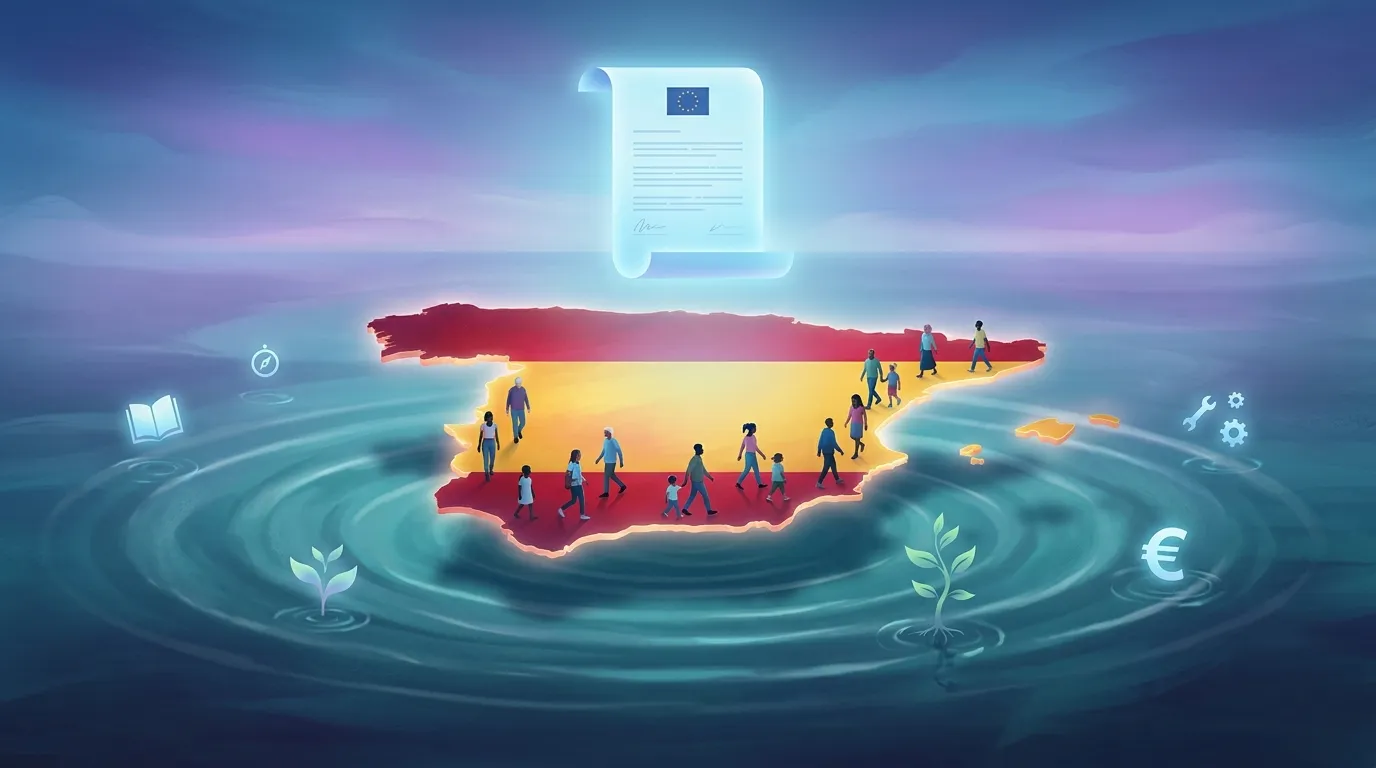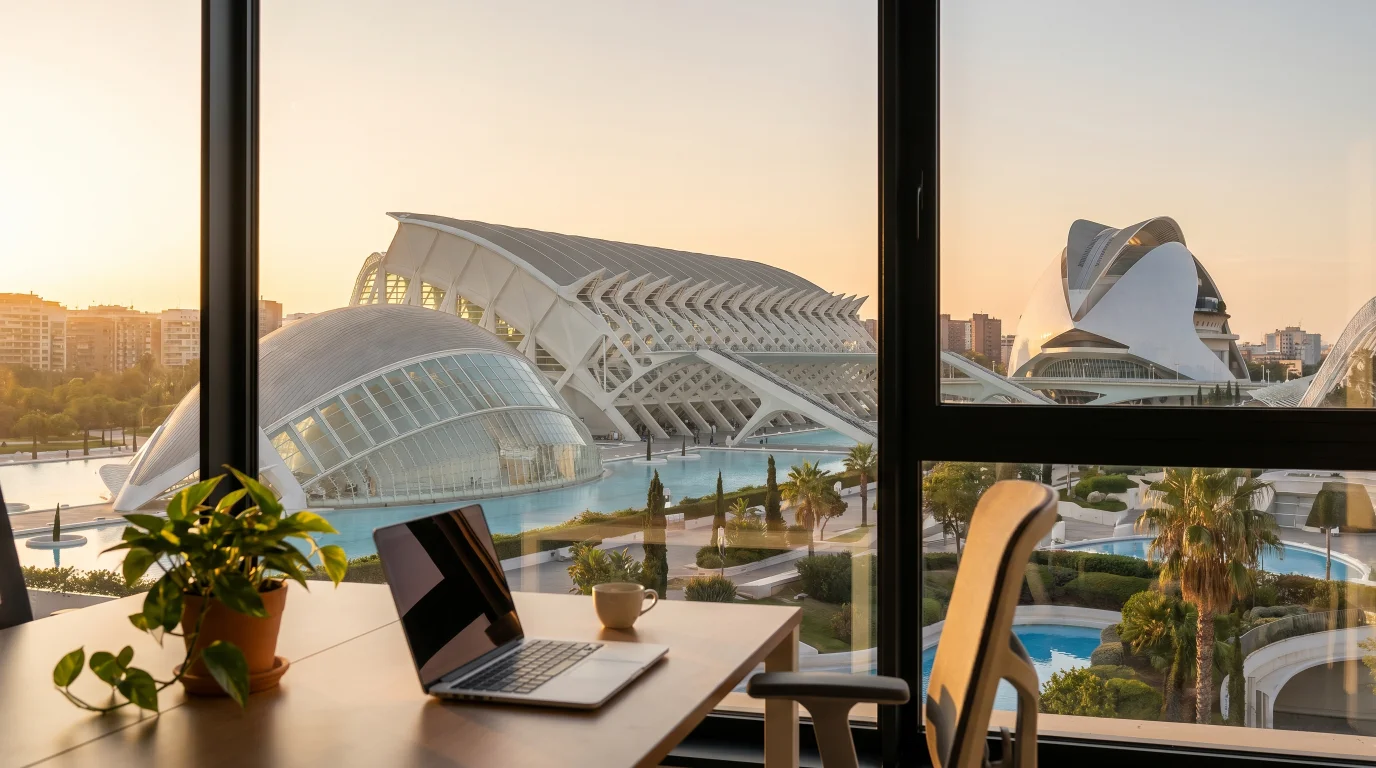
TL;DR: There is a real difference between an expat and an immigrant, and the language does more work than we tend to admit. This is an essay on the three moments that sorted me from one into the other whether I chose it or not – the response to the Brexit referendum, the difference between the people who ran for the border in lockdown and the people who hunkered down, and the day the international community rallied around Valencia after the DANA. Written in the wake of Ángela-Jo Touza-Medina’s Nomad Summit keynote, “Rooted and Remote.”
Ángela-Jo Touza-Medina opened the Nomad Summit in Tallinn recently with a phrase I have not been able to shake. She was talking about the difference between migration and mobility. About the way that language shapes posture. About what it means to arrive somewhere and stop thinking of yourself as passing through.
“Rooted,” she said, “not just portable. That’s the difference between migration and mobility.”
I sat in the audience thinking about Spain, and about the three specific moments that had sorted me – without my having consciously chosen it – from the category of person who lives somewhere temporarily into the category of person who lives somewhere, full stop. Ángela-Jo was talking about the choices remote workers make. She was not, I think, expecting one of them to be sitting in the room mentally reviewing her own life. But that is the risk of a good keynote.
Here is what I have come to think about the difference between an expat and an immigrant, and how I came to think it.
The words are not neutral
When I first move to Spain I never minded being called an expat, casually, in the way you use a word that seems to describe you accurately enough. British person, living in another country, working. Expat.
But the words expat and immigrant are not neutral. They are almost never applied evenly. An “expat” is what a British or American or German person is called when they live somewhere else. An “immigrant” is what someone from a poorer country is called when they live somewhere else. The vocabulary sorts people by class and origin before it sorts them by anything real about what they are actually doing in the country. It is not a distinction most of us made ourselves. But we inherit it, and we tend to use it without noticing what it is doing on our behalf.
Ángela-Jo’s framing helped me see what elements of the Northern European community in Spain had been doing with the word. To call yourself an expat, in the classic sense, is to keep one foot outside the country. To hold the possibility of leaving, always, as your baseline. To make no particular commitment to the place beyond the length of your current arrangement. Expats are people who happen to live somewhere. Immigrants are people who have moved somewhere.
I did not, at some clean identifiable moment, decide to stop being one and start being the other. I got sorted, as life in Spain happened to me. Three specific events did a lot of the sorting.
The first shift: Brexit
The morning after the Brexit referendum I woke up in Spain to a country full of Spanish friends who had spent the day before I went to bed watching, from the outside, my country make a decision that would materially affect my life without my permission. And some of them were more distressed on my behalf than most of the people I knew in Britain.
I do not know how to describe this experience without sounding melodramatic. But I was so comforted by the Spanish response, which was not curiosity, or pity, or “well, that’s your problem now.” It was something closer to grief on my behalf. My mamí friends on the school run hugged me and sent their best gifs. My neighbours made space for me to talk about what it felt like to have my status as an EU citizen negotiated away. Nobody suggested I ought to go back. Everybody, without needing to say it explicitly, treated me as one of theirs.
That was the first moment I noticed that the country had made a claim on me that I had not yet made on it. And though I still worked 100% for a UK-based company at that time and therefore had no professional connections locally, my Spain community had already decided I was theirs.
I did not consciously act on that recognition. It just sat underneath everything from then on.
The second filter: lockdown
Then, in the spring of 2020, everyone was asked to go home and stay put.
What followed showed me something I had genuinely not seen before. There was a small and highly visible category of people – most of them speaking English, most of them from wealthier countries, most of them people who had, up until that point, described themselves as living in Spain – who left.
Or tried to leave. They booked flights out. They packed. They ran for whichever border was still open. The frame they used, to themselves and out loud, was that Spain was a place they had been staying and now it was time to go home.
And there was another category, which included me. People who did not consider Spain a place they had been staying. People whose “home” was already here, whatever their passport said.
It became very clear, very fast, which category each person had actually been in all along. It had not been visible before the pressure arrived. Lockdown, and the pending implementation of the Brexit referendum at that time, made it suddenly painfully visible – the expats ran for the borders while the immigrants hunkered down with everybody else. (A lockdown that was ultimately far more extensive and controlling than the UK ever dealt with, even though in March 2020 everyone thought they were deciding how to spend the next two weeks…)
I do not want to be uncharitable about the people who left. Some of them had families to get back to, or elderly parents, or contracts that made staying impossible. Not every departure meant the same thing.
But there was a version of that departure – a “this was never really my life” version – that I saw playing out in real time, and it felt like a kind of clarifying gift. I understood, watching it, what I had chosen when I chose Spain. And I understood that I had already chosen it. I wasn’t thinking about a border to run for. I was already home, and simply stayed there. Joining in the applause for our emergency services, and sobbing uncontrollably when the Protección Civil did a drive-by “Happy Birthday” dance for my lockdown daughter (it was her 15th and she just cringed, my reaction in front of the cheering neighbours made things worse, apparently.)
Ángela-Jo has a phrase for the thing lockdown revealed. Real belonging, she says, is the situation where your neighbours would notice if you disappeared. Lockdown is the same test in reverse. Real belonging is where you would not think of disappearing, because these are the people you are staying for.
The third sort: the DANA
In late 2024 the DANA – the catastrophic storm event that flooded large parts of the Valencia region – did more damage to more communities in a shorter space of time than anything I have lived through here.
The physical loss was terrible. The response was extraordinary. And a specific part of the response, the part that has stayed with me, was the way the international remote-work and digital-nomad community rallied.
People I had spoken with at conferences the year before turned up in inboxes and DMs asking what was needed, where to send money, whether they could physically come and help. People who had spent time in Valencia and left had absorbed enough of the place to feel it as a loss. People who had never been here wanted to know what to do.
It was one of the clearest expressions I have seen, in real life, of what Ángela-Jo was talking about when she said that belonging is a two-way mutual transformation.
The nomads who had passed through this place had been changed by it, and they responded to its wound as if it were partly theirs. And the community that emerged around the response, including us settled remote workers who had made this city our home, showed up in a thousand acts of solidarity, from aid distribution to directly digging and cleaning the destroyed homes and streets.
This was not a thing that could have existed if remote work had only ever been “portable” for the people who did it. It required people who had been rooted, at least a little. It required people who understood that this was somewhere real, with real neighbours, real houses, and real losses.
For me, personally, the DANA was the moment I understood without needing to be told anything more. That is when you know you have chosen your home. When something terrible happens to it and you cannot imagine being anywhere else, and the people who love it from a distance write to you as though you are part of it, and you write back knowing that you are.
While the political repercussions and blame still continue, the solidarity and actions of the community members themselves – immigrants alongside locals – will never be forgotten by those of us who lived through it.
What Ángela-Jo named
Sitting in Tallinn listening to Ángela-Jo, I recognised what my own life had been slowly teaching me. She was speaking as someone whose family traces back to Bueu, Galicia, working on integration infrastructure through Live Galicia and the Ultreia Network, and collaborating with entities like Fundación Roberto Rivas – projects that exist because rural repopulation and inclusive integration are what make communities able to welcome newcomers without resentment.
Her thesis is that remote workers’ individual choices about integration are not individual at all. They arrive at scale. If most of the people who come to a Galician village learn even a bit of Gallego, get involved in the local calendar, and sit through the awful first year of not quite understanding, the village learns to welcome the next batch. If most of them do not – if they build a parallel English-speaking bubble on top of the village and never touch it – the village learns to resent the next batch.
The version of that sentence that hit hardest, for me, was this one: permanent indecision or permanent unbelonging dressed up as freedom is exhausting.
I have seen that exhaustion in people. I have seen it in friends who kept their bag packed for years and never let themselves love where they were, because loving it would mean losing the option to leave. There is a version of remote-work life that is genuinely free, and there is a version of it that is a way of never committing to anything so nothing can hurt you.
Despite my work being essentially in English, I have continually edged closer to the first version, mostly through Spanish friends who refused to let me hold myself at arm’s length. My daughters have grown up here and I now have a lovely Spanish daughter-in-law in my life as well. Not everything about life in Spain is perfect, but I can look those imperfections in the eye with acceptance because I’m home.
The row in the Spanish press
This is not a debate I have only been having with myself. It is one of the loudest cultural conversations happening in Spain right now, and it has been supercharged over the last few years by the backlash against mass tourism and a perceived digital nomad influx. Housing prices in Valencia, Barcelona, Madrid, Málaga, Palma. Wage pressure in the tourism-dependent cities. Neighbourhood displacement. Every few weeks another Spanish newspaper runs a piece, and the comment thread underneath re-litigates the same question: what are we calling the people who have come here from wealthier countries, and what are they doing to our cities?
Meanwhile, on social media, the Anglosphere-in-Spain re-litigates it from the other side. Facebook groups with names like “Expats in Valencia” – and there is at least one for every Spanish city – argue about the vocabulary in earnest, over and over, in threads that go on for days. Some people insist the word expat is neutral, or descriptive, or the correct term for what they are doing. Others notice, correctly, that nobody has ever used it about a Moroccan strawberry picker or a Venezuelan care worker.
And then – because life will not be denied its ironies – there is a specific subset of British emigrants, particularly on parts of the Costa Blanca, who left the UK explicitly to “get away from the immigrants,” and now live in Spain. I have met these people. People who will out loud oppose immigration to the country of their birth and simultaneously constitute immigration to their country of residence. Who would be furious to be described as immigrants themselves, and who would explain, if pressed, that it is different when they do it. You could not make this up if you tried.
The same instinct shows up in a more insidious form, too. Not every version of it is loud, or dressed in the language of getting away from anyone. Some people simply arrive with a fixed picture of what Spain is supposed to be, set in memory from a holiday or a stereotype, and they bristle at every sign that the place is actually changing.
We write a great deal about digital transformation. There are social transformations as well, and they are harder for this kind of resident to accept. I have watched people respond to a call to join a demonstration here by saying we ought to stay out of it, because “it is not our culture, not our business.”
This triggers me the same way it did when I was a community development officer in London in the 90s, and councillors told me they wouldn’t get involved in the mutilation of female immigrants taking place in their ward because “it’s their culture!” Culture changes, culture develops, culture progresses and evolves. And I, for one, am very glad to see vigils for murdered women or protests against animal cruelty in Spain that might not have existed a decade or two ago. As immigrants we’re part of that change and part of shaping how Spain continues to evolve. I guess the expats can look the other way and stay out of it
I have heard the same resistance come out as a grumble about why Spain has got so involved in something like Pride. It doesn’t fit their preset cultural narrative ( even though I’ll just remind everyone that Spain legalised same-sex marriage in 2005, long before the UK in 2013!) Underneath it, I think, is a wish for the Spain of their preconceptions to stay set in aspic, kept intact for a particular retirement vision, rather than a living society that goes on changing whether they approve of the direction or not. A resistance to change that fixed can underpin a good deal more than an argument about vocabulary.
And then – because irony never sleeps – the same cohort wonder aloud why the word “expat,” in popular English, has come to be used as a proxy for “white lifestyle migrant.” The dictionary meaning, they will earnestly point out, is really something quite different. And they are half right about the dictionary. What they cannot see is that they themselves are the reason for the drift. A word means what enough people use it to mean, over enough time, and they have spent decades using it to mean exactly this.
That last group is why the word matters even more than my private preferences would suggest. Refusing the label expat is, in a small way, refusing the sorting mechanism that lets people believe there is a correct migration for people like them and an incorrect migration for people who do not look like them. It is a small act of noticing that everyone in Spain who was born somewhere else is in the same category, whether they want to be or not, and that the vocabulary should reflect that.
Why the word matters
I still, occasionally, hear myself say the word expat by mistake. It is a hard reflex to unlearn. And I do not think everyone who uses the word means anything by it – plenty of people use “expat” the way you use any inherited label, without weighing it. And I’ve often used it to describe some of the Remote Work Europe community who are more than digital nomads. They’re people who have settled their lives here long term but maybe not forever.
But I have long chosen, deliberately, to use “immigrant” about myself instead. Partly because it is more accurate. I am not passing through. I have not been passing through for a very long time. There’s a reverse culture shock you quickly recognise, experienced on visits back to the UK long before the Brexit referendum, and coming “home” has always meant coming home to where my family lives in Spain.
I also claim the migrant word because it carries a solidarity the other one does not. If I call myself an immigrant, I put myself in the same category as the Moroccan family down the road, the Venezuelan care worker who looks after my elderly neighbour, and the Ukrainian woman who cleans houses around the school run. That is the actual category I am in. Sharing the word matters. Refusing to reach for the more comfortable label matters.
An expat is someone the country tolerates. An immigrant is someone the country has, over time, absorbed and been absorbed by. Ángela-Jo’s frame – rooted, belonging – is the same distinction. The people who make the country home, over time, are the ones who let the country make itself home in them.
What I would tell you if you are earlier in this than I am
If you are living somewhere as a remote worker and you have not yet decided whether you are passing through, I would say the following gently, and only because I have lived the other version.
Notice the language you use about yourself. Notice the version of your life you would tell someone at a party. Notice whether you speak about the place as somewhere you are staying, or somewhere you live. The distinction is small in the moment and enormous over time. It shapes whether you learn the language properly. It shapes whether you show up to the local thing. It shapes whether your neighbours know your name. It shapes whether, one day, when something happens to the country you are in, you find yourself running for the border or hunkering down.
You do not have to decide today. But you might notice, quietly, which way you are already leaning.
Ángela-Jo was right. Rootedness matters. And Spain, over time, without my having asked for it, rooted me.
I am glad it did.
Ángela-Jo Touza-Medina delivered the opening keynote at Nomad Summit Tallinn 2026 on “Rooted and Remote,” building on her work with Live Galicia, and Fundación Roberto Rivas on integration infrastructure for remote workers arriving in rural Galicia.