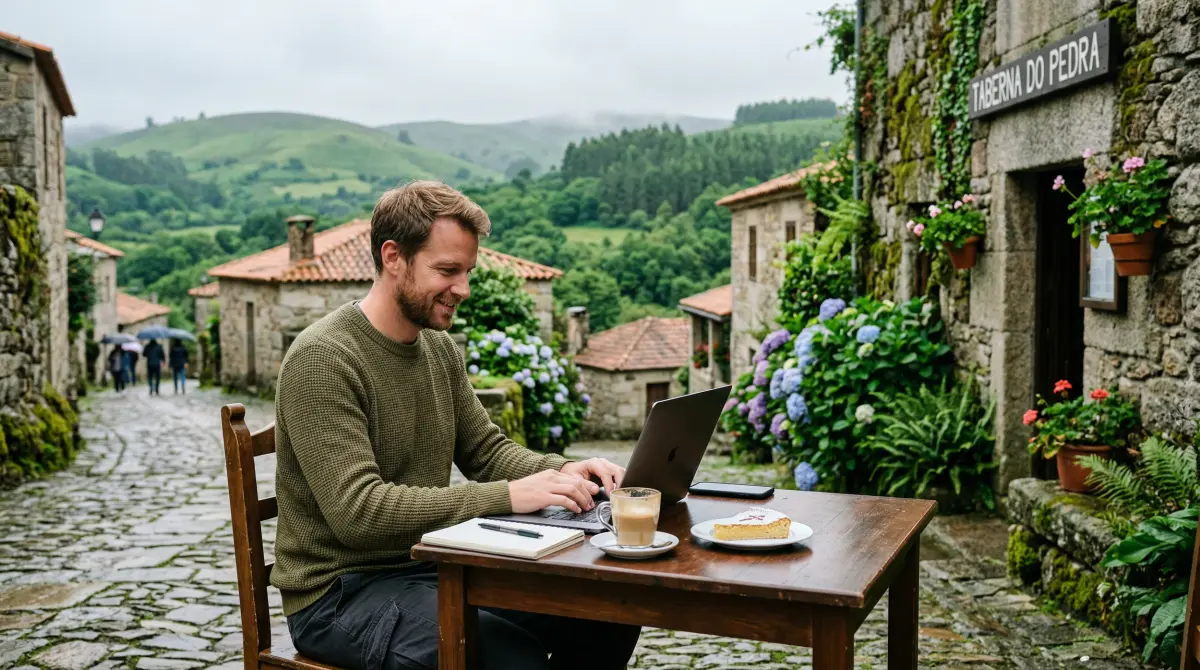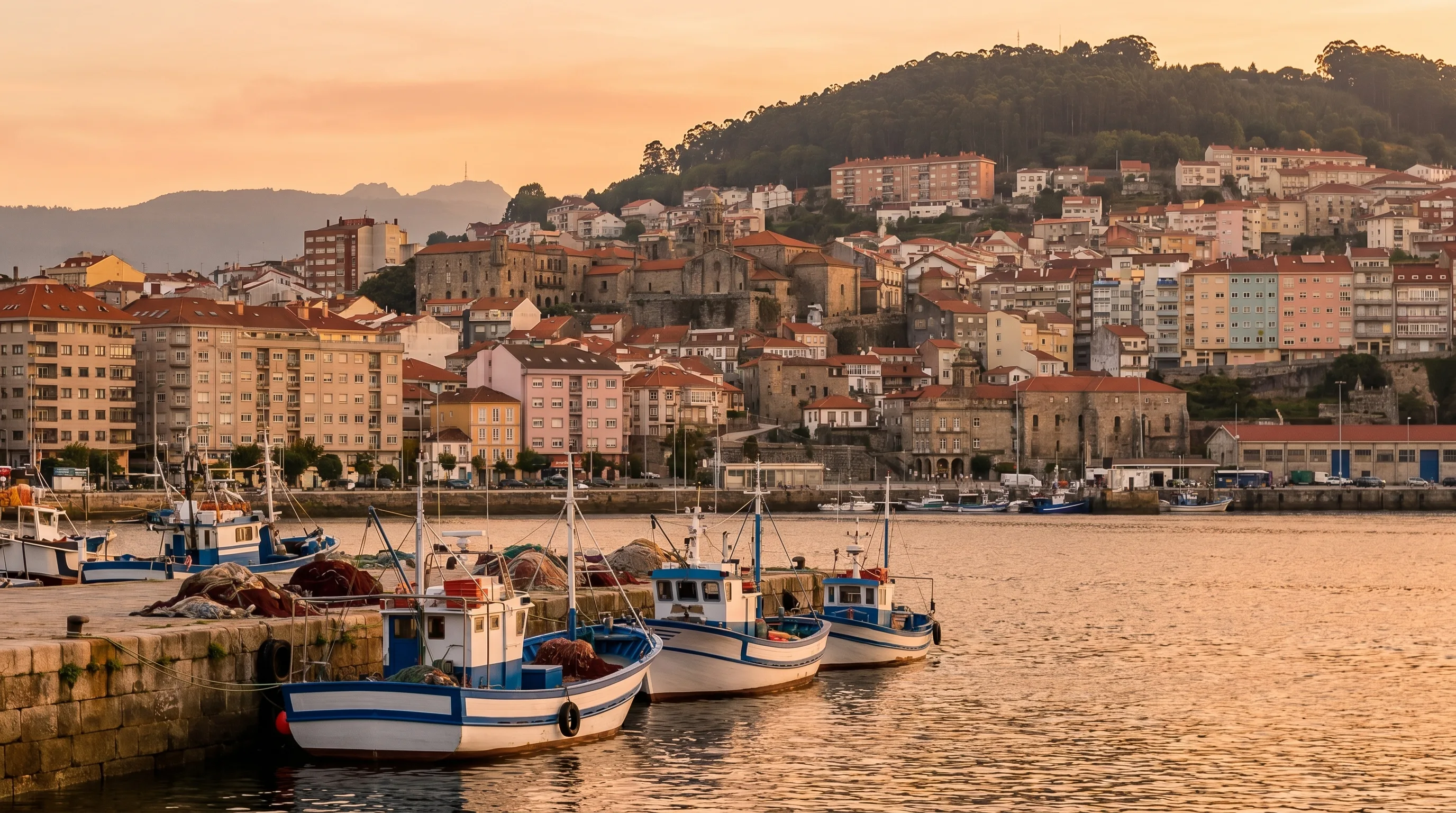
I have lived and worked in Vigo for years. I founded LiveGalicia, a platform for foreigners, immigrants, and returnees building life in Galicia. I spent over two decades working in and around immigrant integration, social impact, and community infrastructure before that. And when I walked into The Way Startup Summit this May at the Palacio de la Oliva – where LiveGalicia was presenting Global Roots, Galician Growth: Why International Entrepreneurs Are Building Here – I realized between sessions that I had been operating with an incomplete map.
Not a wrong one. An incomplete one. Programs I had never heard of. Funding instruments that had been active for months that none of the founders in my community knew to apply for. Municipal services sitting a ten-minute walk from where people live, completely invisible because nobody had written about them in a language or a register that reached us.
That realization is what produced this piece. Think of it as version one – honest about what it covers, honest about what it doesn’t yet. We are going deeper in future iterations, and if you have navigated any part of this ecosystem yourself and found something we missed, I want to hear from you.
The standard content about Galicia for remote workers covers the practical basics well enough: the weather (yes, it really does rain – I say this with love), the cost of living (still reasonable, though housing is tightening in Vigo and A Coruña), the food (there is no better argument for staying), the broadband (solid in the cities, improving in the rural zones). All of that is true and worth knowing.
What it almost never covers is what happens when you stop being a remote worker and start thinking about building something here. And a growing number of people are making exactly that move. They arrive with a laptop and a contract, stay because of the quality of life, and eventually start asking whether they could actually put down roots – economically, not just residentially. They start a consultancy. They turn a side project into something registered. They find a local collaborator and realize the business idea they had been sitting on for three years might actually work here.
When that happens, they walk straight into a wall of institutional opacity – not because the infrastructure doesn’t exist, but because it was never built to be found by people who arrived the way they did. It exists. It is more developed than you would guess. And the sequence for accessing it matters more than most people realize.
Start with the question underneath the question
Before anything else: are you building a business with a Galician legal identity, or are you staying employed by a company abroad and working remotely? These are different situations with different implications, and conflating them will send you down the wrong path.
If you are employed abroad and working remotely from Galicia, your primary concerns are tax residency, the compliance implications of your employment contract, and whether your employer has thought through the cross-border setup at all. Remote Work Europe covers that territory extensively and well. The programs I am describing here are not built for that situation.
If you are freelancing, running a consultancy, developing a product, or starting any kind of business registered in Galicia – as an autónomo or through a company – then what follows is for you. Most of it is free to access. Some of it you need to reach in a specific order. All of it is harder to find than it should be.
The first door: go somewhere before you apply for anything
The single most common mistake I see foreigners and returnees make in this ecosystem is going directly to the funding layer. They find out a grant exists, they try to apply, and they discover they are ineligible because they skipped a step they did not know was a step. That costs people a year. Sometimes more.
Galicia has a territorial support network designed specifically for the moment before you have a business plan, before you have a legal entity, sometimes before you have a clear idea. These offices are free. They are staffed by people whose job is to orient you, not to evaluate you.
The Polos de Emprendimiento are the Xunta de Galicia’s network of fifteen free advisory offices distributed across the region – in Vigo, A Coruña, Santiago de Compostela, Ourense, Lugo, and in smaller comarcas across the four provinces. They have collectively attended more than 2,600 projects and conducted more than 7,000 individual advisory sessions. Their particular strength is territorial and place-based entrepreneurship: rural projects, generational business transfers, social economy, returnees. If you are not coming in with a scalable tech product, the Polo is not the consolation prize – it is the right door. And they are actively being expanded and coordinated into a wider ecosystem network called Red Ultreia, which as of April 2026 has more than 100 institutional members across Galicia.
If you are in Vigo, go to VigoEmprende first. It is the Concello’s own founder advisory service – free, open to any sector, any stage, any nationality. Since 2020 it has accompanied more than 1,200 people and helped more than 250 businesses get started. You can walk in with nothing more than an idea and leave with a tutor and a clearer sense of which programs actually apply to your situation. It is also, for anyone new to the institutional landscape here, a genuinely useful first conversation about how all of this works.
The picture across the other cities is more uneven, and I want to be honest about that rather than smooth it over.
- Santiago de Compostela has the richest local infrastructure outside Vigo and A Coruña: the Concello’s CERSIA Empresa provides free advisory and company registration support, a new founder advisory service launched in June 2025 under the Feito en Santiago program, and the Cámara de Comercio de Santiago operates a business incubator, a digital coworking space, BioIncubaTech, and the Biopolo Sionlla biotechnology hub.
- A Coruña has the Concello’s Departamento de Promoción Económica, two municipal business incubators (A Grela and ACCEDE Papagaio), and the Cámara de Comercio’s España Emprende program.
- Lugo has CEI-NODUS, a municipal innovation and business center that has run six editions of its Inicia Coworking program and supported more than 120 entrepreneurial projects – and it is also the northern venue for ViaGalicia, the regional accelerator.
- Ourense has the thinnest municipal layer of the four provincial capitals: no dedicated city-level advisory program at the scale of the others, which means the Polo de Emprendimiento is genuinely the primary first door there.
- Pontevedra city is similar – the provincial Smartpeme network (Diputación de Pontevedra, with offices in Barro, Cambados, Lalín, O Porriño, Pontevedra, and Vigo) provides the main coverage, advising around 2,500 entrepreneurs and SMEs annually across the province.
None of these services are gatekeepers. They exist to help you understand the system. Going to one before you apply to anything will save you time and, in some cases, a year.
If what you are building is scalable: the acceleration pathway
For founders building something with genuine growth potential – a product, a platform, a service business with clients beyond Galicia – there is a formal acceleration track that leads to significant public funding, and it matters to understand it as a sequence rather than a menu.
ViaGalicia is the flagship, run jointly by the Consorcio de la Zona Franca de Vigo and IGAPE, the Xunta’s economic development institute. It is a generalist accelerator – open to technology, agri-food, culture, health, climate, anything that meets the criteria of being innovative, investable, and scalable. Recent cohorts have included AI applications, active aging, agri-food, and cultural enterprises, which tells you that scalable does not mean exclusively tech.
The program runs in four phases: a pitch day, nine weeks of pre-acceleration, nine months of full immersion in a coworking space at Porto do Molle in Nigrán (with a parallel venue in Lugo), and a final Investors Day with national and international investors. Up to fifteen projects per venue per edition reach the full program. Every project that completes acceleration receives a direct non-repayable grant of €25,000. A €1.5 million fund exists for the highest-potential projects among those. Since its founding, ViaGalicia has generated more than ninety companies and five hundred jobs.
What is not obvious from the outside – and this is the part that matters most – is that completing ViaGalicia or one of the sectoral Business Factories (BFAuto for automotive, BFAero for aerospace, BFFood for agri-food, BFClimatech for climate technology) is a qualifying condition for the IGAPE startup grant. The acceleration track and the funding track are not parallel options. One precedes the other by design. Skipping the first makes you ineligible for the second.
For deeptech founders, StartTIC – launching in 2026 at the Zona Franca’s Bouzas facilities – is a new incubator focused on AI, autonomous systems, digital twins, and new energy applications, being built with Gradiant and the Cámara de Comercio de Vigo.
The funding layer
The IGAPE Startup Grant (IG408G) is the most accessible direct funding instrument currently open: up to €20,000 at 100% subsidy, non-repayable, for expenses and investments from January 1, 2026 forward. Deadline September 30, 2026, first-come first-served, budget has run out before the deadline in previous years. Apply early.
Eligibility requires at least one qualifying condition: ENISA certification under Spain’s Startup Law, the Xunta’s EIBT tech-base qualification, spin-off status from a university or research center, registration in the national Innovative SME Registry, or prior participation in an approved acceleration program. That last one is the most common path – and the reason the acceleration layer above is not optional.
For businesses ready to move internationally, Galicia Exporta Empresas offers up to €150,000 at 70% subsidy for trade fairs, commercial missions, digital market positioning, brand and patent registration, and international e-commerce development. Same September 30 deadline.
GAIN, the Axencia Galega de Innovación, is the right partner once a project has validated its innovation and needs institutional R&D backing. Its programs – InnovaPeme, the DIHGIGAL and DATAlife digital innovation hubs, European FEDER instruments – are not the right first stop for most early-stage founders, but become highly relevant further along.
Banking innovation and private capital
ABANCA Innova has been running since 2016 and is the most practically relevant banking partner for startups in Galicia. Its model is Venture Clienting – the bank becomes your client, running selected projects through a proof-of-concept in a live operational environment. Now in its twelfth edition, nearly a thousand applications received since founding, twenty-five proof-of-concept cycles completed. The 2026 edition focuses on AI, crypto, and tokenization. The PoC phase delivers up to €15,000 in participative loans, with an additional incentive of up to €45,000 for the highest-performing project in each cycle. You need a constituted legal entity and a product already in market to be eligible.
Startup Galicia (startup.gal) is the nonprofit network connecting more than one hundred institutional members and nearly eighty companies across the ecosystem. It is also, notably, one of the very few places in this ecosystem where you will find resources in English – something I will come back to.
The Investors Day at the end of ViaGalicia and The Way Startup Summit each May in Vigo are the two moments in the calendar where private capital becomes most publicly accessible. The Summit brings together more than fifty startups, one hundred speakers, and more than one hundred and twenty investors. LiveGalicia presented Global Roots, Galician Growth: Why International Entrepreneurs Are Building Here at this year’s edition on May 8th – and it was in the conversations around that session, talking with founders who had no idea most of the infrastructure in this article existed, that the gap became impossible to ignore.
A frank note for those navigating this in a second language
None of the programs I have described formally exclude international founders. In practice, the barrier is almost always having a legally registered entity in Galicia – a matter of process for EU citizens, more complex depending on residency status for non-EU residents. The Polos and local advisory services are the right first conversation for anyone trying to understand what is feasible in their specific situation.
However, I want to name something clearly, because it is the thing I hear most often from people in the LiveGalicia and Galipreneur communities: almost none of this ecosystem exists in English. The websites are in Spanish or Galician. The application processes assume Spanish fluency. The informational materials, the program criteria, the institutional communications – nearly all of it.
Startup Galicia (startup.gal) is a genuine exception and worth bookmarking. Beyond that, the international community is navigating this largely without translation, which means that most of the founders who would benefit from these programs are simply not finding them. That is the gap LiveGalicia is working to close, one iteration at a time. This article is part of that.
What I want you to take from this
The infrastructure is real and it is more developed than most people arriving here from abroad know. Some of it is actively undersubscribed precisely because the founders who would benefit from it have no idea it exists.
The gaps are real too. Private capital in Galicia is thinner than in Madrid or Barcelona. The language barrier is structural, not incidental. The sequence from idea to funded startup involves more steps than any single portal makes visible.
Nevertheless the steps are there. The Polo advisors and VigoEmprende tutors I have spoken with are, by and large, genuinely helpful rather than bureaucratically performative. The IGAPE grant money is real and it moves. The ViaGalicia cohorts produce companies that go on to raise private capital. The ecosystem is building.
If you have been living in Galicia as a remote worker and the thought of building something here has started to take up space in your mind – the infrastructure exists to help you find out whether it is viable. You just have to walk through a door for which, until recently, nobody had the address. Now you have it.
Ángela-Jo Touza-Medina is the founder of LiveGalicia, a platform for foreigners, immigrants, and returnees building life in Galicia. Reach her at [email protected] or via LinkedIn.
Bibliography
- Consorcio de la Zona Franca de Vigo. (2026). ViaGalicia: programa de aceleración de startups. viagalicia.gal
- Consellería de Economía e Industria, Xunta de Galicia. (2026). Convocatoria de subvenciones para startups (IG408G). IGAPE. igape.gal
- Consellería de Economía e Industria, Xunta de Galicia. (2026). Galicia Exporta Empresas. IGAPE. igape.gal
- Xunta de Galicia. (2026). Red de Polos de Emprendimiento y Apoyo al Empleo. Consellería de Emprego e Igualdade. emprego.xunta.gal
- Xunta de Galicia. (2025). Axencia Galega de Innovación (GAIN): programas de apoyo á innovación. gain.xunta.gal
- Concello de Vigo. (2026). VigoEmprende: servicio de asesoramiento a emprendedores y PYMEs. hoxe.vigo.org
- Concello de Santiago de Compostela / CERSIA Empresa. (2026). Asesoramiento al emprendimiento y gestión de iniciativas locales de empleo. santiagodecompostela.gal
- Concello de Santiago de Compostela. (2025, June 3). Santiago impulsa el emprendimiento local con un nuevo servicio de asesoramiento: Feito en Santiago. Noticias Galicia.
- Cámara de Comercio de Santiago de Compostela. (2026). Vivero de empresas, BioIncubaTech, Biopolo Sionlla y Punto PAE. camaracompostela.com
- Concello de A Coruña. (2026). Departamento de Promoción Económica: asesoramiento al emprendimiento. coruna.gal/empresa
- Concello de Lugo. (2026). CEI-NODUS: Centro de Empresas e Innovación e Inicia Coworking. concellodelugo.gal
- Diputación de Pontevedra. (2026). Smartpeme: red de asesoramiento a emprendedores y pymes. smartpeme.depo.gal
- Deputación da Coruña / Cámara de Comercio de Santiago. (2026, April 27). Provincia Emprendedora cierra su primer año con 78 proyectos atendidos y más de 500 asesoramientos. El Correo Gallego.
- ABANCA Innova. (2026). 12ª edición del programa de Venture Clienting. abanca.com/innova
- Startup Galicia. (2026). Red del ecosistema emprendedor de Galicia. startup.gal
- Consorcio de la Zona Franca de Vigo / IGAPE. (2025). I Congreso Ultreia Galicia: Manifesto para la creación de la Red Galega do Ecosistema de Emprendemento. Monasterio de Santo Estevo.
- Remote Work Europe. (2025). Not just another nomad event: Why we’re building a new remote work summit.