
German Invoice Requirements for Freelancers: What the Law Demands
TL;DR: German invoices must include specific mandatory fields under UStG §14 – miss any one of them and the invoice is legally invalid, which means your client can’t deduct VAT and you may face penalties. Required fields include your tax number, sequential invoice numbering, full addresses, itemised services, and correct VAT treatment. You must retain all invoices for 10 years. Using German invoicing software (Lexoffice, SevDesk, FastBill) eliminates most errors automatically.
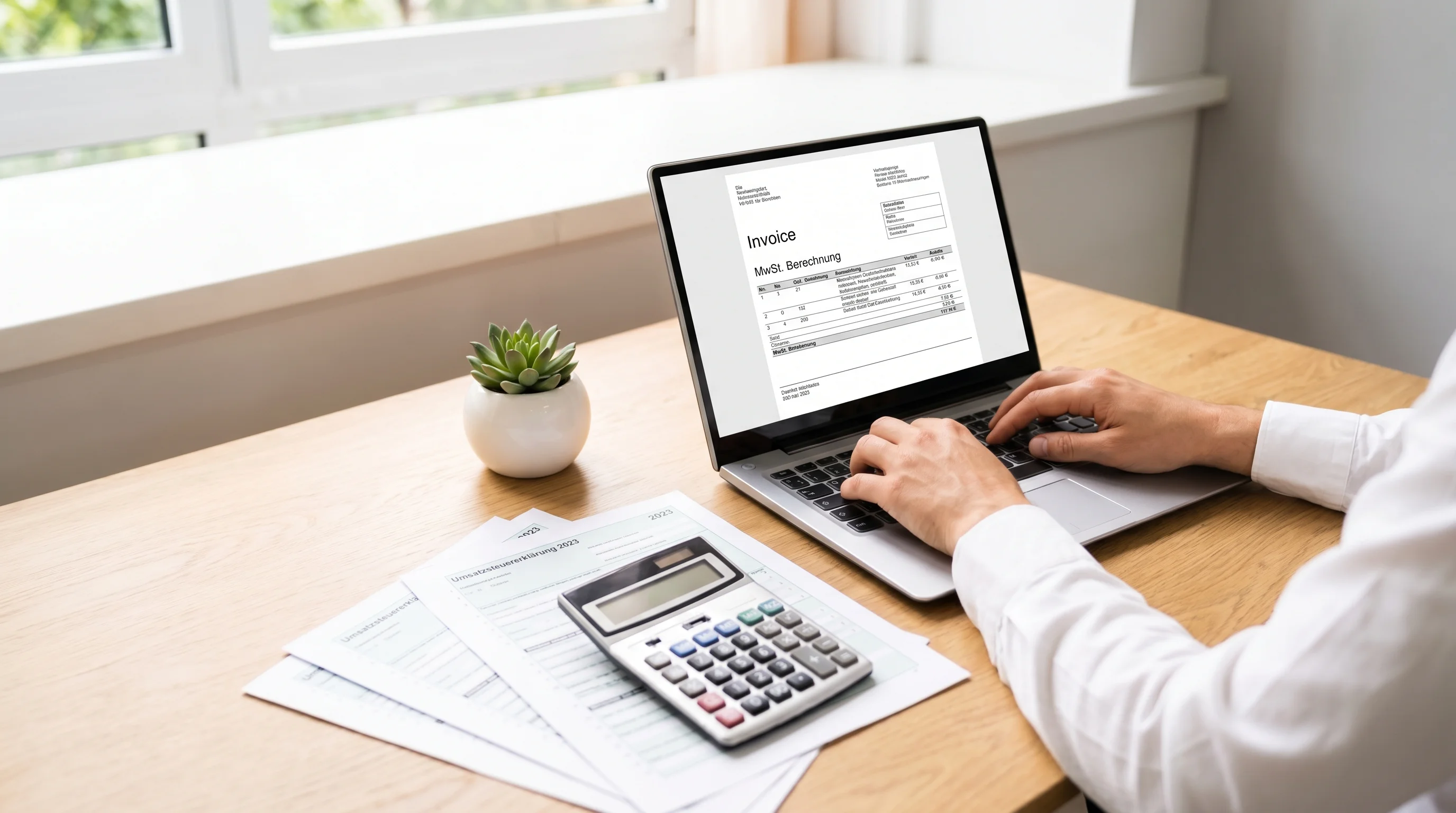
If you’ve freelanced in other countries before arriving in Germany, you probably have a template you’ve been using for years. Maybe a clean spreadsheet, a Canva design, or a PDF you export from your project management tool. It has your name, the amount, a description. Job done.
Remote Work Europe verifies regulatory figures like these against primary sources from national tax authorities and EU directives before publishing.
In Germany, that invoice is almost certainly invalid.
German invoice law is codified in Section 14 of the Umsatzsteuergesetz (UStG) – the VAT Act – and it is remarkably specific about what a compliant invoice must contain. It’s not guidance. It’s not best practice. It’s law. An invoice missing any mandatory element is not merely sloppy – it’s legally deficient. Your client cannot use it to reclaim input VAT (Vorsteuerabzug), and you could face penalties from the Finanzamt.
For international freelancers setting up in Germany, this is one of the first practical hurdles – and one of the most common sources of expensive mistakes.
The mandatory fields under UStG §14
Every invoice you issue from Germany must include all of the following:
1. Your full name and address
Your complete legal name (or business name) and the full address as registered with the Finanzamt. A PO box is not sufficient – it must be your registered business address.
2. Your client’s full name and address
The complete legal name and address of the recipient of your services. For companies, this means the registered company name, not a contact person’s name (though you can add the contact person additionally).
3. Your tax identification number
Either your Steuernummer (tax number, issued by your local Finanzamt) or your USt-IdNr (Umsatzsteuer-Identifikationsnummer – EU VAT identification number, starting with “DE”). You must include at least one. If you have both, either is acceptable.
For B2B invoices within the EU, the USt-IdNr is preferred because it enables the reverse charge mechanism. For domestic invoices, the Steuernummer is standard.
4. The invoice date (Rechnungsdatum)
The date the invoice is issued. This must be a specific date, not a range.
5. A sequential invoice number (Rechnungsnummer)
Each invoice must have a unique number assigned from a continuous sequence. The Finanzamt requires that your numbering system allows them to verify that no invoices are missing from the sequence.
You have flexibility in the format – “2026-001”, “INV-0042”, “RWE-2026-03-001” are all fine. What matters is that:
- Every number is unique
- The sequence has no gaps (or any gaps can be explained)
- The system is consistent
Common mistake: restarting numbering when you switch software, leaving gaps that look suspicious during an audit.
6. Description of the service or goods (Leistungsbeschreibung)
A clear, specific description of what you provided. “Consulting” is not sufficient. “Content strategy consulting for Q1 2026 product launch, including competitor analysis, messaging framework, and editorial calendar – 40 hours” is.
The Finanzamt expects enough detail that a third party could understand what was delivered. For ongoing retainer work, reference the contract and specify the period covered.
7. The date or period of service delivery (Leistungszeitpunkt)
When the service was performed or when the goods were delivered. This can be a specific date or a period (e.g., “March 2026”). If the delivery date is the same as the invoice date, you must state this explicitly – “Leistungsdatum entspricht dem Rechnungsdatum” (delivery date equals invoice date).
8. Net amount (Nettobetrag)
The amount before VAT. If you’re invoicing for multiple items or services, each should be listed separately with its own net amount.
9. VAT rate and VAT amount
For most services, the standard rate is 19%. Some goods and services qualify for the reduced rate of 7% (books, food, certain cultural services). You must state both the applicable rate and the calculated VAT amount.
If different items on the same invoice attract different VAT rates, they must be listed separately with each rate clearly identified.
10. Gross amount (Bruttobetrag)
The total including VAT. For invoices with multiple VAT rates, show the subtotals and the overall total.
11. Payment terms
When and how payment is expected. While not strictly mandatory for VAT compliance, payment terms are standard practice and expected by the Finanzamt for bookkeeping purposes.
Special cases
Kleinunternehmerregelung (small business exemption)
If your annual turnover is below EUR 25,000 (raised from EUR 22,000 in 2025), you can opt for the Kleinunternehmerregelung under §19 UStG. This means you don’t charge VAT on your invoices. But you must include a specific reference on every invoice:
“Gemäß §19 UStG wird keine Umsatzsteuer berechnet.” (No VAT is charged pursuant to §19 UStG.)
Omitting this note on an invoice that doesn’t show VAT creates ambiguity that the Finanzamt dislikes. Include it on every invoice you issue under the exemption.
Reverse charge for EU B2B invoices
When invoicing a business client in another EU country, the reverse charge mechanism (§13b UStG) shifts the VAT obligation to the recipient. Your invoice must:
- Show no German VAT
- Include both your USt-IdNr and your client’s EU VAT number
- Include the note: “Steuerschuldnerschaft des Leistungsempfängers” (reverse charge – VAT liability transferred to recipient)
This is the same principle used across the EU – if you’ve freelanced in Spain, the Spanish sistema de inversión del sujeto pasivo works identically. The key difference in Germany is that the Finanzamt is more likely to audit your compliance with the formal requirements.
Invoices to non-EU clients
Services provided to business clients outside the EU are generally not subject to German VAT (§3a UStG – place of supply rules). Your invoice should include:
- No VAT amount
- A note such as: “Nicht steuerbare Leistung gemäß §3a UStG” (service not subject to VAT under §3a UStG)
- The client’s full business details
Kleinbetragsrechnungen (small invoices)
For invoices under EUR 250 (gross), simplified requirements apply under §33 UStDV. You only need:
- Your name and address
- Invoice date
- Description of service/goods
- Gross amount including VAT
- The applicable VAT rate
This is useful for small incidental charges but shouldn’t be your default approach for regular client work.
Record retention: the 10-year rule
Under §14b UStG, you must retain copies of all invoices – both issued and received – for 10 full calendar years from the end of the year in which the invoice was issued. An invoice dated March 2026 must be retained until at least 31 December 2036.
Digital copies are acceptable, but they must be stored in a format that prevents modification (PDF, not editable Word documents). The GoBD (Grundsätze zur ordnungsmäßigen Führung und Aufbewahrung von Büchern) standards require that digital records are:
- Unalterable once saved
- Accessible and readable for the entire retention period
- Organised systematically
In practice, using proper invoicing software handles this automatically. If you’re running your own filing system, make sure your backup strategy covers the 10-year window.
Invoicing software recommendations
Manual invoicing in Germany is technically possible but practically foolish. The mandatory fields, sequential numbering, VAT calculations, and retention requirements are far too easy to get wrong. German invoicing software handles compliance automatically.
Lexoffice
The most popular choice for German freelancers and Kleinunternehmer. Cloud-based, integrates with ELSTER (the Finanzamt’s electronic tax filing system), and produces GoBD-compliant invoices out of the box. Plans start around EUR 7.90/month.
SevDesk
Strong on automation – bank account integration, automatic receipt capture, and direct Steuerberater access. Popular with freelancers who want to minimise bookkeeping time. From EUR 8.90/month.
FastBill
Focused specifically on freelancers and small businesses. Clean interface, good invoice templates, and expense tracking. From EUR 8.99/month.
Billomat
Good for freelancers working with international clients – supports multiple currencies and languages while maintaining German compliance. From EUR 8/month.
All four produce invoices with the correct mandatory fields, handle sequential numbering, manage VAT calculations, and store records in GoBD-compliant formats. The choice between them is largely about interface preference and which integrations matter to you.
Common mistakes international freelancers make
-
Using a foreign invoice template – your Freshbooks or Wave template from the UK or US almost certainly doesn’t include all mandatory German fields. Switch to a German tool.
-
Missing the Steuernummer or USt-IdNr – this is the single most common error. Without it, the invoice is invalid for VAT purposes. Your client’s Steuerberater will reject it.
-
Vague service descriptions – “Design work – March” won’t survive a Finanzamt audit. Be specific about what you delivered and when.
-
Gaps in invoice numbering – using different numbering systems for different clients, or resetting numbering when switching software, creates audit red flags.
-
Not referencing the Kleinunternehmer exemption – if you don’t charge VAT, you must say why. Every time.
-
Forgetting the service delivery date – even when it matches the invoice date, you must state it explicitly.
-
Issuing invoices in a foreign language only – while there’s no strict legal requirement for invoices to be in German, the Finanzamt can request German translations of all business documents. Issuing bilingual invoices (German/English) avoids problems.
Cross-border comparison: Germany vs. Spain
If you’ve freelanced as an autónomo in Spain, some comparisons help orient you:
| Requirement | Germany | Spain |
|---|---|---|
| Tax number on invoice | Steuernummer or USt-IdNr | NIF or NIF-IVA |
| Standard VAT rate | 19% | 21% |
| Small business exemption | Kleinunternehmer (EUR 25,000) | Recargo de equivalencia (retail only) |
| EU reverse charge | §13b UStG | Inversión del sujeto pasivo |
| Record retention | 10 years | 4 years (general), 6 years (commercial) |
| Electronic invoicing mandate | Coming (B2B from 2027) | VeriFACTU from 2026 |
| Sequential numbering | Mandatory, no gaps | Mandatory, series allowed |
The biggest adjustment for Spain-to-Germany movers is the retention period – 10 years is significantly longer – and the stricter enforcement of formal requirements. Spain’s Hacienda cares about the numbers; Germany’s Finanzamt cares about the numbers and the format.
Bottom line on German invoice requirements
German invoice requirements are strict, specific, and enforced. This isn’t bureaucracy for its own sake – it’s a system designed to ensure VAT compliance across one of Europe’s largest economies. As a freelancer, you’re part of that system.
The good news is that compliance is straightforward once you’re set up correctly. Choose a German invoicing tool, configure it with your tax details, and let it handle the mandatory fields, numbering, and VAT calculations. The cost – under EUR 10/month – is trivial compared to the penalties for non-compliance or the embarrassment of sending invalid invoices to German clients.
Get your invoicing right from day one. It’s one of those tasks that takes 30 minutes to set up and saves you from years of problems.
This article is for general information only and does not constitute tax or legal advice. VAT rules, thresholds, and requirements are subject to change. Consult a qualified German Steuerberater for advice specific to your situation.
Related reading from this series: Remote bookkeeping in Spain (autonomo and employed routes) · Remote HR and people ops jobs in Europe
Frequently asked questions
Can I issue invoices in English to German clients?
There’s no strict legal prohibition, but the Finanzamt can request German translations of all business records. Issuing bilingual invoices (German/English) is the safest approach and is standard practice for international freelancers in Germany.
What happens if I issue an invoice with missing mandatory fields?
The invoice is not legally valid for VAT purposes. Your client cannot use it to reclaim input VAT (Vorsteuerabzug), and you may need to issue a corrected invoice. Repeated non-compliance can trigger a Finanzamt audit and potential penalties.
Do I need to charge VAT as a Kleinunternehmer?
No – the Kleinunternehmerregelung (§19 UStG) exempts you from charging VAT if your annual turnover is below EUR 25,000. However, you must include a specific statement on every invoice explaining why no VAT is charged. You also cannot reclaim input VAT on your own business expenses.
How strict is the sequential numbering requirement?
The Finanzamt expects continuous, gap-free numbering. If an invoice number is missing from the sequence, they will ask why. Voided invoices should be retained (marked as cancelled) rather than deleted, so the numbering remains unbroken. Using invoicing software manages this automatically.
When is electronic invoicing becoming mandatory in Germany?
Germany is introducing mandatory B2B electronic invoicing (E-Rechnung) from January 2027, with a transition period. This will require structured data formats (XRechnung or ZUGFeRD), not just PDF invoices sent by email. Invoicing software providers are already preparing for the transition.