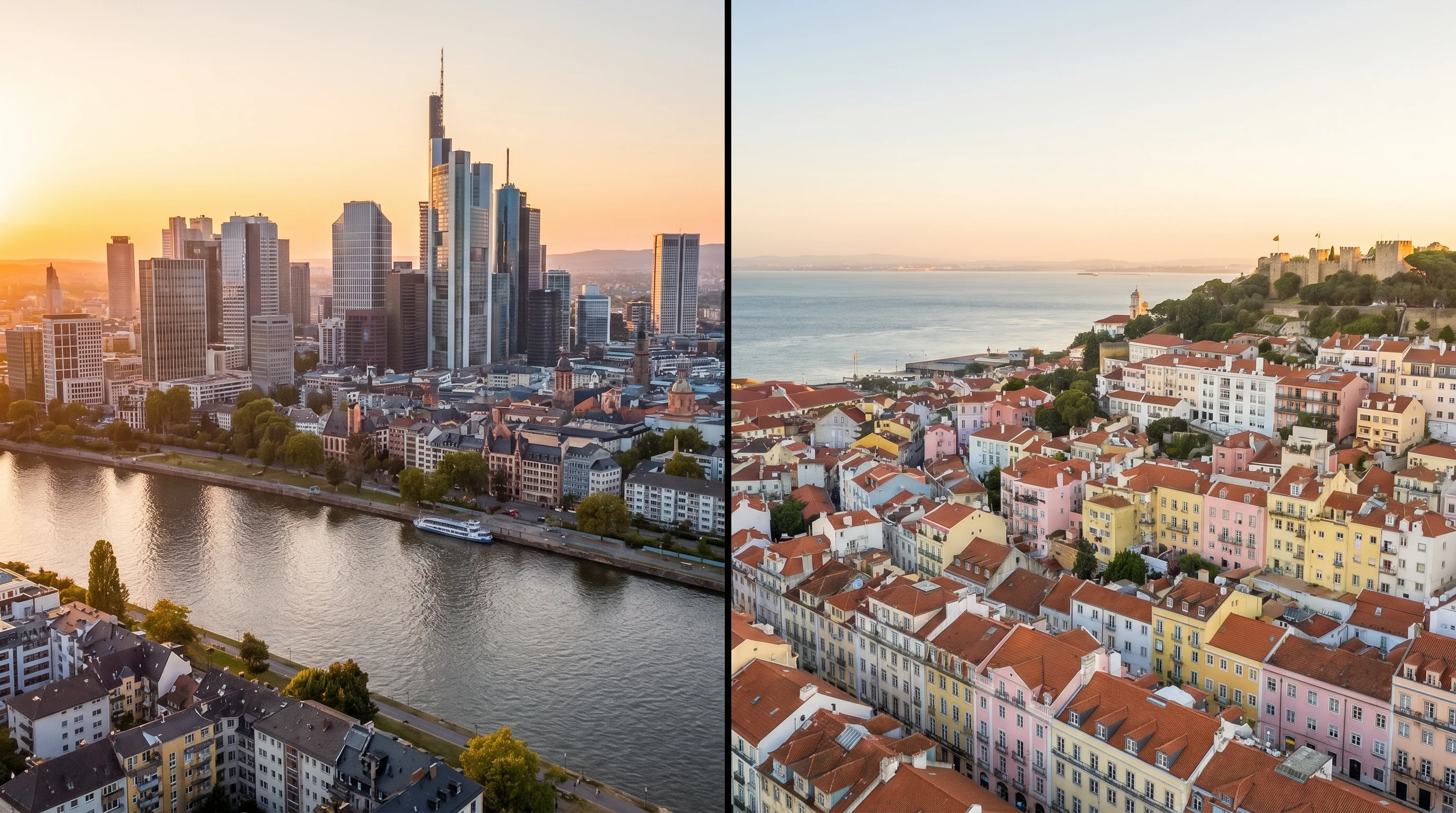
TL;DR: Germany’s April 2026 Visa Handbook includes – for the first time – a chapter on a forthcoming Remote Work Visa with a minimum income threshold of EUR 1,200/month. The full permit has not launched yet, but consulates now have interim guidance. Current options remain the freelance visa (Section 21 AufenthG) for self-employed workers and the EU Blue Card for highly qualified employees. The dedicated remote work permit is expected later in 2026.
Germany has never made it easy for remote workers. While countries like Spain, Portugal, and Croatia rolled out dedicated digital nomad visas years ago, Europe’s largest economy has kept remote workers in a grey area – forced to shoehorn themselves into visa categories that were never designed for location-independent work.
That may finally be changing.
On 8 April 2026, Germany’s Federal Foreign Office released the latest edition of its 680-page Visa Handbook – and for the first time, it contains a full chapter outlining criteria for a forthcoming Remote Work Visa. The permit itself hasn’t launched yet, but the handbook gives consular officers an interim framework and, more importantly, signals a clear direction of travel.
Here’s what we know, what it means for remote workers eyeing Germany, and how it stacks up against the alternatives.
What the April 2026 Visa Handbook actually says
The new chapter in the Visa Handbook sets out income, insurance, and tax-compliance benchmarks for third-country nationals who want to live in Germany while working remotely for foreign employers. This is significant because it represents the first time the German government has formally acknowledged remote work as a distinct category deserving its own immigration pathway.
The key points from the handbook include:
- Income threshold: A minimum of EUR 1,200 per month in demonstrable income
- Health insurance: German-compliant health insurance is mandatory
- Address requirement: Applicants must provide a registered German address
- Tax compliance: Clear benchmarks for tax obligations while resident in Germany
While the full remote work permit won’t launch until later in 2026, the handbook gives consular officers an interim framework. Digital nomads from visa-waiver countries can use Section 19c residence permits as a bridge, provided they meet the criteria above.
This matters because it removes much of the ambiguity that has plagued remote workers in Germany for years. Previously, consular officers had no specific guidance on how to handle applications from people whose work didn’t fit neatly into existing categories.
The current options: how remote workers get into Germany today
Until the dedicated permit arrives, remote workers still need to navigate Germany’s existing visa landscape. None of these routes were designed with digital nomads in mind, but each can work in the right circumstances.
The freelance visa (Section 21 AufenthG)
Germany’s freelance visa has been the go-to option for self-employed remote workers. It comes in two flavours:
Section 21(5) – Liberal professions (Freiberufler)
This is the more accessible route for knowledge workers. Qualifying professions include IT consultants, engineers, architects, translators, writers, journalists, teachers, and artists. The requirements are relatively straightforward – you need proof of sufficient funds, relevant qualifications, and any licences required for your profession.
The initial permit is issued for up to three years and can be extended if your business is viable and you can cover your living costs.
Section 21(1) – Commercial self-employment (Gewerbe)
If your activity doesn’t qualify as a liberal profession, you’ll need to demonstrate that your business serves an economic interest or regional demand, will have a positive effect on the economy, and can be financed through your own capital or a loan commitment. This is a higher bar, and the classification is ultimately determined by your local Finanzamt (tax office).
The distinction between Freiberufler and Gewerbe is critical and often catches newcomers off guard. Get it wrong, and you may find yourself needing to reapply under a different category entirely.
Key limitation: If you’re over 45, you must provide proof of adequate old-age pension provision – an additional hurdle that other countries don’t impose.
EU Blue Card
The Blue Card is Germany’s flagship route for highly skilled employees, but it requires a concrete job offer from a German employer with a salary above a set threshold (currently EUR 43,800 for shortage occupations, EUR 56,400 for standard roles). Remote workers employed by foreign companies generally don’t qualify unless their employer has a German entity.
ICT permits and corporate transfers
For employees of multinational companies, the Intra-Corporate Transfer (ICT) permit or a Section 19c permit can facilitate a move to Germany. These require employer sponsorship and a formal assignment, so they’re not useful for independent remote workers.
How the new remote work visa compares to other European DNVs
Germany is late to the digital nomad visa party, but its approach reflects its characteristically thorough regulatory style. Here’s how the incoming permit compares to what’s already available elsewhere in Europe.
| Feature | Germany (incoming) | Spain DNV | Portugal DNV | Croatia DNV | Estonia DNV |
|---|---|---|---|---|---|
| Income requirement | EUR 1,200/month | EUR 2,646/month (approx.) | EUR 3,510/month | EUR 2,539/month | EUR 3,504/month |
| Health insurance | German-compliant required | EUR 30,000+ coverage | Required | Required | Required |
| Duration | TBC (likely 1–3 years) | Up to 5 years | 1 year (renewable) | 1 year (renewable) | Up to 1 year |
| Tax residency | Likely full German tax rates | Beckham Law option (24%) | NHR ended; standard rates | Local rates apply | No local tax on foreign income |
| Self-employed eligible | TBC | Yes | Yes | Yes | Yes |
| Path to permanent residency | Likely yes | Yes | Yes | No | No |
Germany’s income threshold of EUR 1,200 per month stands out as remarkably low compared to competitors. Spain requires more than double, and Portugal nearly triple. If this threshold holds when the full permit launches, Germany could become one of the most accessible DNV destinations in Europe – at least on paper.
The trade-off, as always with Germany, will be bureaucracy. The registration requirements, tax obligations, and health insurance compliance will almost certainly be more demanding than in countries that have designed their DNV programmes to be as frictionless as possible.
What about tax?
This is where Germany gets complicated – and where many remote workers stumble.
Germany applies worldwide taxation to its tax residents. If you hold a German residence permit and live in Germany for more than 183 days in a calendar year, you’re likely to be considered a tax resident. That means your global income – not just what you earn from German clients – could be subject to German income tax.
German income tax rates are progressive, ranging from 14% to 45%, plus solidarity surcharge. There is no equivalent of Spain’s Beckham Law offering a flat rate for new arrivals.
For employed remote workers, the interaction between German tax obligations and your employer’s home country tax system can create complex dual-taxation situations. Germany has double taxation agreements with most major economies, but navigating them typically requires professional advice.
For freelancers, you’ll also need to deal with trade tax (Gewerbesteuer) if classified as Gewerbe, VAT registration and compliance, quarterly advance tax payments, and annual tax returns in German.
None of this is insurmountable, but it’s a far cry from the streamlined tax regimes offered by some competing DNV programmes.
The interim framework: what to do right now
If you’re planning a move to Germany and can’t wait for the dedicated permit, here’s the practical roadmap:
-
Check your visa-waiver status. Citizens of visa-waiver countries (including the US, UK, Canada, Australia, and Japan) can enter Germany visa-free for 90 days and apply for a residence permit from within the country.
-
Determine your classification. Are you a Freiberufler or Gewerbe? This affects which permit route you take and your tax obligations. Research this before you arrive.
-
Secure German-compliant health insurance. This means either public health insurance (if you’re employed with earnings below the opt-out threshold) or private insurance that meets German standards. Travel insurance and nomad-specific policies like SafetyWing typically won’t qualify.
-
Register your address. You must register at your local Buergeramt within 14 days of moving into accommodation. This is a prerequisite for almost everything else.
-
Book an appointment at the Auslaenderbehörde. Germany’s foreigners’ offices are notoriously backlogged. Book your appointment as soon as you can – in Berlin, waits of 8-12 weeks are not unusual.
-
Get tax advice. Seriously. German tax compliance is not something to wing. A Steuerberater (tax advisor) who understands international remote work situations is worth every euro.
What this means for the remote work landscape
Germany’s move towards a dedicated remote work permit is significant not just for those who want to live there, but for the broader European remote work ecosystem. When the EU’s largest economy formally recognises remote work as a legitimate immigration category, it sends a signal to other countries that are still on the fence.
It also reflects a practical reality: Germany is facing acute labour shortages across many sectors, and its population is ageing rapidly. Attracting skilled remote workers – even those who aren’t employed by German companies – brings talent, spending power, and tax revenue into the country.
The EUR 1,200 monthly income threshold, if it holds, suggests Germany is casting a deliberately wide net. This isn’t about attracting only high-earners; it’s about recognising that remote workers at various income levels contribute to local economies through rent, consumption, and integration.
Frequently asked questions
Does Germany have a digital nomad visa? Not yet. The April 2026 Visa Handbook outlines criteria for a forthcoming Remote Work Visa, but the permit itself hasn’t launched. In the meantime, remote workers can use the freelance visa (Section 21) or the interim Section 19c framework.
What income do I need for the German remote work visa? The handbook specifies EUR 1,200 per month as the minimum. This is significantly lower than most European digital nomad visas.
Can I work remotely in Germany on a tourist visa? No. Working remotely – even for a foreign employer – while on a tourist entry or Schengen short-stay is not legally permitted. You need a residence permit that authorises work.
Do I need to speak German? There’s no formal language requirement for the remote work visa or freelance visa. However, dealing with German bureaucracy, tax authorities, and daily life is significantly easier with at least basic German. Many official forms and processes are only available in German.
How does Germany’s remote work visa compare to Spain’s? Germany’s incoming permit has a lower income requirement but will likely involve higher tax rates and more complex bureaucracy. Spain’s digital nomad visa offers access to the Beckham Law (24% flat tax for employees), a longer initial duration (up to 5 years), and a more established application process.
Can I get permanent residency through the remote work visa? This hasn’t been confirmed for the incoming permit, but Germany generally offers a path to permanent residency (Niederlassungserlaubnis) after five years of legal residence, provided you meet integration and financial requirements.
The bottom line
Germany’s Visa Handbook update is a meaningful step forward, but it’s still a step – not the destination. The dedicated Remote Work Visa hasn’t launched yet, and the details around tax treatment, permit duration, and the application process remain to be finalised.
For remote workers who are specifically drawn to Germany – for its cities, its culture, its central European location, or its robust infrastructure – the direction of travel is encouraging. The interim framework via Section 19c provides a workable bridge, and the low income threshold suggests the final permit will be genuinely accessible.
For those who simply want the easiest path to legal remote work in Europe, countries with established DNV programmes – Spain, Portugal, Croatia – still offer a smoother experience today. Germany will catch up, but on its own timeline and with its own characteristically thorough approach.
Watch this space. When the full permit launches later in 2026, we’ll have the complete picture.