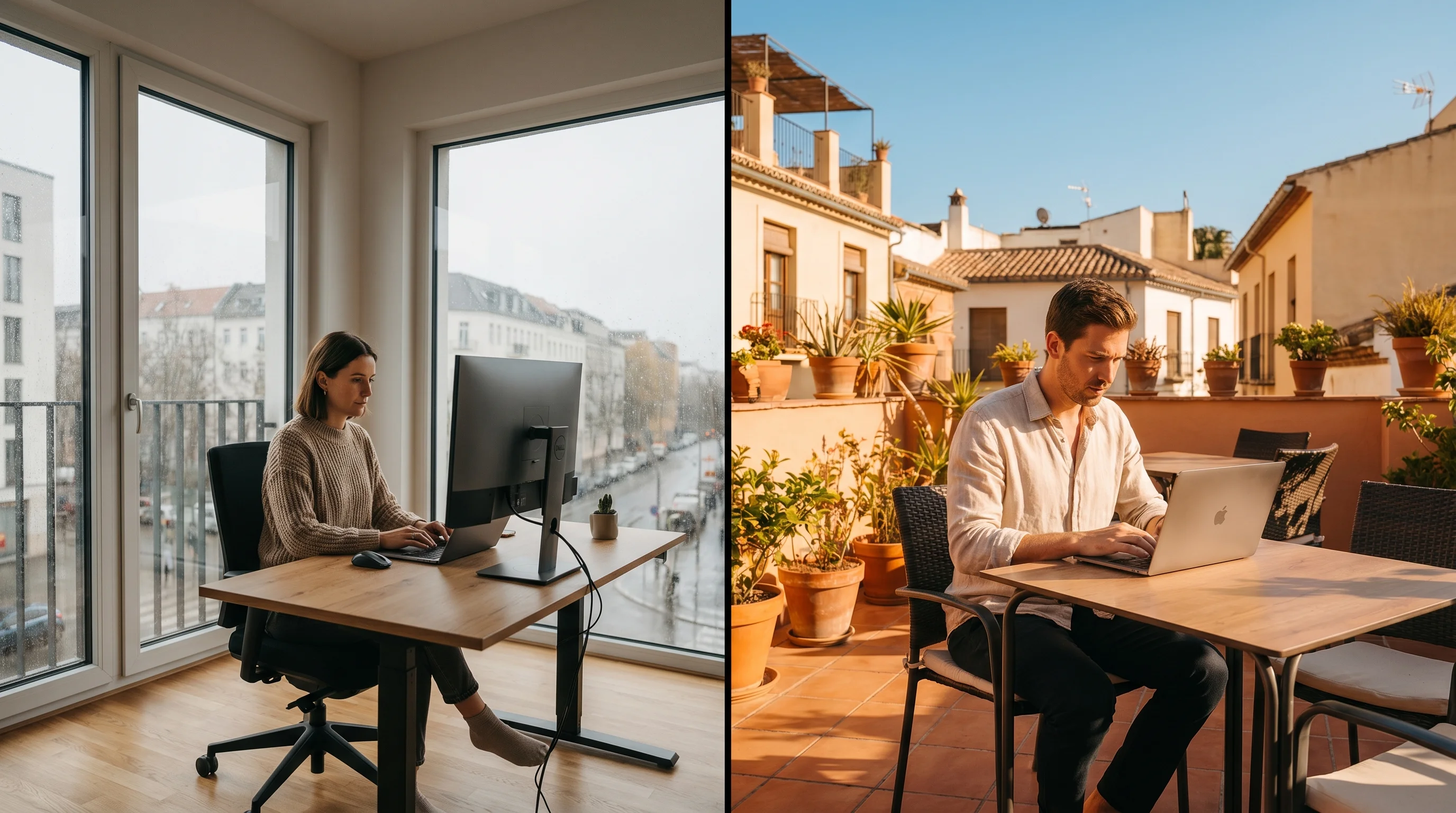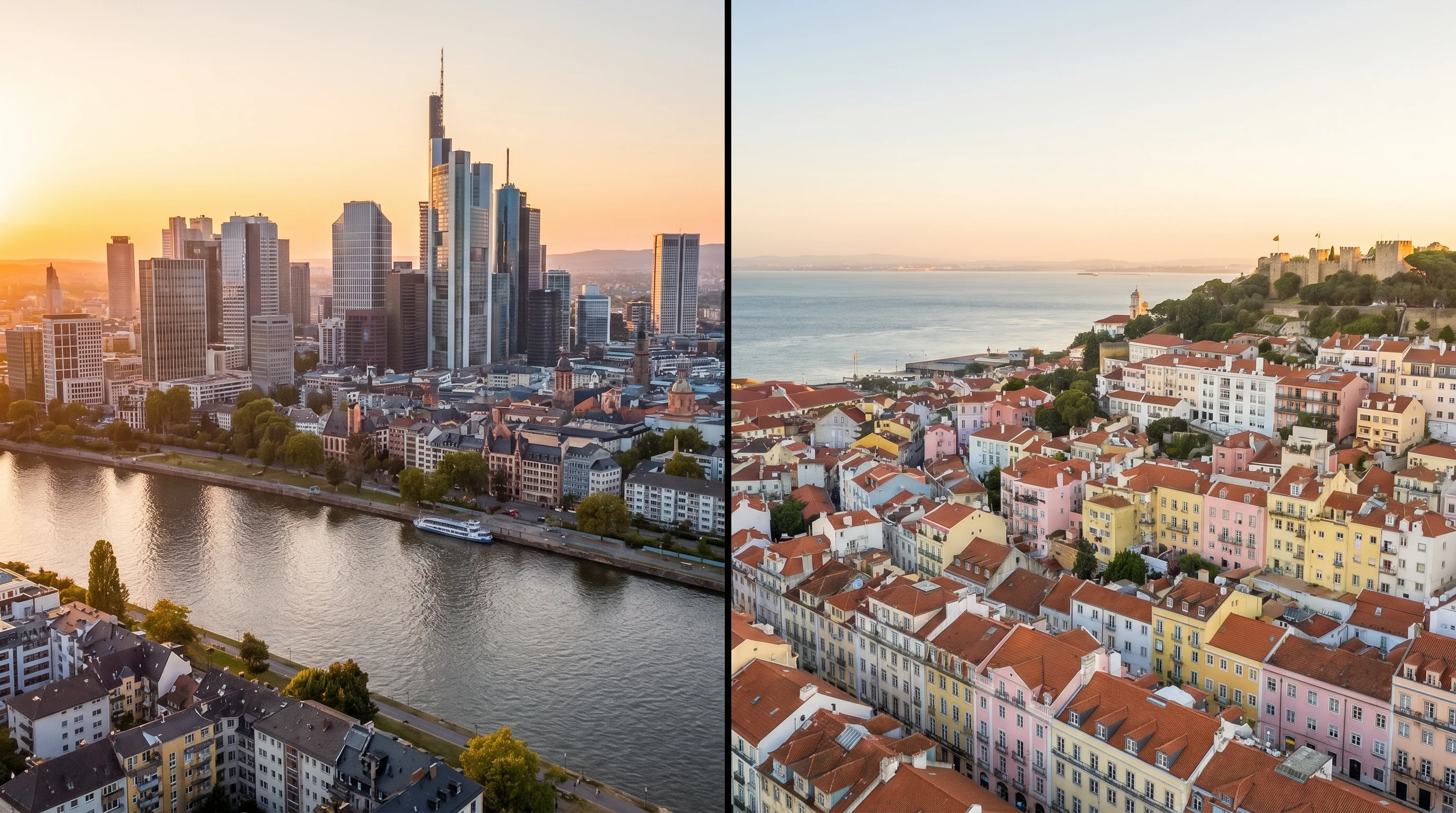
TL;DR: Germany and Portugal appeal to very different remote worker profiles. Portugal offers lower taxes (especially for those who qualify for the IFICI regime – though eligibility is narrow), the D8 digital nomad visa, and a lower cost of living – but infrastructure outside Lisbon and Porto can be patchy. Germany has no digital nomad visa and charges significantly more in health insurance and tax, but delivers rock-solid infrastructure and access to Europe’s largest economy. At EUR 100K income, you could pay 25–30% effective tax in Portugal (under IFICI) versus 40–48% in Germany. Without IFICI, Portugal’s standard progressive rates (up to 48%) are comparable to Germany’s.
The Two-Speed Choice
Germany and Portugal sit at opposite ends of the European remote work spectrum. One is northern, structured, expensive, and efficient. The other is southern, flexible, affordable, and increasingly popular with the international remote work community.
Both are legitimate long-term bases for remote workers. The question isn’t which is better – it’s which is better for you.
Tax: A Significant Gap
This is the category where Portugal has the clearest advantage, particularly for higher earners.
Germany
Germany’s progressive income tax system runs from 14% to 45%, with the top rate applying above approximately EUR 278,000. For a remote worker earning EUR 100,000, the effective income tax rate lands around 33–36%, before adding the solidarity surcharge (5.5% of your income tax) and church tax if applicable.
Factor in mandatory health insurance contributions (up to approximately EUR 1,250/month for public insurance at maximum income, including long-term care) and the total tax-plus-contributions burden reaches 40–48% of gross income for most freelancers.
Germany offers no special tax regime for incoming remote workers or digital nomads.
Portugal
Portugal’s standard income tax rates are progressive from 14.5% to 48%, which looks similar to Germany on paper. The difference lies in the IFICI regime – Portugal’s successor to the old NHR (Non-Habitual Resident) programme.
IFICI (Incentivo Fiscal à Investigação Científica e Inovação), which replaced NHR from January 2024, offers a 20% flat rate on qualifying Portuguese-source employment and self-employment income for up to 10 years. Foreign-source income from certain categories may be exempt entirely.
For a remote worker earning EUR 100,000, the effective rate under IFICI can drop to roughly 25–30% including social contributions – a substantial saving compared to Germany.
The catch: IFICI has significantly stricter eligibility requirements than the old NHR. You must not have been a Portuguese tax resident in the previous five years, and you need to be engaged in certified qualifying activities – specifically in scientific research, technology, healthcare, renewable energy, or roles within certified startups and export companies. General freelancers and remote workers who don’t work for a qualifying Portuguese entity are unlikely to be eligible. It’s essential to confirm eligibility with a Portuguese tax advisor before building your plans around it.
Visas: D8 vs Nothing
Portugal’s D8 Visa
Portugal’s D8 visa – officially the visa for remote workers and digital nomads – launched as part of the country’s 2022 digital nomad legislation. It allows non-EU nationals to live in Portugal while working remotely for a foreign employer or as a freelancer.
The income threshold is EUR 3,680/month (four times Portugal’s minimum wage as of 2026). You’ll need to demonstrate this income level consistently, provide proof of accommodation, and show health insurance coverage.
The D8 residency visa grants a four-month entry visa, after which you apply for a two-year residence permit, renewable for three-year periods. After five years, you can apply for permanent residency. It’s a genuine pathway to long-term settlement.
We’ve covered the common mistakes applicants make in our Portugal D8 visa guide.
Germany: No Digital Nomad Visa
Germany doesn’t offer a digital nomad visa and has signalled no plans to create one. If you want to freelance in Germany, your main option is the Freiberufler visa for liberal professions, which requires demonstrating professional qualifications, client relationships, and adequate income.
The Chancenkarte (Opportunity Card), launched in June 2024, uses a points system based on qualifications, language skills, and professional experience – but it’s designed for jobseekers, not established remote workers.
For employed remote workers, the EU Blue Card offers a path, but requires a local employment contract with a German company and a minimum salary threshold.
See our guide to Germany’s freelance visa options for the full breakdown.
Healthcare: Coverage vs Cost
Germany
German healthcare is comprehensive and expensive. The public system (GKV) provides universal coverage with no meaningful gaps, but freelancers pay the full contribution – roughly EUR 1,000–1,250/month (health plus long-term care insurance at the 2026 contribution ceiling) – because there’s no employer to share the cost. Private insurance (PKV) starts cheaper for young, healthy individuals but rises with age and becomes essentially irreversible after a certain point.
The quality of care is excellent. Wait times for specialists are generally reasonable, hospitals are well-equipped, and the system works in English in major cities.
Portugal
Portugal’s public health system (SNS) is available to legal residents, including D8 visa holders. Quality is good in Lisbon and Porto but can be variable in rural areas. Wait times for specialists and non-urgent procedures can be long – sometimes months.
Social security contributions for self-employed workers in Portugal run around EUR 200–350/month depending on income, and these include healthcare access.
Most expats supplement with private insurance at EUR 50–150/month, giving them access to the private hospital network (which is generally excellent in Portugal’s main cities).
Total healthcare costs in Portugal typically run EUR 250–500/month versus EUR 1,000–1,250 in Germany for self-employed workers – a meaningful difference that adds up quickly.
Cost of Living: The Gap is Real
Portugal is significantly cheaper than Germany for most day-to-day expenses, though Lisbon has been catching up fast.
| Category | Germany | Portugal |
|---|---|---|
| Monthly total (single, city) | EUR 2,000–3,000 | EUR 1,500–2,500 |
| Rent (1-bed, city centre) | EUR 800–1,400 | EUR 700–1,200 |
| Rent (1-bed, outside centre) | EUR 550–900 | EUR 500–800 |
| Groceries (monthly) | EUR 300–400 | EUR 200–300 |
| Coworking (monthly) | EUR 200–350 | EUR 100–200 |
| Dining out (meal) | EUR 12–20 | EUR 8–15 |
| Public transport (monthly) | EUR 63 | EUR 30–50 |
A few notes on these numbers. Lisbon rents have risen dramatically since 2020 and are now comparable to many German cities outside Munich. Porto remains more affordable. Germany’s Deutschlandticket (EUR 63/month for all regional transport) is excellent value.
The real savings in Portugal come from food – both groceries and eating out – and from the generally lower service costs (cleaning, repairs, personal services).
Infrastructure: Germany’s Strength
This is where Germany pulls ahead decisively.
Internet: Germany’s fibre rollout has accelerated in recent years, and major cities offer reliable high-speed connections. Portugal has good coverage in Lisbon and Porto but can be unreliable in smaller towns and rural areas.
Transport: Germany’s rail network, despite its reputation for delays, is comprehensive. The Deutschlandticket makes exploring the country incredibly affordable. Portugal’s rail network is limited – Lisbon to Porto is well-served, but many areas require a car.
Coworking: Both countries have strong coworking scenes in their major cities. Berlin probably has more coworking spaces per capita than any city in Europe. Lisbon’s scene is also mature and well-developed.
General reliability: German infrastructure – from postal services to utilities to public administration – works predictably. Portugal is improving rapidly but still has gaps, particularly outside the two main cities.
Community: Both Strong, Differently
Berlin
Berlin’s remote work and freelancer community is one of the largest and most established in Europe. The city attracts tech workers, creatives, and entrepreneurs from around the world. Meetups, coworking events, and professional networks are plentiful. The community skews younger and more tech-focused.
The city’s affordability (by German and northern European standards) and its cultural richness make it a magnet for creative freelancers. English is widely spoken in professional and social contexts.
Lisbon and Porto
Lisbon has become one of Europe’s top digital nomad destinations, with a large and active community of remote workers. The city offers a blend of historic charm, good weather, and a walkable lifestyle that’s hard to beat.
Porto’s community is smaller but growing, with a more authentic Portuguese feel and lower costs than Lisbon.
Both cities have strong networks of coworking spaces, regular meetups, and an established infrastructure for remote workers. The community tends to be more diverse in terms of professions – not as tech-dominated as Berlin.
Long-Term Residency Paths
Both countries offer pathways to permanent residency and eventually citizenship, but the timelines and requirements differ.
Germany
- Permanent residency (Niederlassungserlaubnis) after 5 years with a residence permit
- Requires B1 German language skills and financial stability
- Citizenship available after 5 years (reduced from 8 under 2024 reforms; the 3-year fast-track option was repealed in October 2025)
- Germany now allows dual citizenship (since June 2024)
Portugal
- Permanent residency after 5 years of legal residence
- D8 visa holders can follow this path
- Citizenship after 5 years of legal residence under current law – but Portugal’s parliament approved extending this to 10 years for most non-EU nationals (7 years for CPLP nationals) in April 2026. The new law awaits Presidential review and is not yet in force, but applicants should plan for the longer timeline.
- Portuguese language test required (A2 level)
- Dual citizenship allowed
- Portugal’s Golden Visa programme (investment-based) has been significantly restricted since 2023
Portugal’s path to EU citizenship has historically been a significant draw for non-EU nationals, though the proposed extension to 10 years would bring it closer to other European countries. Under the current 5-year rule, a D8 visa holder could theoretically become a Portuguese (and therefore EU) citizen within roughly 7–8 years (including processing times). Under the proposed 10-year rule, this would extend to 12+ years.
Climate and Lifestyle
Let’s be honest – for many remote workers, this is the real deciding factor.
Portugal offers 2,800+ hours of sunshine per year in Lisbon, mild winters (rarely below 8°C), and warm summers. The Algarve in the south is even sunnier. The food is excellent and affordable, the wine is world-class and cheap, and the pace of life is genuinely relaxed.
Germany offers distinct seasons, with cold winters (especially in the east and south) and pleasant summers. Berlin gets around 1,600 hours of sunshine annually – barely more than half of Lisbon’s total. The cultural offering is extraordinary – museums, music, theatre, nightlife – but the grey months from November to March can weigh heavily.
If climate matters to your productivity and wellbeing (and research consistently shows it does), this isn’t a trivial consideration.
Who Should Choose What?
Germany makes more sense if you:
- Want access to the DACH market and German-speaking clients
- Value infrastructure reliability above everything
- Are in an employed role with a German company (EU Blue Card)
- Prefer a structured, predictable system – even if it costs more
- Enjoy urban culture, seasons, and don’t mind grey winters
Portugal makes more sense if you:
- Qualify for the D8 visa and want a clear residency path
- Can benefit from the IFICI tax regime (20% flat rate)
- Prioritise cost of living and healthcare affordability
- Want a warmer climate and more relaxed lifestyle
- Are working remotely for non-local clients and don’t need the German market
The Bottom Line
At similar income levels, a remote worker in Portugal can save EUR 10,000–20,000 per year compared to Germany – through lower taxes (under IFICI), cheaper health insurance, and a lower cost of living. That’s not a rounding error.
Germany’s advantages are real but less quantifiable: better infrastructure, a more predictable system, and access to Europe’s largest economy. If your work depends on the German market or you value the structure of a northern European system, those intangibles may justify the premium.
For many remote workers – particularly freelancers working with international clients who don’t need a specific geographic base – Portugal’s combination of the D8 visa, favourable tax treatment, good weather, and lower costs is a compelling package.
If you’re also considering Spain as a third option, our Germany vs Spain comparison and Portugal vs Spain DNV comparison round out the picture. And if you end up going the freelance route in either Germany or Spain, Xolo can handle the accounting and compliance for a Spanish autonomo or Estonian OÜ structure.
FAQ
Can I move from Portugal to Germany (or vice versa) without losing tax benefits? If you leave Portugal before completing the 10-year IFICI period, you forfeit the remaining years of preferential tax treatment. There’s no way to pause and resume it. Moving from Germany to Portugal is simpler – Germany has no special regime to lose. In either case, you’ll need to formally deregister your tax residency and re-register in the new country.
Is the D8 visa income threshold per person or per household? The EUR 3,680/month threshold applies to the main applicant. Dependents (spouse, children) increase the requirement – by 50% for a spouse and 30% per child. So a family of four (two adults, two children) would need to demonstrate roughly EUR 7,728/month in income (EUR 3,680 + EUR 1,840 + EUR 1,104 + EUR 1,104).
Which country is easier for non-EU freelancers to enter? Portugal, clearly. The D8 visa is designed for remote workers and has a straightforward application process. Germany’s Freiberufler visa is more complex, less predictable (outcomes vary by city), and requires demonstrating ties to the German economy.
Do I need to speak the local language? In Portugal, English is widely spoken in Lisbon and Porto, and many administrative processes can be handled in English or with minimal Portuguese. In Germany, the administrative system operates almost entirely in German, though Berlin and Munich have more English-friendly services. For long-term residency and citizenship, both countries require language proficiency – A2 Portuguese or B1 German.
What about the Golden Visa – is that still an option in Portugal? Portugal’s Golden Visa programme was significantly restricted in 2023. Real estate investment is no longer eligible. Investment fund routes still exist but require minimum EUR 500,000 commitments. For most remote workers, the D8 visa is a more practical and affordable path.