TL;DR
- Montenegro’s digital nomad residence scheme is embedded in the 2025-2026 ‘Europe Now 2’ economic programme and is politically framed as running through the end of 2026; as of mid-2026 there is no published government decision either formally extending it or abolishing it for the period beyond.
- The scheme is designed so that digital nomads whose income is treated as foreign-source and who are not classified as Montenegrin tax residents do not pay Montenegrin personal income tax on that income; however, individual tax treatment depends on residence and source-of-income rules and there is no blanket statutory exemption.
- The visa is open to non-Montenegrin nationals (including non-EU nationals) working remotely for employers or clients located outside Montenegro, subject to standard documentary and income requirements. It does not permit local employment for Montenegrin entities.
- Montenegro uses the euro despite not being an EU member state (the country unilaterally euroised), and the cost of living sits well below Western European averages – Podgorica, Tivat, and the Bay of Kotor are the main bases.
- Montenegro is a formal EU candidate state in active accession negotiations, currently described as the most advanced Western Balkan candidate. The long-term tax position for foreign residents will eventually shift as the accession process progresses, but the current visa terms hold for now.
Montenegro has been building one of Europe’s most attractive digital nomad programmes since 2022, and if you have been thinking about making the move, the clock may be ticking. The Montenegrin government originally set the programme to run until the end of 2026, and there is no official confirmation yet that it will be renewed.
Remote Work Europe verifies regulatory figures like these against primary sources from national tax authorities and EU directives before publishing.
That does not mean it is disappearing tomorrow. But it does mean that if a tax-exempt base on the Adriatic coastline appeals to you, now is the time to understand what is on offer, and act on it.
Why Montenegro appeals to remote workers
Montenegro packs a remarkable amount into a country roughly the size of Northern Ireland. You get dramatic Adriatic coastline, UNESCO-listed old towns, mountain hiking that rivals the Alps, and a cost of living significantly below western European averages – all without the crowds that have transformed parts of neighbouring Croatia.
When I visited a pop-up co-living in Tivat in 2025, the contrast was striking. The coast itself – the same Adriatic, mountains rising straight from the water, beaches that would not look out of place in Puglia or the Marches – could just as easily have been Italian. But the demographic composition of who was actually there was clearly different from anywhere you would find inside Schengen. International migration was visibly reshaping the place, in ways the Schengen constraints do not permit on the other side of the same sea. And there was real wealth and investment flowing in – capital that Europe, as a bloc, is not capturing any of.
The country uses the euro (despite not being in the EU), which simplifies finances for anyone earning in euros. English is widely spoken in coastal and urban areas. And the food – fresh seafood, grilled meats, local wine – is both excellent and affordable. A main meal with wine in Podgorica can cost as little as five or six euros.
For remote workers specifically, the appeal goes beyond lifestyle. Montenegro’s digital nomad visa comes with a genuine tax exemption that sets it apart from many competing programmes across Europe.
The tax exemption – and why it matters
Under Article 32d of Montenegro’s Law on Personal Income Tax, digital nomad visa holders are exempt from paying personal income tax on foreign-sourced income. Social security contributions are also not applicable under recent changes to the law.
This is not a vague grey area – it is a codified exemption. As long as you are working for an employer or clients not registered in Montenegro, your income is not taxed locally.
There is one important caveat. If you spend more than 183 days in Montenegro within a calendar year, you may be considered a tax resident – which could expose your worldwide income to Montenegrin taxation. This is a common threshold across Europe, but it is worth planning around carefully. As always, get professional tax advice specific to your circumstances and your home country’s rules on foreign-sourced income and social security.
Requirements for the digital nomad visa
Montenegro’s programme is relatively straightforward compared to some European alternatives. Here is what you will need:
| Requirement | Details |
|---|---|
| Valid passport | With sufficient remaining validity (at least 6 months recommended) |
| Proof of remote work | Employment contract or evidence of freelance/self-employed work for clients outside Montenegro |
| Minimum income | At least three times the Montenegrin minimum wage – approximately EUR 1,800–2,400/month depending on education level |
| Health insurance | Valid for two years, covering Montenegro |
| Accommodation proof | Rental agreement or proof of address in Montenegro |
| Clean criminal record | From your home country, apostilled and translated |
| Passport photos | Meeting official requirements |
| Application fee | EUR 42–67 depending on location, plus EUR 25 for resident card registration |
The income requirements are notably lower than many competing European programmes. Croatia, for comparison, asks for approximately EUR 3,622.50 per month – nearly double what Montenegro requires.
How to apply
Montenegro’s digital nomad visa is not applied for at an embassy before you travel. Instead, you enter the country on a standard visa-free or visa stay, then apply in person at your local Ministry of Internal Affairs office before that initial stay expires.
Step-by-step process:
- Enter Montenegro – most nationalities get 90 days visa-free within a 180-day period
- Secure accommodation – sign a rental agreement and register your address
- Gather documents – have your criminal record check, health insurance, and income proof ready (translated and apostilled where necessary)
- Visit the local MIA office – submit your application and provide biometric data (photo and fingerprints)
- Wait for processing – decisions take approximately 40 days; you may remain in the country while your application is being processed, even if your initial visa-free period expires
- Receive your residence permit – valid for up to two years, renewable for the same period
Total processing time from start to finish is approximately two months. Budget for document translation and notarisation costs on top of the application fee – these vary but are generally modest.
The sunsetting question – should you worry?
This is the elephant in the room. Montenegro’s digital nomad programme was announced with an end date of 2026. As of March 2026, the government has not confirmed whether it will be extended, wound down, or replaced with something new.
There are a few scenarios worth considering:
- Extension or renewal – Montenegro is actively pursuing EU membership and wants to project an image as a modern, open economy. Attracting skilled remote workers fits that narrative. An extension is plausible.
- Gradual phase-out – existing permit holders may be allowed to see out their two-year terms, but new applications could stop being accepted at some point in 2026.
- Replacement programme – the government may redesign the scheme with different terms, potentially adjusting the tax exemption or income requirements as the country moves closer to EU accession.
What this means practically: if you are seriously considering Montenegro, do not wait to see what happens. Apply now, secure your two-year permit, and you will have legal residence regardless of what happens to the programme itself. A permit granted before any sunset date should remain valid for its full duration.
Where to base yourself
Montenegro offers four main options for remote workers, each with a distinct character and trade-offs.
Podgorica – the practical choice
| Factor | Details |
|---|---|
| Rent | EUR 450–800/month |
| Character | Functional capital city, not a tourist destination |
| Best for | Budget-conscious nomads who want year-round stability |
| Internet | Best infrastructure in the country |
| Downsides | No coastline, less scenic than coastal towns |
Podgorica will not win any beauty contests, but it is the most practical base. Rental prices are stable year-round – no seasonal surges – and you get the best internet infrastructure, the widest choice of coworking spaces, and easy access to both the coast and the mountains. The Preko Morace and City Kvart neighbourhoods are popular with expats and remote workers.
Kotor – the stunning one
| Factor | Details |
|---|---|
| Rent | EUR 700–1,200/month (summer), EUR 450–700 (winter) |
| Character | UNESCO-listed old town on a dramatic fjord-like bay |
| Best for | Those who want beauty and atmosphere |
| Internet | Good in the town centre, patchier in surrounding areas |
| Downsides | Seasonal price swings, cruise ship crowds in summer |
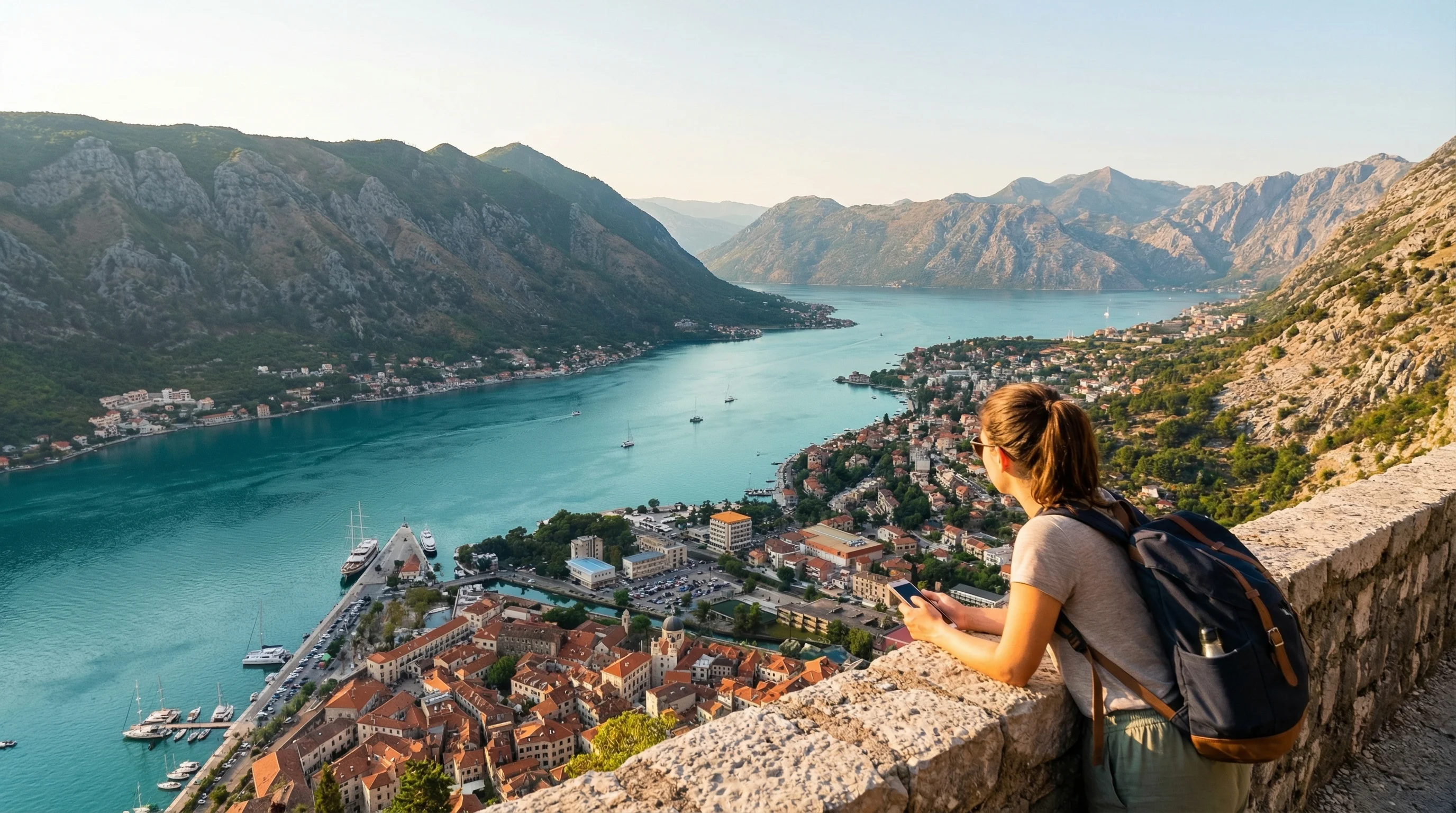
Kotor is genuinely one of the most beautiful small towns in Europe. The walled old town sits at the edge of the Bay of Kotor – a dramatic inlet that looks like a Scandinavian fjord dropped into the Mediterranean. Hiking trails lead up to the fortress above the old town, and the surrounding bay villages are stunning. The trade-off is seasonal pricing and summer crowds.
Budva – the social one
| Factor | Details |
|---|---|
| Rent | EUR 800–1,200/month (summer), EUR 500–700 (winter) |
| Character | Montenegro’s main coastal resort hub |
| Best for | Those who want beaches, nightlife, and a social scene |
| Internet | Reliable, with coworking options |
| Downsides | Landlords may try to hike rents or evict tenants during July–August peak season |
Budva is where the action is – beaches, restaurants, nightlife, and the largest concentration of other nomads on the coast. Be aware that some landlords still operate on a tourist-season mentality and may attempt to renegotiate or terminate leases during July and August. Get your rental contract watertight, ideally with a clause covering the summer months explicitly.
Bar – the quiet alternative
| Factor | Details |
|---|---|
| Rent | EUR 350–600/month |
| Character | Low-key port town with good weather |
| Best for | Budget-focused nomads who want coast without crowds |
| Internet | Adequate but less developed than Podgorica |
| Downsides | Fewer amenities, smaller expat community |
Bar flies under the radar but offers the most affordable coastal living in Montenegro. It is a working port town rather than a resort, which means lower prices and less seasonal disruption. The old town (Stari Bar) is an atmospheric ruin worth exploring, and the Adriatic beaches are within reach. Coworking options are limited – you will likely be working from cafes more often here.
Cost of living overview
Here is a realistic monthly budget for a single remote worker in Montenegro:
| Expense | Budget range (EUR) |
|---|---|
| Rent (1-bed apartment) | 450–1,000 |
| Groceries | 180–280 |
| Eating out | 100–200 |
| Utilities (electric, water, heating) | 60–120 |
| Mobile data + internet | 20–40 |
| Private health insurance | 25–50 |
| Transport | 30–80 |
| Coworking (if needed) | 80–150 |
| Total | 945–1,920 |
A comfortable single-person budget sits around EUR 1,200–1,500 per month in most locations. Couples can expect EUR 1,800–2,200. That is significantly less than Croatia, Portugal, or Spain – and with the tax exemption on top, your effective savings rate can be remarkably healthy.
Internet and infrastructure
Montenegro’s internet has improved considerably in recent years. As of late 2023, about 78.5% of households could access 100 Mbps or faster fixed broadband – just below the EU average of 79.2%. Household internet penetration reached 81.3%, with ongoing investment in 5G rollout targeting 50% population coverage by 2026.
In practical terms, you will have no trouble working from home in Podgorica or the larger coastal towns. Speeds are generally reliable for video calls, file transfers, and standard remote work. That said, if you are heading to smaller villages or off-the-beaten-path locations, test the connection before committing to a lease.
As with any location, invest in a decent VPN for security – especially when working from cafes or shared spaces.
Healthcare for digital nomads
This is one area where Montenegro is straightforward but limited. Digital nomad visa holders do not get access to the public health system – free medical care is reserved for employed residents and their families.
You are required to have private health insurance as part of your visa application, and this is not just a box-ticking exercise. Private healthcare in Montenegro is affordable and increasingly good – a doctor’s visit costs around EUR 25, and private plans run at roughly EUR 300 per year. Many doctors speak English and have trained abroad.
For anything serious, you are looking at evacuation to a larger medical centre, which your insurance should cover. Montenegro’s healthcare infrastructure is adequate for routine needs but not comparable to a major EU country for specialist treatment.
EU accession – what it means for you
Montenegro is the most advanced EU candidate country, having opened all 33 negotiating chapters with fourteen provisionally closed as of March 2026. The European Commissioner for Enlargement has suggested Montenegro could complete negotiations by the end of 2026 or 2027, with actual membership potentially arriving around 2028.
This matters for digital nomads in two ways:
- Short-term: EU accession pressure may drive improvements in infrastructure, governance, and digital services – all good things for remote workers.
- Long-term: Once Montenegro joins the EU, freedom of movement rules change. The current digital nomad visa may become irrelevant for EU citizens, but the country could become a more attractive (and potentially more expensive) destination. Getting established now, while costs are low, could pay off.
How Montenegro compares to Croatia
Since RWE covers Croatia’s digital nomad visa in detail, here is a quick head-to-head:
| Factor | Montenegro | Croatia |
|---|---|---|
| Income requirement | ~EUR 1,800–2,400/month | ~EUR 3,623/month |
| Visa duration | Up to 2 years, renewable | Up to 18 months, extendable to 36 |
| Tax exemption | Yes – income tax + social security | Yes – income tax exempt |
| Application process | In-country, ~2 months | Embassy or in-country, 8–30 days |
| Cost of living | EUR 1,000–1,500/month | EUR 1,300–2,000/month |
| EU member | No (candidate) | Yes |
| Programme status | May sunset end of 2026 | Established, recently expanded |
| Schengen access | No | Yes |
Montenegro wins on affordability and income requirements. Croatia wins on programme stability, EU/Schengen membership, and processing speed. If budget is your primary concern and you are comfortable with some uncertainty about the programme’s future, Montenegro offers better value. If you want regulatory certainty and seamless EU access, Croatia is the safer bet.
Practical tips for making it work
Before you go:
- Get your criminal record check apostilled and translated early – this is often the slowest part of the document preparation
- Secure health insurance that explicitly covers Montenegro for two years
- Have at least three months of bank statements showing your income meets the threshold
On arrival:
- Register your accommodation within 24 hours of arrival (your landlord typically does this)
- Open a local bank account – not required for the visa, but makes daily life much easier
- Get a local SIM card for backup internet and cheaper calls
While you are there:
- Track your days carefully if you want to stay under the 183-day tax residency threshold
- Keep your rental contract airtight, especially for coastal properties during summer
- Connect with the local nomad community – Facebook groups and coworking spaces in Podgorica and Kotor are good starting points
For your digital security:
- Use a VPN on public wifi – cafes, coworking spaces, and accommodation shared networks
- Have a backup internet solution (mobile hotspot) for critical calls and deadlines
Frequently asked questions
Can I bring my family on the Montenegro digital nomad visa?
Yes. Family members can apply for dependent residence permits alongside your application. You will need to demonstrate sufficient income to support the family – budget accordingly.
Do I need to speak Montenegrin?
No. English is widely spoken in Podgorica, Kotor, Budva, and other urban/tourist areas. For official dealings, you may need a translator, but day-to-day life is very manageable in English.
Can I work for Montenegrin clients while on the digital nomad visa?
No. The visa – and crucially, the tax exemption – applies to work performed for employers or clients outside Montenegro. If you take on local clients, you would need a different type of work permit and would be subject to local taxation.
What happens if the programme ends while I have a valid permit?
A residence permit granted before any sunset date should remain valid for its full two-year duration. However, renewal after that point would depend on whatever replacement arrangements the government puts in place.
Is Montenegro safe?
Yes. Montenegro is generally safe, with low rates of violent crime. Petty theft can occur in tourist areas during summer, as in any popular destination. Use common sense and you will be fine.
How is the wifi in Montenegro really?
Good enough. Urban areas and larger coastal towns offer reliable connections at speeds comparable to many EU countries. Podgorica has the best infrastructure. Smaller villages can be patchy – always test before committing.
Can I open a bank account?
Yes. With your residence permit, opening a local bank account is straightforward. Several banks offer accounts to foreign residents, and you will find the process much simpler than in some other Balkan countries.
What is the weather like?
The coast enjoys a Mediterranean climate – hot, dry summers and mild winters. Podgorica, inland, gets very hot in summer (regularly above 35C) and cooler in winter. Kotor and the bay can feel humid in July and August. The mountains get proper snow in winter if you are into that.
Bottom line on the Montenegro digital nomad visa
Montenegro’s digital nomad visa is one of Europe’s best-kept secrets – low income requirements, genuine tax exemption, affordable living, and an Adriatic coastline that rivals anything in the Mediterranean. The uncertainty around the programme’s future beyond 2026 is the main drawback, but it also creates urgency.
If you have been thinking about basing yourself somewhere in southern Europe for a year or two, Montenegro deserves serious consideration. Apply now, lock in your two-year permit, and enjoy one of Europe’s most underrated countries while the programme – and the prices – last.
Related reading on Remote Work Europe:
- Digital nomad visa income requirements and remote jobs
- A1 certificates and social security in Europe
- Working from home in Europe
- VPN security for remote workers
- Remote working from coffee shops
This article provides general information about Montenegro’s digital nomad visa programme. It does not constitute legal or tax advice. Immigration and tax rules depend on individual circumstances – always consult a qualified advisor for your specific situation.
Last reviewed: March 2026. Requirements and programme status are subject to change. Check the Montenegrin Ministry of Internal Affairs for the latest information.