TL;DR
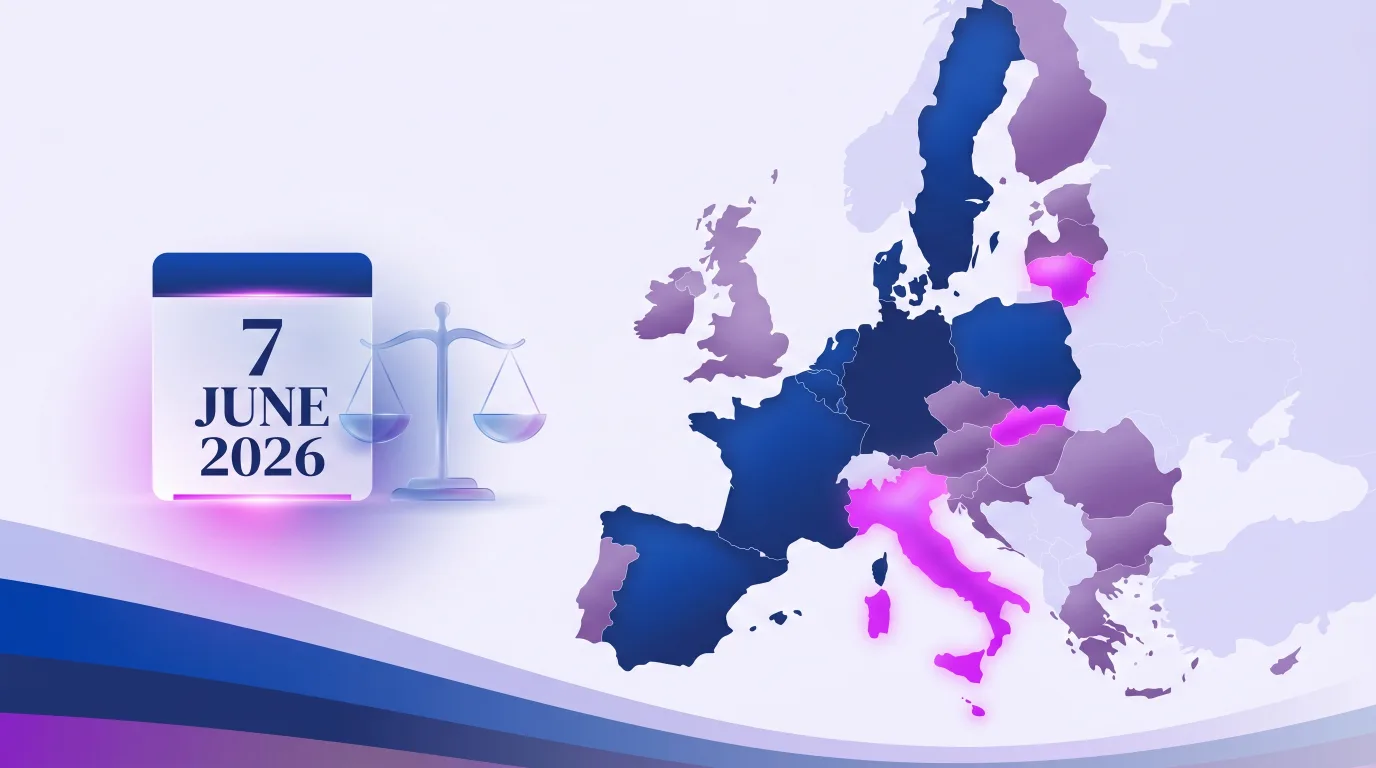
- The EU Pay Transparency Directive (Directive (EU) 2023/970) had a transposition deadline of 7 June 2026. As of 10 June, only four member states have full implementing law in force: Italy (Legislative Decree 96/2026), Slovakia (Act 76/2026 Coll.), Lithuania (Law XV-969 amending the Labour Code), and Malta (Legal Notice 173 of 2026).
- A second group has partial transposition already binding: Poland (recruitment-stage rules in force since 24 December 2025), Belgium (a Fédération Wallonie-Bruxelles decree in force since 1 January 2025 covering only the French Community public sector), and Czechia (bans on both pay-secrecy clauses and salary-history questions).
- Large economies that have missed the deadline outright include Germany (no draft published), France (draft law published, targeted entry into force 1 January 2027), Spain (prior consultation on a Royal Decree closed 8 May 2026, no draft text yet), the Netherlands (officially targeting 1 January 2027), Sweden (paused transposition, seeking renegotiation), Denmark (draft bill, 1 January 2027 entry), Finland (delayed), Ireland (will not fully meet the deadline), Portugal, Austria, Hungary, and Luxembourg.
- The European Commission published the explainer “New EU rules on pay transparency explained” on 5 June 2026. Commissioner Hadja Lahbib has confirmed the deadline is not moving and that infringement proceedings under Article 258 TFEU may follow for late states. No letters of formal notice specific to Directive 2023/970 have been publicly announced as of 10 June 2026.
- For remote workers in countries that did transpose, the practical change is immediate: salary ranges in job ads, no salary-history questions, pay-secrecy clauses void, the right to ask for comparator pay data, and the burden of proof on the employer in pay discrimination cases.
- Gender pay gap reporting for employers with 250+ workers begins 7 June 2027, on 2026 data.
It was a Wednesday morning, and a job ad caught my eye for a fully remote senior content role with a Spanish-headquartered company. Permanent contract, EU-only. I scrolled. Skills, experience, mission statement, perks. No salary, but apparently the package was “competitive.” Not a single number anywhere… Just a meaningless word. Competitive relative to what, exactly?
Three days earlier, on 7 June 2026, the EU Pay Transparency Directive’s transposition deadline had passed. That deadline was meant to make pay ranges in job ads a legal floor across all 27 EU member states. The ad I was looking at was posted from Spain, and Spain has not transposed. So technically it’s not illegal, and let’s face it, it’s pretty much in line with common practice to date. Practically, it is a useful reminder that the Directive is now a patchwork, and the employer’s postcode is what determines what you see.
Remote Work Europe has covered this Directive twice: in August 2025 from the employer-side hiring angle, and in March 2026 on what it changes for remote workers in cheaper cities. This piece is the deadline-day status report. Who actually landed national law by 7 June, who didn’t, and what does that mean if you are job-hunting, hiring, or freelancing across borders this week?
What the deadline was, and what it triggered
Directive (EU) 2023/970 was adopted in May 2023 and entered into force on 6 June 2023. Article 34 gave member states a hard deadline: bring national laws into force by 7 June 2026. From 8 June 2026, any state that has not notified Brussels of complete transposition measures is in breach of EU law.
The core obligations, once a state transposes: employers must give candidates the initial pay or pay range before interview, usually in the job ad. Employers may not ask about salary history. Pay-secrecy clauses are prohibited. Workers can ask their employer for their own pay level and the average pay levels by sex for comparable work, with a two-month response window. The burden of proof in pay discrimination cases shifts to the employer once a prima facie case is shown. From 7 June 2027, employers with 250 or more workers must publish annual gender pay gap reports on 2026 data, with smaller-employer thresholds phasing in from 2027 and 2031.
The Commission published its public explainer “New EU rules on pay transparency explained” on 5 June 2026, framed around the deadline and stating that the rules are “now taking effect across the EU.” Commissioner Hadja Lahbib has confirmed in written answers on behalf of the Commission that late-transposing states may face infringement proceedings starting with a letter of formal notice under Article 258 TFEU. No infringement package naming specific states for this Directive has been published yet; on the Commission’s usual cycle, the earliest letters of formal notice are likely later in 2026.
Market by market: who actually transposed by 7 June
The headline number, as of 10 June 2026: four. Four EU member states have complete national implementing legislation in force.
The four that landed on time
Italy. Legislative Decree No. 96 of 7 May 2026 was published in the Gazzetta Ufficiale on 1 June 2026 and entered into force on 7 June 2026. It applies to public and private sector employers, mandates the initial salary or range in job postings, prohibits questions about current or previous remuneration, gives workers an annual right to request comparator pay information, and triggers a joint pay assessment where an unjustified 5%-plus gender pay gap in any category goes uncorrected for six months. Source: Italian Official Gazette, 1 June 2026.
Slovakia. The Equal Pay Act (Act No. 76/2026 Coll.) was approved by the National Council on 15 April 2026, signed by President Peter Pellegrini on 23 April 2026, published in the Collection of Laws on 8 May 2026, and entered into force on 7 June 2026. First gender pay gap reports are due 15 April 2027. Source: Slovak Collection of Laws.
Lithuania. Labour Code amendments under Law No. XV-969 were enacted by the Seimas on 21 May 2026. Most provisions take effect on 7 June 2026, including the salary-history ban, the express right to disclose your own salary, and rights to pay information. Two technical pieces are deferred: employers have until 31 December 2026 to align their pay systems, and monthly data submission to the State Social Insurance Fund Board (SoDRA) begins on 1 January 2027. Source: Seimas.
Malta. Legal Notice 173 of 2026 (the Equal Pay (Transparency and Reporting) Regulations, 2026) was published in Government Gazette No. 21,661 on 5 June 2026 and is of immediate effect, completing a transposition that began with partial right-to-information measures in August 2025. Source: legislation.mt.
Partially transposed, already creating real obligations
Poland. Recruitment-stage rules from Article 5 are in force under the Act of 4 June 2025 amending the Labour Code, effective 24 December 2025: every Polish employer must give applicants the initial pay or pay range, and may not ask about salary history. A second draft law dated 29 April 2026 covers reporting and joint pay assessments, but provides that the new regulations enter into force six months after official publication, so Poland will not fully meet the deadline. Source: Dziennik Ustaw for the 2025 amendment.
Belgium. The Fédération Wallonie-Bruxelles decree of 12 September 2024 transposed the Directive for public-sector employers under its jurisdiction, in force from 1 January 2025. Federal-level transposition has stalled. The New Flemish Alliance (N-VA) tabled a Proposal for a Resolution in the House of Representatives on 26 January 2026 calling for federal implementation. The Commission has previously refused to move the deadline.
Czechia. Partial transposition is in force via the Labour Code “flexi-amendment” effective 1 June 2025: both the prohibition on contractual terms restricting workers from disclosing pay, and a ban on asking candidates about salary history. A comprehensive draft law was introduced on 16 March 2026 by the Ministry of Labour and Social Affairs, targeting 1 January 2027 entry into force, first reporting 2028.
Missed the deadline, draft pending
France. A draft transposition law has been published, introducing a seven-indicator gender equality index, codifying the right to comparator pay information, prohibiting pay-secrecy clauses, and imposing penalties of up to 1% of total remuneration for failures on pay-gap reporting or corrective measures. Stated entry into force: 1 January 2027. No Loi or Ordonnance has appeared in the Journal officiel.
Germany. Germany has the Entgelttransparenzgesetz on the books, but it falls short of the Directive’s expanded requirements. As of 10 June 2026, no draft implementation law has been published. The old law continues to apply; per ECJ case law on direct effect, the Directive already applies to public employers, so public-sector employees may be able to rely on it.
Spain. Spain already has relatively stringent national pay rules: a salary register disaggregated by profession and gender, remuneration audits and equality plans for employers with 50+ workers, and a 25% threshold for the duty to justify gender pay gaps (the Directive uses 5%). But these predate the Directive and do not constitute transposition. The Ministry of Labour and Social Economy ran a prior consultation on a draft Royal Decree from 24 April to 8 May 2026, the stage before the legal text is drafted. No Royal Decree is in the Boletín Oficial del Estado. First Spanish pay gap reports are still expected on 7 June 2027 using 2026 data, which now requires a compressed legislative schedule in H2 2026.
Netherlands. The Dutch government announced in September 2025 it would miss the deadline, targeting 1 January 2027 for entry into force and 2028 for first reporting. An updated wage transparency bill was sent to the Council of State on 19 January 2026. In its 18 December 2025 answers to Parliament, the Commission specifically addressed the Dutch delay and reiterated that the deadline would not move.
Sweden. The furthest in active resistance. After proposing 1 July 2026 entry into force (already past the deadline), the government delayed to 1 January 2027 on 11 March 2026, then on 26 March 2026 paused transposition altogether and announced it would seek EU-level renegotiation, citing administrative burden and overlap with existing pay analysis under the Discrimination Act (2008:567). No bill has been submitted to the Riksdag.
Ireland. A draft bill published 15 January 2025 addresses parts of the regime, but the government has acknowledged it will not fully implement by the deadline. Implementation will be phased; reporting templates and equality-body tools are still in development.
Denmark. A draft bill released on 26 February 2026 proposes entry into force on 1 January 2027, with first reporting on 1 September 2028 for 2027 data. The draft applies the Directive’s reporting obligations to employers with 100+ workers, in line with the Directive’s threshold. Denmark’s pre-existing wage-statistics regime already covers some smaller employers (down to roughly 35 staff in certain conditions), under separate national rules.
Finland. Draft published 16 May 2025, originally targeting 18 May 2026 entry into force. On 22 December 2025 the Ministry of Social Affairs and Health confirmed parliamentary processing would be delayed; a final entry-into-force date depends on Parliament.
Portugal, Austria, Hungary, Luxembourg. None have published draft transposition legislation visible in the major legal trackers. Existing national equal pay laws remain in force, but the Directive’s specific transparency and reporting architecture is not in any draft, Royal Decree, or Bundesgesetzblatt yet.
Bulgaria. A draft law went into public consultation on 19 May 2026, running until 18 June 2026. No enacted law as of 10 June.
Cyprus. A draft bill on equal remuneration was released by the Labour Relations Department in November 2025, with consultation closing 4 December 2025. No enacted law found in the Επίσημη Εφημερίδα της Κυπριακής Δημοκρατίας as of 10 June 2026: Cyprus has missed the deadline.
Latvia and Romania. Both published draft transposition legislation earlier this year: Latvia’s Ministry of Welfare draft on 1 April 2026, and Romania’s revised draft on 30 March 2026 (consultation closed 8 April 2026). Neither is enacted as of 10 June 2026.
Estonia, Greece, Croatia, Slovenia. All four are at pre-draft stage. Estonia announced on 16 April 2026 it would seek a postponement and amendment of the Directive (the Minister of Economic Affairs and Industry said Estonia would rather pay a fine than increase business burdens), then partially reversed to move forward with limited pre-employment transparency, but no public legislative text has been released. Greece’s working group missed its 2025 drafting milestone. Croatia has no public draft. For Slovenia, despite one commercial tracker (pay-transparency-tracker.com) listing Slovenia as “Transposition Complete,” no Slovenian law number or Uradni list reference is available, and Trusaic, Morgan Lewis, and Littler do not include Slovenia among fully transposed states.
What it means for remote workers and freelancers right now
The Directive applies at the location of the worker, not the employer. If you live in Bologna and work for a Berlin-headquartered company, the Italian Decree applies from this week. The same logic covers Slovak, Lithuanian, and Maltese residents regardless of who pays them: pay ranges in new job ads, no salary-history questions, the right to ask for comparator pay data, the right to discuss what you earn with colleagues, and the burden of proof on the employer in any pay discrimination claim. In Poland, the recruitment-stage rules already apply; the rest is coming on a delayed schedule.
Anywhere else in the EU, the position is less comfortable. The Directive is Union law from 8 June 2026, but it is not directly enforceable against private-sector employers until national law is in force. National courts must interpret existing equal pay law in conformity with the Directive wherever possible, and public-sector employees can rely on it directly against the state as employer. That helps public servants in Germany, France, or the Netherlands, but it is not the legal certainty the Directive was meant to give everyone.
For cross-border remote work, the asymmetry is sharper. A Spanish company hiring someone who lives in Italy must comply with Italian transparency rules now; the same company hiring someone in Spain still has the older 25%-gap regime. A German employer hiring across the Union faces a fragmented picture: Italian, Slovak, Lithuanian, and Maltese hires covered by the full machinery; German, French, and Spanish hires not. For the mechanics underneath this, our cross-border hiring guide is the companion piece.
For freelancers, the Directive does not apply directly. It covers workers in an employment relationship (part-time, fixed-term, agency, and platform workers included), not genuine independent contractors. The Spain-based autónom@ working for a Dutch client through a service contract is outside the scope. The indirect effect is real though: once your client’s employees see published salary ranges for comparable in-house roles, you have new data points for your own rates.
What is coming next
The Commission has signalled it will use Article 258 TFEU against late-transposing states. Realistic timeline: letters of formal notice in the second half of 2026, reasoned opinions in late 2026 or 2027, any CJEU referral from 2027. Financial penalties under Article 260 TFEU typically come years later (Spain was fined €6.83 million plus a daily penalty for delayed transposition of the Work-Life Balance Directive). Most laggards will legislate well before any CJEU judgment; political pressure tends to outpace legal pressure.
The next hard date is 7 June 2027, when employers with 250 or more workers must publish their first annual gender pay gap report on 2026 calendar-year data. The 150-249 band reports first on the same date (then every three years), and the 100-149 band on 7 June 2031. In transposed countries the 2027 date holds. In late-transposing countries, whether it moves, splits, or slips will dominate the next year of compliance conversations: the Netherlands has explicitly planned first reporting for 2028, and Sweden, if it secures renegotiation, may push further. Remote-first scale-ups in the 100-250 band are the ones who need to invest now in the pay architecture, banding, and documentation that make pay differences defensible.
For job seekers, the short version: if you see a remote job ad in June 2026 without a salary range, check where the role is based. Italian, Slovak, Lithuanian, or Maltese employer, ask why. Anywhere else, legal for now, but the exception is becoming the rule. Italy, Slovakia, Lithuania, and Malta are where the rules are real this week. The rest of the Union is on a spectrum from “draft on the desk” to “actively pushing back.” If you work across borders, the employer’s postcode just became one of the most material things on the page.
For the negotiation-side deep dive, see our piece on pay transparency and remote work in cheaper cities. For the employer perspective on building defensible pay architecture, see how EU pay transparency reshapes remote hiring. For the structural mechanics of hiring across European borders, cross-border hiring without an EOR covers the groundwork this Directive now sits on top of.
Looking for remote roles with transparent pay? RWE Connected curates verified European remote job leads, hand-picked and scam-free, so you can spend less time hunting and more time negotiating from strength.