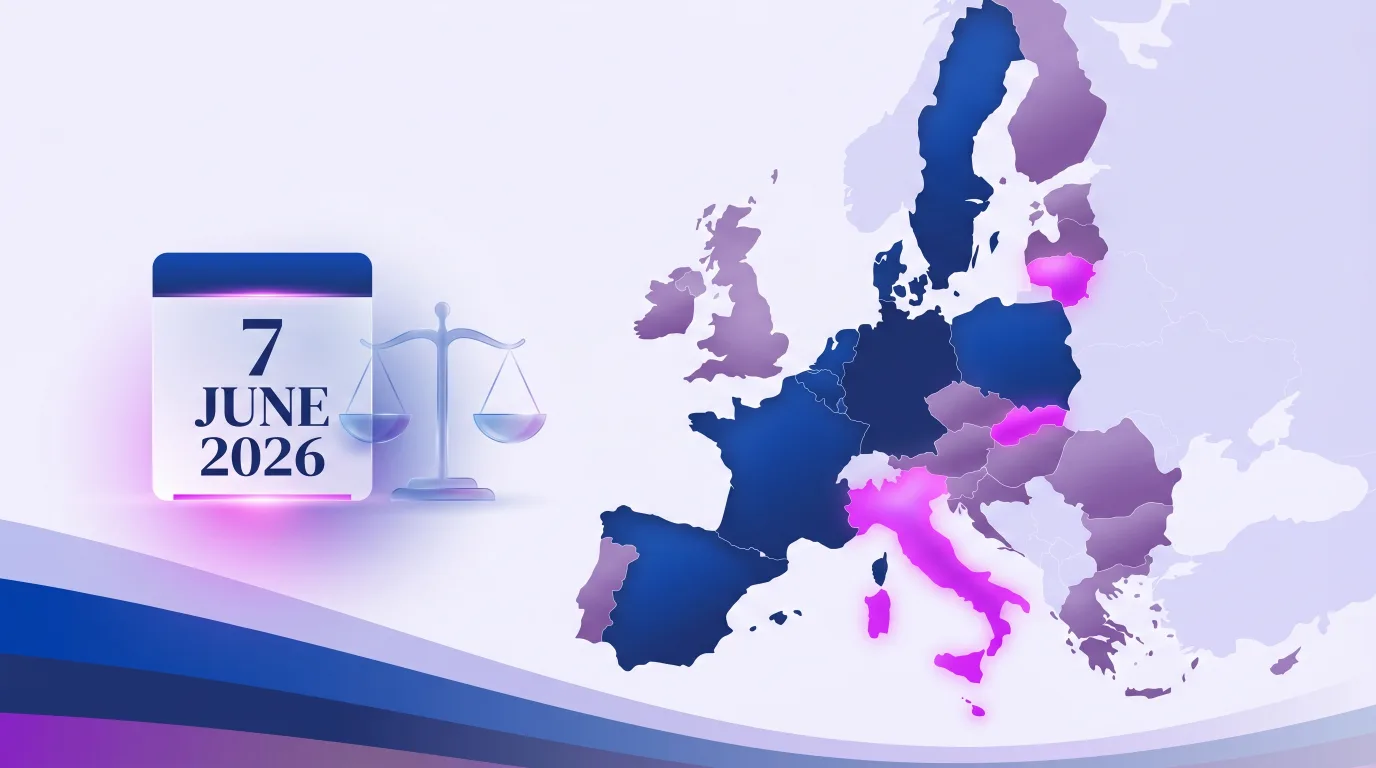
TL;DR: From 7 June 2026, the EU Pay Transparency Directive requires employers to publish salary ranges in job ads, bans salary history questions, prohibits pay secrecy clauses, and shifts the burden of proof to employers in pay discrimination cases. Companies with 250+ employees must report gender pay gaps annually from June 2027. For remote workers in lower-cost cities, this means location-based pay discounts become much harder to justify. Updated May 2026 with the latest transposition status across member states – with the deadline now four weeks away, only six countries have meaningful legislation in place.
From 7 June 2026, EU employers must publish salary ranges in job ads, cannot ask about salary history, and must let employees discuss pay freely. For remote workers in lower-cost cities, this changes the negotiation landscape significantly.
You live in Braga, or Plovdiv, or Tartu. You work remotely for a company headquartered in Amsterdam or Munich. You do the same job as a colleague who lives ten minutes from the office – but your salary is 30% lower because your postcode is cheaper.
That arrangement has been the unspoken norm in European remote work for years, arguable even more so globally. But in Europe at least, from June 2026, it gets a lot harder to justify – and a lot easier to challenge.
The EU Pay Transparency Directive (2023/970) is about to hand workers new tools for understanding what their colleagues earn, and why. For remote workers negotiating from lower-cost cities, that shift is significant.
What’s actually changing
The Directive, adopted in May 2023, establishes minimum standards for pay transparency across all EU member states. Its primary goal is closing the gender pay gap – but the mechanisms it creates reach far beyond gender.
Here are the provisions that matter most:
Salary ranges in job ads. Employers must provide candidates with the initial pay or pay range for any advertised position, based on objective, gender-neutral criteria. Most companies will put this directly in the job posting. No more “competitive salary” placeholders. Incidentally this has always been a requirement for ads in the Remote Work Europe Facebook groups. How can any advertiser know what is “competitive” for any applicant?
A ban on salary history questions. Employers cannot ask what you earned in your last role. This prevents the practice of anchoring offers to a candidate’s previous (potentially location-depressed) salary. This has always been a difficult area to navigate, but now you have the law on your side to push back against questions that are now beyond unfair, and actually illegal.
The right to request pay information. Once employed, you can ask your employer for your individual pay level and the average pay levels – broken down by gender – for workers doing the same work or work of equal value. They must respond within two months.
No more pay secrecy clauses. Contractual terms that prevent you from discussing your salary with colleagues are now prohibited. You can talk about what you earn. You don’t have to - but it’s quite possible that greater transparency will become more culturally normal.
Burden of proof shifts to the employer. If you present evidence suggesting pay discrimination, it’s up to your employer to prove the difference is justified – not up to you to prove it isn’t.
Gender pay gap reporting. Companies with 250+ employees must report gender pay gaps annually from June 2027. Those with 150–249 employees report every three years from 2027, and companies with 100+ employees from 2031. Where a gap exceeds 5% and can’t be justified by objective criteria, employers must conduct a joint pay assessment with worker representatives.
Timeline: when does this kick in?
Member states have until 7 June 2026 to transpose the Directive into national law. That deadline is just weeks away – and the European Commission confirmed in December 2025 that it expects all member states to meet it.
Key dates to know:
- 7 June 2026 – Transposition deadline. Core obligations begin: salary ranges in ads, salary history ban, employee right to information, pay secrecy prohibition
- 7 June 2027 – First gender pay gap reports due from companies with 150+ employees
- 7 June 2031 – Reporting extends to companies with 100+ employees
In practice, the speed and scope of implementation varies. Some countries are ahead, others are dragging their feet – more on that below.
What this means for remote workers specifically
The Directive applies to all employers operating in EU member states – and to non-EU companies with employees based in the EU. If you’re a remote worker residing in an EU country, you’re covered regardless of where your employer is headquartered.
This matters because the transparency provisions cut through the information asymmetry that has historically disadvantaged remote workers, especially those in lower-cost locations.
Consider the practical impact. When salary ranges appear in every job ad, a developer in Lisbon can see exactly what a company is offering for a role – not a vague promise to “discuss compensation based on experience and location.” When you can request data on what colleagues doing equivalent work actually earn, you have leverage. When pay secrecy clauses vanish, the informal salary conversations that office-based workers have always had become available to remote teams too.
The Directive doesn’t explicitly address location-based pay. It doesn’t say employers can or can’t pay differently based on where you sit. What it does is require that any pay differences be justified by objective, gender-neutral criteria – skills, effort, responsibility, and working conditions. And it gives you the tools to find out if those criteria are being applied consistently.
The location-based pay debate
Location-based compensation has been standard practice in global remote work. GitLab famously uses a formula that factors in a location multiplier based on local rent prices. Buffer adjusts base salaries by cost of living, then publishes them transparently. Spotify’s “Work From Anywhere” policy lets employees choose their location but ties pay to the local market where they’re employed. (For more on how these companies actually operate, see our remote-first company profiles.)
The argument for location-based pay is straightforward: a salary that provides a comfortable life in Berlin goes further in Bucharest, so paying the same nominal amount everywhere either overpays in cheaper cities or underpays in expensive ones.
The argument against it is equally clear: if two people do identical work to the same standard, paying one less because of their address isn’t really “equal pay for equal work.” And when the work is remote, anybody who finds Berlin a bit pricey for their pocket is welcome to move to Bucharest. Key workers like nurses or carers who have to live in expensive locations deserve a salary weighing to support that, but those who choose to live there do not.
The Directive doesn’t settle this debate outright, but it changes the terrain. Location-based pay differentials are not explicitly prohibited, but employers must now demonstrate that any differences stem from objective factors unrelated to gender. And when pay disparities disproportionately affect protected groups (if, say, workers in cheaper Southern or Eastern European cities are predominantly one gender), location-based models face real legal risk of indirect discrimination.
What the Directive does prohibit is opacity. You can’t hide behind vague “market adjustment” language anymore. If you pay a software engineer in Porto 25% less than one in Paris for the same role, you need a documented, defensible reason – and the Porto-based engineer now has the legal right to ask for that data.
Your rights under the new rules
From June 2026, here’s what you can concretely do:
Before you apply. Check job ads for salary ranges. Under the Directive, employers must provide this information before the interview stage. If a range isn’t listed, you’re entitled to ask – and they must answer.
During the hiring process. You don’t have to disclose your previous salary. If an interviewer asks, they’re in breach of the Directive (once transposed into your country’s law). This is particularly powerful for remote workers who may have accepted lower pay in previous roles due to location.
Once you’re hired. You can formally request information about your pay level relative to colleagues doing the same or equivalent work, broken down by gender. Your employer must respond within two months. They must also proactively inform you of this right every year.
If you find a gap. If your pay is lower than the average for comparable work and you believe it’s unjustified, the burden of proof is on the employer. They must demonstrate the difference is based on objective criteria. You have the right to full compensation if pay discrimination is found, including back pay and related bonuses.
Talk freely. No employment contract can stop you from discussing your salary with colleagues. Period.
How to use transparency in salary negotiations
Knowing your rights is one thing, but using them effectively is another. Here’s how to approach salary conversations with the new rules in your corner.
Research the range before you interview. Once salary ranges are mandatory in job ads, build a database of what companies are actually offering for your role across different EU markets. This gives you a factual foundation – not just Glassdoor estimates.
Anchor to the role, not your location. The Directive is built around equal pay for equal work. Frame your negotiation the same way. Talk about the value you deliver, the skills the role requires, the experience you bring, the responsibilities you carry – not your cost of living.
Ask the right questions. “What objective criteria determine where someone falls within this salary range?” is a question employers must now be able to answer clearly. If they can’t articulate it, that’s a red flag.
Use your right to information strategically. If you’re already employed and suspect you’re paid less than colleagues in the same role, submit a formal request. The data you receive gives you a factual basis for renegotiation – or, if necessary, for a formal complaint.
Document everything. Keep records of job ads with salary ranges, your formal information requests, the employer’s responses, and any inconsistencies. If the situation escalates, you’ll need evidence.
Know your country’s specific implementation. The Directive sets minimum standards, but national law may go further. Some member states are adding requirements beyond what the Directive mandates – check what applies where you work.
What employers are doing in response
The smart ones are getting ahead of this. Companies with distributed European teams are:
- Auditing their pay structures – mapping roles against objective criteria and checking for unexplained gaps, whether by gender, location, or both
- Building transparent compensation frameworks – defining salary bands per role with clear, documented criteria for where within the band someone falls
- Reconsidering location-based models – some are moving toward regional bands rather than city-level adjustments, or eliminating geographic factors entirely for certain roles
- Training hiring managers – ensuring interviewers know they can’t ask about salary history and understand the new disclosure requirements
- Preparing reporting infrastructure – companies approaching the 100-employee threshold are building systems now to track and report gender pay data
Industry surveys in early 2026 suggest that fewer than one in ten Europe-based employers had a full pay transparency strategy in place, despite the June deadline being months away. Many are scrambling. As a candidate or employee, you may find yourself better informed about the rules than the company you’re negotiating with.
Country-by-country: where implementation stands
Update (August 2026): The 7 June 2026 transposition deadline has now passed, with only about four member states – Italy, Lithuania, Malta, and Slovakia – having fully transposed the Directive. The country-by-country status below reflects the pre-deadline (May 2026) picture and is kept for reference.
Not all member states are moving at the same pace. With four weeks to the deadline, the picture as of May 2026 looks like this.
Transposed (full or partial):
- Belgium – First to act. The Fédération Wallonie-Bruxelles signed legislation in September 2024, effective January 2025. Flanders followed with a partial transposition on 31 March 2026. Full national alignment still in progress.
- Malta – Comprehensive transposition delivered by Legal Notice 173 of 2026, published 5 June 2026. One of the few member states to fully transpose.
- Poland – Hiring-transparency provisions passed and live from 24 December 2025; remaining components of the Directive followed in a December 2025 draft.
- Slovakia – Legislation passed 15 April 2026. Among the latest to land before the deadline.
- Lithuania – Updated draft approved on 18 March 2026; expected to complete transposition before 7 June.
- Italy – Preliminary legislative decree approved early 2026 covering the full scope: pay-secrecy ban, pre-employment transparency, right to information, 5% gap trigger.
In progress, racing the deadline:
- France – Draft bill issued 29 January 2026; legislative process tight but on track.
- Germany – Government commission recommended a “bureaucracy-reduced” model in November 2025. Draft legislation still pending.
- Finland – Draft bill published May 2025, government proposal expected to land before deadline.
- Ireland – Draft legislation focuses on pre-employment transparency but pay-gap reporting provisions are notably absent. Likely partial transposition only by 7 June.
Confirmed missing the deadline:
- Netherlands – Announced 17 September 2025 that it would not meet the June 2026 deadline, targeting January 2027 instead. The European Commission has reaffirmed the original deadline and is expected to open infringement proceedings.
- Estonia – The labour minister stated publicly the government would rather pay an EU fine than rush legislation. Likely to face infringement action.
- Sweden – Government announced March 2026 that it does not intend to submit a proposal to parliament at all, arguing the Directive is too administratively burdensome. Pushing for renegotiation at EU level. Covered in our news brief on Sweden delaying the EU Pay Transparency Directive.
Behind, status unclear:
- Spain – Limited publicly documented transposition activity, though existing 2021 pay-equity legislation (remuneration registers and audits for employers with 50+ workers) provides a foundation. Madrid is expected to lean on the existing register and add the missing components in stages.
- Around half of the remaining 27 member states have no publicly documented draft as of early May 2026. Most will miss the deadline.
For the latest developments, our news monitor has been tracking transposition: see most member states will miss the deadline and the EU’s confirmation that the deadline holds.
The Commission has the power to launch infringement proceedings against any member state that fails to transpose by 7 June. Those proceedings take years to bite, but the legal force of the Directive doesn’t depend on national legislation in countries where direct effect applies. Workers in late-transposing states will still be able to invoke key rights through national courts and the European Court of Justice. The practical experience will be patchy and slow – but the floor is set.
What comes next
Even in countries that are slow to transpose the Directive into law, the direction is clear. Pay transparency is becoming the European norm. Remote workers – especially those in lower-cost locations who have historically lacked the informal salary signals available to office-based colleagues – stand to benefit most.
The Directive won’t eliminate location-based pay overnight. What it will do is make every pay decision visible, documented, and challengeable. For a remote worker in a cheaper city, that changes the negotiation from “what’s the market rate where you live?” to “what’s this role worth, and can you justify paying me less?”
That’s a much stronger position to negotiate from.
Looking for remote roles with transparent, fair compensation? RWE Connected curates verified European remote job leads – hand-picked, scam-free, with clear terms – so you can spend less time hunting and more time negotiating from strength.