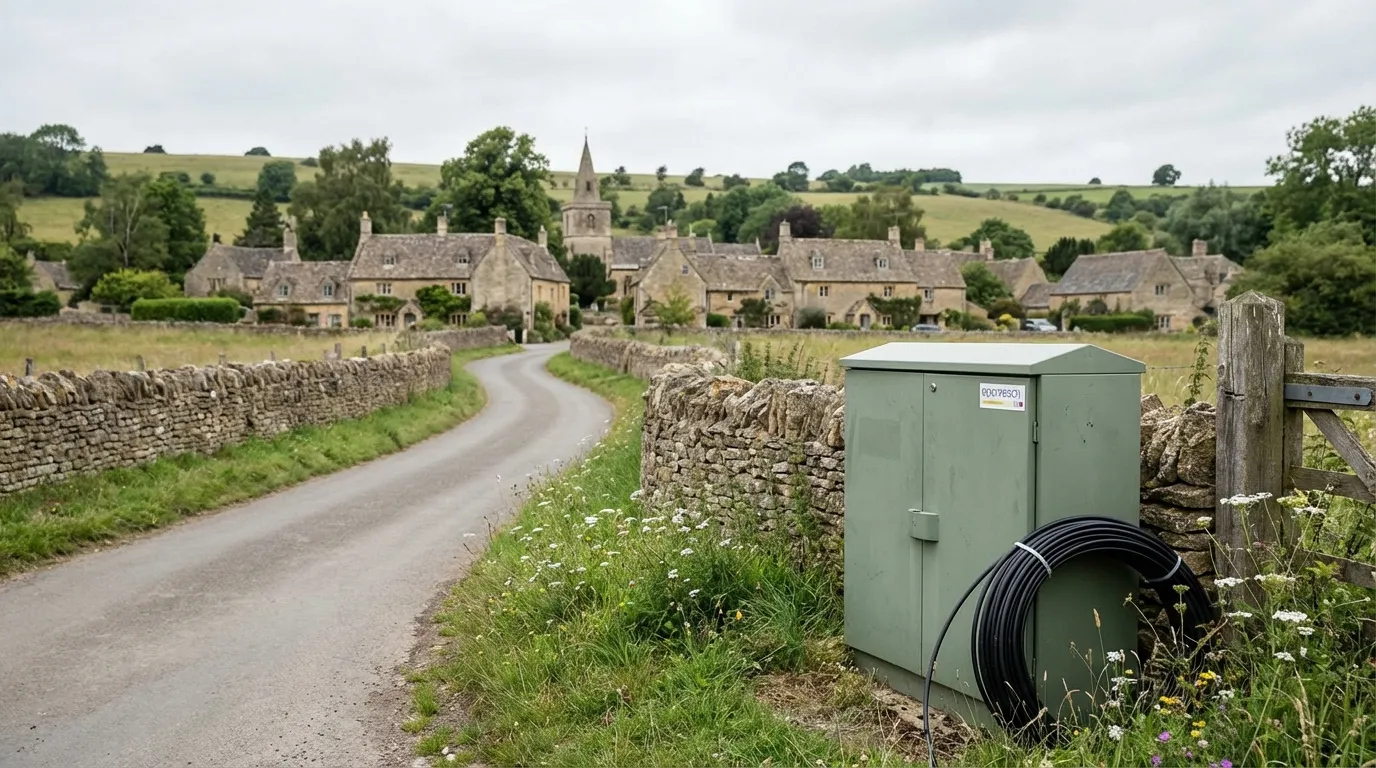

Remote work should mean working from anywhere. In practice, “anywhere” has often meant “anywhere with decent broadband” – which, in the UK, has historically excluded large parts of the countryside. That’s changing, and the numbers are starting to look meaningful.
The UK government’s Project Gigabit programme – a £5 billion investment in gigabit-capable broadband – is now upgrading over 750 premises per day, the fastest rate since the programme launched in 2021. Gigabit coverage has reached approximately 90% of UK premises, up from under 50% just three years ago.
For remote workers weighing the move from expensive cities to more affordable rural or semi-rural areas, this changes the calculation significantly.
What Is Project Gigabit?
Project Gigabit is the UK government’s flagship broadband infrastructure programme, designed to bring gigabit-capable connections (1,000 Mbps or faster) to areas where commercial providers wouldn’t build without public subsidy. That typically means rural communities, small towns, and hard-to-reach properties where the cost of laying fibre is too high for a market-led return.
The programme works through a combination of:
- Procurement contracts with providers like Openreach, CityFibre, and GoFibre to build gigabit infrastructure in specific areas
- Voucher schemes for individual rural properties to contribute toward connection costs
- Partnership with commercial rollout – coordinating public funding with the private sector to avoid duplication
Openreach, the UK’s largest network builder, has already passed 22 million premises commercially and aims for 25 million by the end of 2026, with up to 30 million by the end of the decade. Project Gigabit fills in the gaps that commercial investment won’t reach.
The Numbers So Far
As of early 2026:
- ~90% of UK premises now have access to gigabit-capable broadband
- 750+ premises per day are being upgraded through the programme
- Over 1 million additional premises are due upgrades through live contracts
- 99% coverage target has been set for 2032 (pushed back from an original 2030 deadline)
- Ofcom forecasts up to 97% coverage by January 2028
A new address checker launched in March 2026 on GOV.UK allows residents of England and Wales to enter their postcode and see whether Project Gigabit funding is planned for their area – a useful tool if you’re considering a rural relocation. Scotland and Northern Ireland have separate broadband services.
Why This Matters for Remote Workers
The cost-of-living gap between UK cities and rural areas is substantial. A one-bedroom flat in London costs £1,800–£2,200 per month. In a market town in Yorkshire, the West Country, or rural Wales, equivalent or better housing might cost £500–£700. That’s a potential saving of over £15,000 a year – before you factor in lower food costs, free parking, and the absence of an expensive commute.
The catch has always been connectivity. Video calls freeze, large files crawl, and VPN connections drop. Gigabit broadband eliminates these problems entirely. With 1,000 Mbps, you can run multiple video calls simultaneously, upload large design files or datasets without waiting, and maintain a stable VPN connection to corporate networks – all without the anxiety of “will the internet hold up?”
What Gigabit Speeds Actually Mean in Practice
| Activity | Bandwidth Needed | Gigabit Headroom |
|---|---|---|
| HD video call (Zoom/Teams) | 3–5 Mbps | 200x+ over |
| 4K video streaming | 25 Mbps | 40x over |
| Large file upload (1GB) | ~8 mins at 20 Mbps | ~8 seconds at gigabit |
| VPN + cloud apps | 10–25 Mbps | 40–100x over |
| Multiple users, same household | 50–100 Mbps | 10–20x over |
For households where two or more people work remotely – increasingly common – gigabit connectivity means no more fighting over bandwidth. This is a genuine quality-of-life improvement that makes rural remote work practical rather than aspirational.
The Voucher Scheme
For properties in areas where Project Gigabit contracts aren’t yet in place, the government’s Gigabit Broadband Voucher Scheme offers funding to help cover connection costs. Rural homes and businesses can apply for vouchers worth up to £4,500 (residential) to contribute toward the cost of installing a gigabit connection.
Since June 2025, the scheme is open to properties with broadband speeds below 1 Gbps (previously 100 Mbps) – significantly expanding eligibility. Providers registered with the scheme handle the installation, and the voucher covers part or all of the cost depending on the property’s location and existing infrastructure.
Check eligibility through the GOV.UK address checker.
Where the Gaps Remain
While 90% coverage is impressive, the final 10% is the hardest – and most expensive – to reach. These are typically:
- Very remote properties – isolated farmhouses, island communities, properties far from existing fibre routes
- Listed buildings and conservation areas – where installation restrictions add complexity and cost
- Areas with difficult terrain – mountainous regions, flood plains, properties requiring long cable runs
The shift from a 2030 to a 2032 target for 99% coverage reflects this reality. Some of the remaining contracts have been scaled back as providers encounter higher-than-expected costs. For properties in the final percentage, satellite broadband (such as Starlink, which offers 50–200 Mbps in the UK) provides an interim solution – not gigabit, but sufficient for most remote work.
The Bigger Picture
Project Gigabit is infrastructure policy, but its impact is felt as lifestyle policy. Every rural property that gains gigabit broadband is a property where someone can realistically work remotely – which means more choices about where to live, lower housing costs, stronger local economies in places that have been losing working-age residents for decades, and a genuine alternative to the urban concentration that defines much of UK economic life.
For remote workers thinking about their next move, the question is no longer “can I get broadband?” but “how fast will it be?” In an increasing number of places across the UK, the answer is: fast enough for anything. The impact is already visible in Britain’s coastal towns, where Project Gigabit-funded upgrades have made the Kent and Sussex coast broadband-competitive with major cities.
For more on where to base yourself in the UK, see our UK cities for remote workers guide and The State of Remote Work in the UK.
Sources: GOV.UK – New Gigabit Address Checker | ISPreview – Project Gigabit Broadband Rollout | Ofcom – Connected Nations Report