What ElevenLabs does
ElevenLabs builds AI voice technology – speech synthesis, voice cloning, dubbing and audio tooling used by publishers, studios, game developers and anyone turning text into speech at scale. It is one of the most prominent companies in generative audio, and it opened a European headquarters in London.
It describes itself as remote-first and global, with staff across more than fifteen countries, alongside physical hubs for people who want them.
Remote Work Europe tracks ElevenLabs through the Connected members’ jobs board, where it was the single largest source of live European roles at the end of September 2026.
Remote culture: what it’s actually like
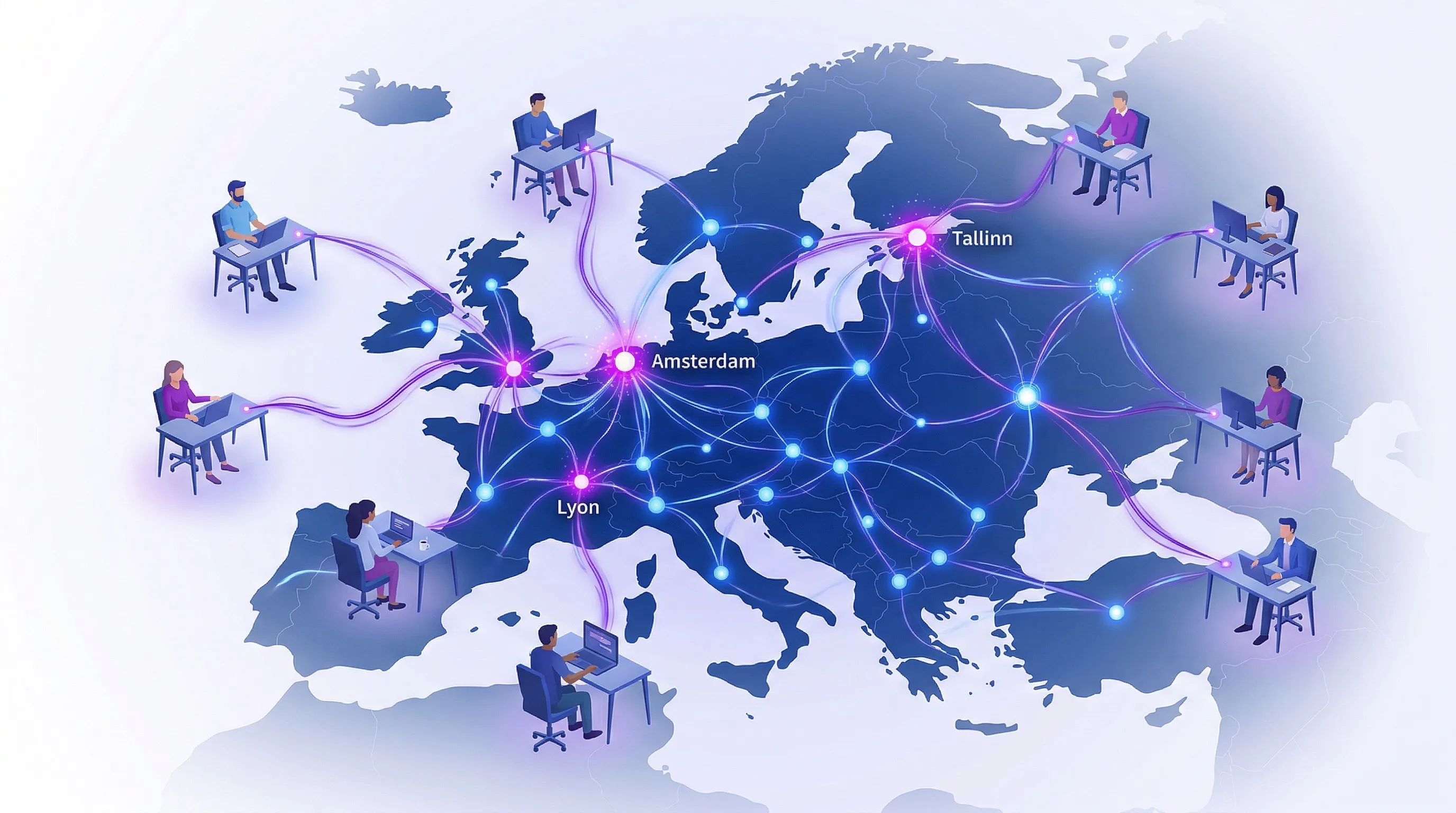
Remote-first with optional hubs is the stated arrangement, and the hiring pattern is consistent with it – roles spread across eight European countries rather than clustered around London.
The honest context is that ElevenLabs is a fast-scaling, well-funded AI company, and those environments are demanding in a particular way. Pace is high, scope changes, and the company is competing for people against every other AI firm with money. Remote-first here means genuinely distributed; it does not mean gentle.
Hiring in Europe: the details
Countries. Broad. Of forty-nine ElevenLabs roles on our board at the end of September 2026: eighteen in the United Kingdom, five in Sweden, four in Poland, four open EU-wide, four in France, four in the Netherlands, three in Germany and three in Italy.
Employment model. Not consistently stated in the listings.
Language. English as the working language, with four language-specific roles in the set – including Polish-speaking customer success and Spanish-market sales. A company selling voice technology across Europe needs people who speak the market.
Salary approach. Not published on the adverts. Compensation and total rewards appears as a role in its own right, which suggests the structure is being formalised.
Remote Work Europe Connected
EUR 15 a month for daily curated remote job leads across Europe, hand-picked by a human and scam-filtered, with a non-technical filter because most job boards are built for engineers.
Who they’re looking for
Far more commercially than the company’s reputation suggests. Thirty-one of forty-nine roles on our board were non-technical: account executives by market, social growth strategists, customer success, accounts payable, compensation and rewards.
The technical hiring is concentrated around the creative product – design engineers and full-stack engineers for the Creative Studio, rather than core research roles.
If you assumed a frontier AI company hires only researchers, the numbers say otherwise. Roughly two in three of its European openings were commercial or operational.
What the hiring pattern tells you
Here is the thing we would want a reader to take away, and it cuts against the excitement.
Not one of the forty-nine ElevenLabs roles carried our gateway flag.
A gateway role, as Remote Work Europe defines it, is one where an experienced person can bring their background into a first remote setting – where the employer is not screening for a remote track record because they cannot. Famous remote-first companies are the opposite case. They receive enormous volumes of applications and can afford to select for people who have already proved they work well remotely.
That is not a reason to avoid applying. It is a reason to be realistic about the odds, and to make sure ElevenLabs is not the only kind of employer on your list. The companies where a first remote role is genuinely winnable tend to be the ones you have not heard of, and our guide to remote gateway roles explains the four signals that identify them.
The volume is still worth having. Forty-nine live European roles from one employer is rare, and the commercial weighting makes most of them open to people who do not write code.
How to apply
- Careers page: ElevenLabs posts through Ashby and applications go directly to the company
- LinkedIn: ElevenLabs on LinkedIn
Specific tips: use the product before you apply, and say what you built with it – at a company whose tools are free to try, having actually made something is a cheap and uncommon differentiator. For the market-facing sales roles, the language requirement is real rather than preferred. And given the application volume, a generic application will not land: name the specific product surface you want to work on.
See our full guide to Remote-First Companies That Actually Hire in Europe, and our honest breakdown of what “remote” actually means on a job advert.