In 2001, I had proved to my employer that working from home worked, and also that the subsidiary business I was working on had real potential. In fact, it needed another team member. I didn’t realise the inflexion point represented by that first hire of a part-time administrator, and I focused on getting somebody local who could sit in the corner of my spare room while she trained.
While I loved everything that remote work gave me as a team of one, I’d always thought we’d probably hire an office one day. But at the end of my first employee’s probationary review, she brought up something I hadn’t thought through: How about I work this way as well? Can you set me up to work from home like you do?
So we did – a process involving lots of beige boxes and Ethernet cables, but it proved a blueprint for how we recruited and grew going forward.
And over time I built a team of people, which came to include those I had never met in person. We held a small business together across time zones and dial-up connections, over email and a great deal of good faith. I did not have a word for what we were doing. “Remote work” was barely a phrase, and “working from home” still conjured someone in their pyjamas dodging the office, rather than someone running something serious from a spare room, and at that point we didn’t put our atypical working arrangements front and centre to our research clients either. I was always happy to go to them for meetings, at least until this working arrangement gave me the freedom to relocate from London to Spain.
Of course the social acceptability and awareness of remote work continued to evolve alongside the technology and connectivity that made it work in the first place. And when I went freelance nearly a decade ago, I realised that my experience growing one of the first truly distributed teams put me in a good place to help other people do the same, and develop a career blending journalism, consultancy, content strategy, and advisory work.
In the 2010s, I worked with companies and teams who wanted distributed work to genuinely function – not as a perk, not as an emergency, but as a way of building something that would last. I sat with leaders who could feel their teams fraying at the edges and could not name why. Good people, real effort, and still the thing would not hold together. And that was if they even got to the point of trying it in the first place, because it felt like a lot of the consultancy was around endlessly scoping and piloting and reviewing and then maybe piloting once more. Actually committing to remote working felt like too huge a step to contemplate, or they’d had a look and decided it wasn’t for them – “thank you for the report and presentation and we’ll file that somewhere in case we need it.”
Then 2020 happened, and suddenly every manager realised their team could work remotely if they had to, at least sort of – even though many people on both sides had a terrible experience, even beyond the threat of a global health crisis. I remember the friends who’d sometimes been curious about how I worked, saying they had no idea how I’d endured it for two decades. This “working from home” thing was terrible! And probably for them it was – their managers had never had to do their job in this way, and a mixture of paranoia, presenteeism, and general panic combined with totally inadequate setups and systems, to create a genuinely hellish experience for many.
But some still saw the potential and the unlock that came from realising their job could be done without going to an office and starting to imagine the possibilities if they never had to do that again. So many people realised they did not want to hand the freedom back that I started a Facebook group for people in Spain asking the same question over and over: how do I build a life where I get to work like this? That group became Remote Work Spain, then Remote Work Europe – a community, a mailing list, a growing body of content, and eventually a place people trust to tell them the truth about visas, tax, jobs, and what it is really like to move your whole life to another country.
For a long time, two professional strands – supporting job seekers and helping team leaders – lived separately in my head. I moved between the two without noticing I was reaching for the same knowledge in both rooms. The same problems, the same friction points, the same “one issue disguised as another” – nope, getting a new project management app won’t cure your failure to design your work around collaborative visibility and accountability, nor will listing the apps you’ve used get you the remote job of your dreams…
So then I drew the diagram, and I realised I’d been circling the same five things for decades, without ever giving them a name. Every team, every situation was different – and yet, every situation fitted into one of five buckets, every single time.
Culture – do people share what matters, when no one is in the room to remind them?
Communication – does the right message reach the right person at the right time, or get lost on the way?
Console – do the tools serve the work, or make it more difficult?
Collaboration – can people actually work together across distance, without friction or frustration?
Connection – are people trusted and engaged, or slowly drifting into isolation?
A struggling remote team has usually got one or two of these wrong. So has a talented person who cannot land a remote job and has no idea why. The same five foundations, seen from two sides of the same glass.
That is Remote Readiness. It is the framework underneath everything I do – the part I actually know, distilled from everything I have watched succeed and fail since that first hire at the turn of the century. It is deliberately not tied to Europe, or to a visa, or to any single audience. A Head of Operations in Manchester and a career-changer in Málaga are working on the same five things. One model, two paths: for the people building teams, and for the people building their own remote careers.
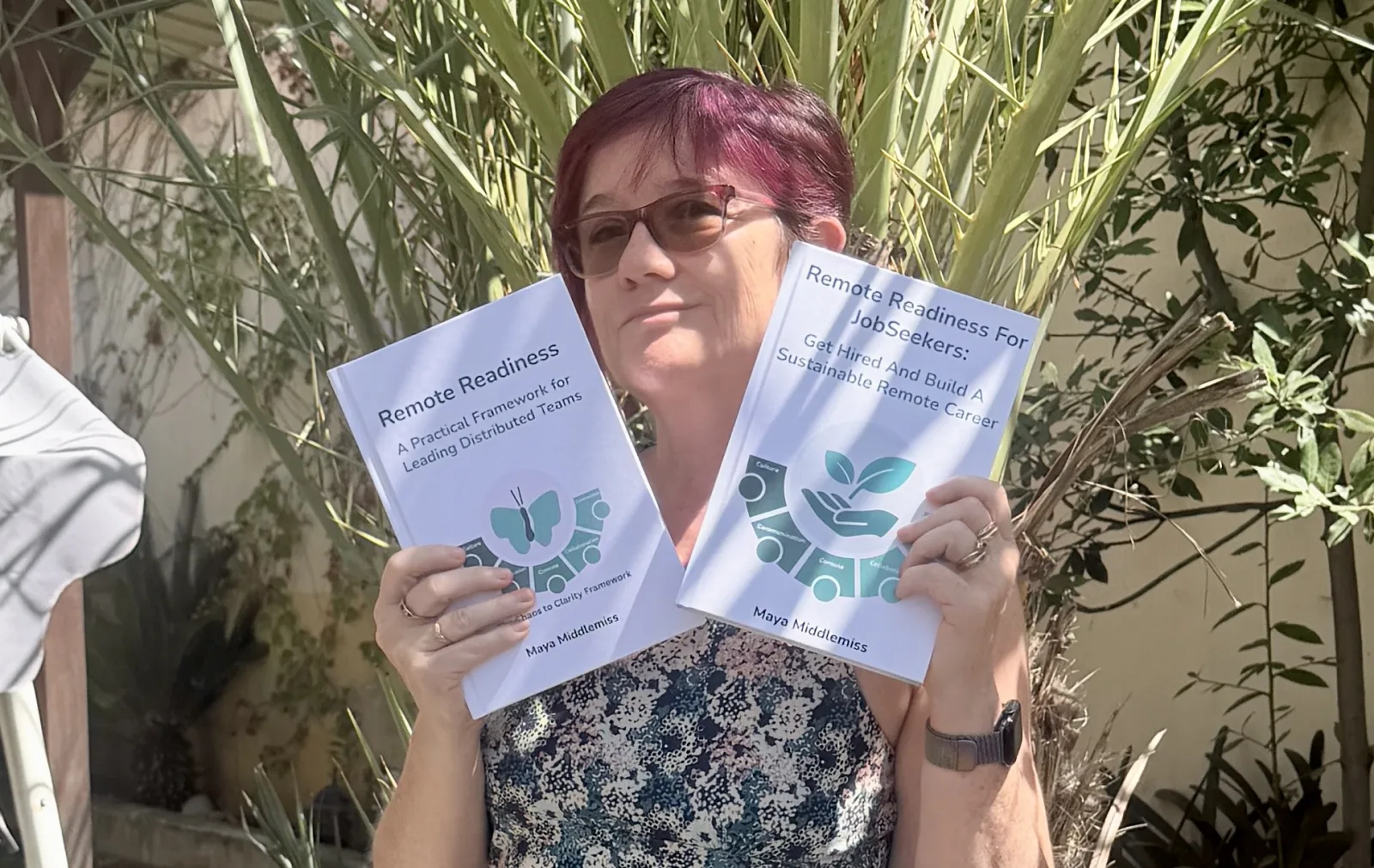
I wrote the first Remote Readiness book for team leaders to put this work into context, about everything they shared with me about hiring and recruitment, combined with everything I knew from working with the Remote Work Europe community of job seekers, to point me at the need for the second book, flipping the framework on its head to help job seekers identify exactly what distributed team leaders are looking for and need to see in a prospective employee.
Remote Work Europe reaches beyond Remote Readiness in return. A framework on its own is only a diagram, a generalisation. Remote Work Europe is where it meets real life – the messy, specific, human version. The person who has the visa but cannot find a flat. The American who lies awake worrying about the Spanish tax office. The team lead who read the book and now has a very real Tuesday-morning problem. The community is where the model gets tested against reality, and reality always has the final word.
That is the half of my work that keeps the other half honest, and helps me stay up to date with trends and changes too. From more or less universal 5G to the existence of co-living and digital nomad visas, a great deal has changed since I started building this framework in my head. It gets tested every day, and that’s what keeps it live and valuable. Console, the technical element of the framework, changes in manifestation on more or less a monthly basis, but the core elements remain true: we all need a digital workspace which serves our needs, whatever devices or apps may be involved in a year’s time.
So the two concepts work in parallel, and neither one lives inside the other. Remote Readiness is what I have learned. Remote Work Europe is where I practise it, out loud, with a community that will tell me the moment I am wrong.
The two books serve different audiences, and yet I know plenty of people who have read both: job seekers who want to dive deeper into how their next role will really work and how to make a great success of it, and the managers and recruiters who appreciate the grounding in that transition and the examples and experiences people can bring to their first remote role. Similarly, the keynotes and workshops I run can easily be adapted to both audiences, depending on who’s in the room, and their immediate professional goals.
Remote Work Europe is remote-ready by design, and I’ll always practise what I preach. I still have never opened an office anywhere, and I’m pretty sure I never will!
Explore the Remote Readiness framework – one model, two paths, for teams and for your remote career.