Krakow: Europe’s best-value city for remote workers 2026
TL;DR: Krakow is Europe’s best-value city for remote workers in 2026, with total monthly costs of ~EUR 1,423 – including rent of EUR 450–700 for a central 1-bed apartment. Internet speeds reach 300–500 Mbps. The coworking scene is mature, the cultural infrastructure is world-class, and eating out costs EUR 5–8 for lunch. No other EU city matches this combination of quality and affordability.
Every year, publications and platforms rank cities for remote work across various metrics – cost, connectivity, safety, community, lifestyle. Krakow keeps appearing near the top of every list, and in 2026 it has claimed the title outright: the best-value city for remote workers in Europe.
The numbers support the claim. A total monthly budget of around EUR 1,423 covers rent, food, transport, coworking, and entertainment in a city with world-class architecture, a sophisticated cultural scene, excellent internet, and a community of remote workers that has been growing steadily for years. No other city in the EU offers this combination of quality and affordability.
But Krakow’s appeal is not only about the numbers. It is a city with genuine depth – centuries of history, a thriving university culture, a food and nightlife scene that punches well above its weight class, and an atmosphere that balances old-world charm with modern energy. This guide covers what you need to know to make it work.
Why Krakow stands out
The value equation
To understand Krakow’s position, consider what you get for your money compared to other popular remote work destinations in Europe.
| City | Monthly rent (1-bed) | Total monthly cost | Internet speed | Coworking options |
|---|---|---|---|---|
| Krakow | EUR 450 – 700 | EUR 1,423 | 300 – 500 Mbps | Extensive |
| Lisbon | EUR 1,200 – 1,600 | EUR 2,500 | 200 – 500 Mbps | Extensive |
| Athens | EUR 550 – 850 | EUR 1,630 | 100 – 200 Mbps | Growing |
| Budapest | EUR 500 – 800 | EUR 1,500 | 200 – 500 Mbps | Good |
| Tallinn | EUR 600 – 900 | EUR 1,700 | 300 – 1,000 Mbps | Good |
| Berlin | EUR 900 – 1,400 | EUR 2,200 | 100 – 250 Mbps | Extensive |
Krakow consistently undercuts comparable cities while matching or exceeding them on infrastructure quality. The internet is fast – genuinely fast, not just “adequate for video calls” fast. The coworking scene is mature. The transport system works. And the city is safe, walkable, and visually stunning.
Beyond the budget
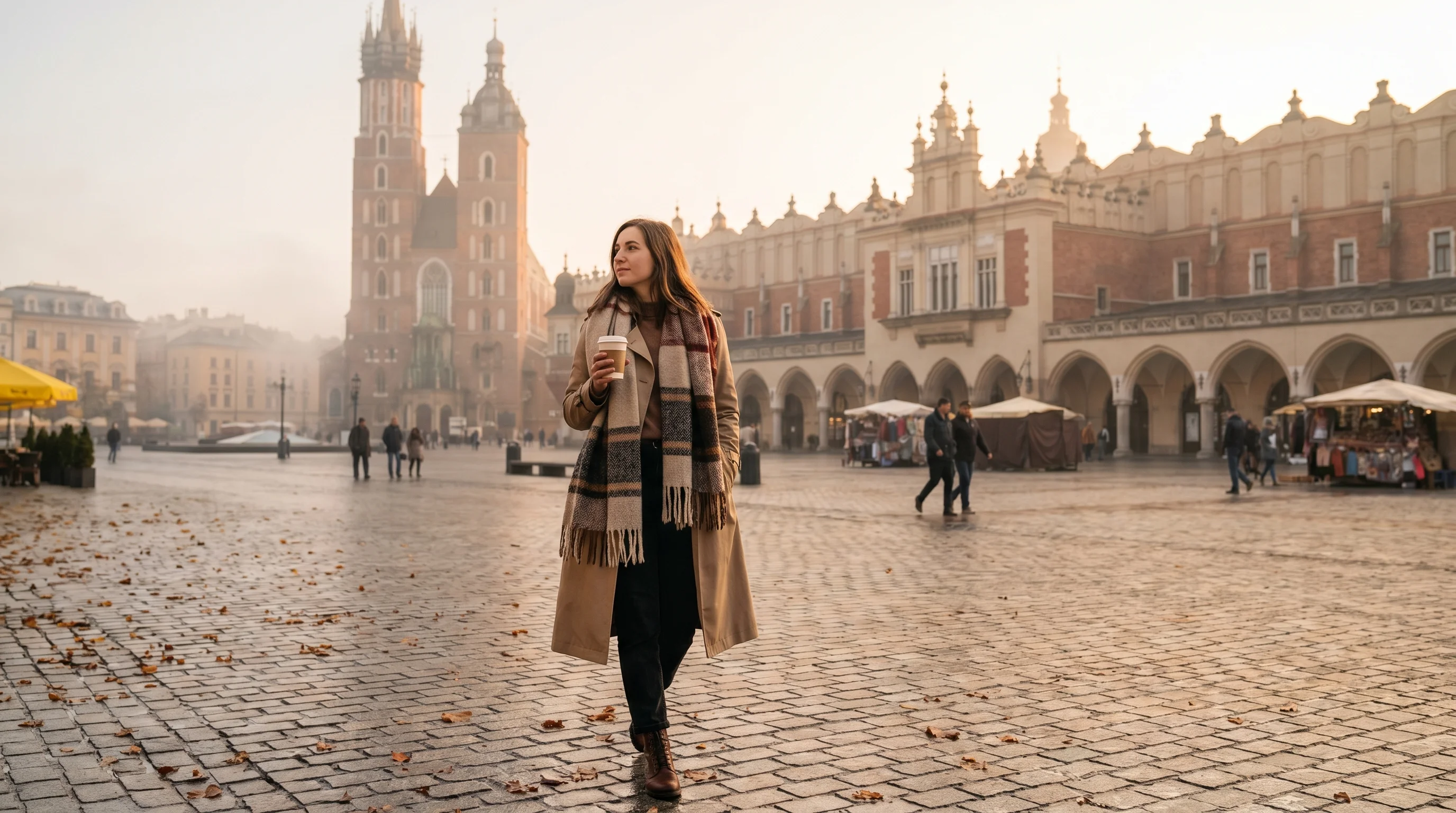
Cost alone does not make a city worth living in. Krakow succeeds because the low prices coincide with genuinely high quality of life. The Main Market Square (Rynek Glowny) is the largest medieval town square in Europe. The Wawel Royal Castle anchors the city’s skyline. The Jewish Quarter of Kazimierz – once neglected, now one of Europe’s most vibrant cultural districts – offers bars, restaurants, galleries, and street art that rival any neighbourhood in Berlin or Barcelona.
The cultural infrastructure is deep. Opera, theatre, live music, independent cinema, contemporary art – Krakow has all of it, at prices that make it accessible rather than aspirational. A ticket to the Krakow Opera costs a fraction of what you would pay in Vienna or Milan for comparable quality.
Cost of living breakdown
Here is what a typical month looks like for a remote worker in Krakow in 2026.
| Category | Monthly cost (EUR) | Notes |
|---|---|---|
| Rent (1-bed, central) | 450 – 700 | Kazimierz/Podgorze; outer areas from EUR 350 |
| Utilities | 100 – 150 | Heating significant in winter |
| Groceries | 180 – 250 | Excellent local markets |
| Eating out | 120 – 200 | Lunch EUR 5 – 8 at a local restaurant |
| Transport | 20 – 35 | Monthly tram/bus pass |
| Coworking | 80 – 180 | Hot desk range |
| Entertainment | 50 – 100 | Cinema, bars, culture |
| Health insurance | 60 – 120 | Private coverage |
| Total | 1,060 – 1,735 | Average ~EUR 1,423 |
A few things stand out. The transport costs are almost negligible – Krakow’s tram and bus system is efficient, well-maintained, and extraordinarily cheap. Eating out is genuinely affordable; you can have a proper sit-down lunch with soup and a main course for EUR 5 – 8 at a milk bar (bar mleczny) or local restaurant. And the entertainment budget stretches further than almost anywhere in Western Europe.
The main cost variable is heating. Krakow winters are cold – properly cold, with temperatures regularly below zero from December through February. Heating costs can double your utility bill during winter months. Factor this into your budget rather than being surprised by a January electricity bill.
Neighbourhoods
Kazimierz
Once Krakow’s Jewish Quarter, Kazimierz has undergone one of Europe’s most remarkable urban transformations. From near-abandonment in the 1990s to its current status as the city’s cultural epicentre, the neighbourhood now offers an extraordinary density of restaurants, bars, galleries, bookshops, and vintage stores. It is atmospheric, walkable, and has a creative energy that draws comparisons to Kreuzberg or the Marais – before those neighbourhoods became expensive parodies of themselves.
For remote workers, Kazimierz combines character with convenience. It sits between the Old Town and Podgorze, with good tram connections and walkable access to the Main Market Square. Rents are moderate – EUR 500 – 700 for a one-bedroom apartment – and the area has enough cafes with good wifi to provide alternatives when you want to work outside the apartment or coworking space.
The main consideration is noise. Kazimierz’s nightlife is vigorous, and apartments on main streets can be loud on weekend nights. If you are a light sleeper, look for apartments on quieter side streets or upper floors.
Podgorze
Across the river from Kazimierz, Podgorze has emerged as one of Krakow’s most interesting neighbourhoods for residents. It is less tourist-focused than Kazimierz while offering excellent amenities – the Zabka convenience stores that dot Polish cities, independent cafes, good restaurants, and proximity to the Krakus Mound for walking and views.
Podgorze is home to the Schindler’s Factory museum and the growing Zablocie district, where former industrial buildings are being converted into apartments, offices, and cultural spaces. Rents are typically 10 – 20% lower than equivalent Kazimierz apartments, and the atmosphere is calmer. The neighbourhood suits remote workers who want to be close to the action without being in the middle of it.
Stare Miasto (Old Town)
The historic centre within the Planty park ring is beautiful but primarily oriented toward tourism. Living here means daily exposure to the city’s finest architecture but also to tourist crowds, higher prices, and the particular atmosphere of a neighbourhood that exists partly as a stage set. Some remote workers love it. Others find the tourist density wearing after the first few weeks. Rents are at the higher end of the Krakow range – EUR 600 – 800 for a one-bedroom.
Nowa Huta
The socialist-realist planned district built in the 1950s as a model workers’ community, Nowa Huta is architecturally fascinating and the cheapest central area in Krakow. It has a growing reputation among younger Poles and international residents who appreciate its wide boulevards, green spaces, and absence of tourist infrastructure. The tram to the centre takes 20 – 30 minutes. It is an unconventional choice but an interesting one for workers who enjoy living in a place with genuine character and story.
Coworking spaces
Krakow’s coworking scene reflects the city’s position as a significant tech hub – the city hosts offices for Google, IBM, ABB, and numerous Polish tech companies, creating a professional ecosystem that supports sophisticated coworking infrastructure.
Cluster Cowork
One of Krakow’s most popular coworking spaces, Cluster operates multiple locations across the city. The spaces are well-designed, professionally managed, and offer a range of options from hot desks to private offices. Monthly hot desk memberships start around EUR 100. The community events and networking opportunities are strong – this is not a space where people work in isolation.
Hub:raum
A startup-focused coworking space with ties to the tech ecosystem, Hub:raum offers a more entrepreneurial atmosphere. It tends to attract startup founders, freelance developers, and tech-adjacent professionals. Good for networking within the Polish tech scene.
Coworkium
A smaller, more intimate space in the Kazimierz area that emphasises community over scale. Coworkium is popular with freelancers and solo remote workers who prefer a quieter, more personal environment. Pricing is at the lower end of the market – around EUR 80 – 120 for a hot desk.
Others
Spaces like O4 Coworking and Business Link round out the picture. The density of options means you can try several before committing, and day passes are widely available for EUR 8 – 15.
Internet and connectivity
This is one of Krakow’s strongest selling points. Poland has invested heavily in broadband infrastructure, and Krakow benefits from fibre coverage that is extensive and genuinely fast. Home broadband speeds of 300 – 500 Mbps are standard through providers like UPC, Orange, and Play. Gigabit connections are increasingly available.
Mobile data is excellent, with Play, Orange, T-Mobile, and Plus offering competitive 4G/5G coverage across the city. Prepaid SIM cards with generous data allowances are available for EUR 5 – 10 per month – a fraction of what equivalent packages cost in Western Europe.
Every coworking space and most cafes offer reliable wifi. The infrastructure reliability is high – outages are rare and typically brief. For remote workers whose livelihood depends on consistent connectivity, Krakow delivers with a level of reliability that not all popular destinations can match.
Poland’s four-day work week trial
Poland’s government has been actively exploring a four-day work week, with pilot programmes underway in the public sector since 2025. While this does not directly affect remote workers employed by companies outside Poland, it reflects the broader cultural direction – Poland is increasingly positioning itself as a country that takes work-life balance seriously and is willing to experiment with progressive labour policies.
For remote workers, the practical impact is indirect but real. A society that values time outside of work tends to create the kind of urban environment – vibrant evening culture, active weekends, parks and recreation that are actually used – that makes a city enjoyable to live in. Krakow already benefits from this; the four-day work week conversation reinforces the trajectory.
If you are employed by a Polish company or considering working through a Polish entity, the four-day work week trial is worth monitoring. Our EOR guide for Europe covers the mechanics of working through a local employer while maintaining a remote arrangement.
Visa and residency
Poland does not currently offer a dedicated digital nomad visa. This is a gap in the country’s otherwise progressive approach to remote work, and there are ongoing discussions about introducing one, but nothing has been formalised as of early 2026.
For practical purposes, here is how the access works:
EU/EEA citizens can live and work in Poland freely. Registration with the local authorities is required if you stay longer than three months, but the process is straightforward. Poland is in the EU and the Schengen Area, so movement is unrestricted for European citizens.
Non-EU citizens have several options. The standard Schengen visa allows stays of up to 90 days within any 180-day period – long enough for an extended trial but not for permanent relocation. A national visa (type D) for self-employment or business purposes is available but requires establishing a Polish business entity. Some remote workers use a combination of Schengen stays and strategic travel to maintain legal presence, though this approach has legal grey areas that are worth understanding clearly.
The lack of a dedicated DNV is a disadvantage compared to Portugal, Greece, or Italy. However, for EU citizens – who represent a large proportion of Europe’s remote workforce – this is irrelevant. If you hold an EU passport, Krakow is as accessible as any other city on the continent.
Practical tips
Language
Polish is a Slavic language with a reputation for difficulty, and the reputation is earned. The grammar is complex, the pronunciation challenging for non-Slavic speakers, and the alphabet includes characters that do not exist in Romance or Germanic languages. That said, English is widely spoken in Krakow, particularly among younger people and in professional settings. You can manage daily life comfortably in English.
Learning basic Polish – greetings, numbers, restaurant vocabulary, polite phrases – is appreciated and will smooth interactions in situations where English is not available. Language schools and private tutors in Krakow are affordable, with group classes running EUR 5 – 10 per session.
Food culture
Polish food is hearty, satisfying, and excellent value. The milk bar (bar mleczny) tradition – subsidised canteens serving traditional Polish dishes at rock-bottom prices – is alive and well in Krakow. A full meal at a milk bar costs EUR 3 – 5, and the food, while simple, is genuinely good. Pierogi, zurek (sour rye soup), bigos (hunter’s stew), and placki ziemniaczane (potato pancakes) are staples worth getting to know.
Beyond traditional food, Krakow’s restaurant scene has diversified enormously. Korean, Vietnamese, Middle Eastern, and Italian restaurants are abundant and consistently good. The Stary Kleparz market, operating since the 14th century, is a wonderful source of fresh produce, meats, and cheeses.
Climate
Krakow has a continental climate – warm summers (25 – 30 degrees) and cold winters (regularly below zero, occasionally reaching minus 15). The transitional seasons – April/May and September/October – are often the most pleasant, with mild temperatures and beautiful light. Winter requires proper clothing – a good down jacket, waterproof boots, and layers. The city handles winter well; transport runs reliably, buildings are well-heated, and the Christmas market season (November – January) gives the cold months a festive atmosphere.
Air quality has been a concern in Krakow, particularly during winter when coal heating and atmospheric inversions combine to create smog. The city has been aggressively addressing this through coal boiler replacement programmes and emission zones, and air quality has improved significantly. It remains something to monitor, particularly for those with respiratory sensitivities.
Getting around
Krakow’s tram and bus network is excellent – frequent, reliable, and covering the entire city. A monthly pass costs around EUR 20 – 35 depending on the zones selected. The city centre is highly walkable, with most areas of interest within a 30-minute walk of the Main Market Square. Cycling infrastructure is developing, with bike-sharing available and dedicated lanes on major routes.
Healthcare
Poland’s public healthcare system is available to residents and those covered by the EHIC/GHIC card (for EU citizens). Quality in Krakow is reasonable for routine care. Private healthcare is affordable by Western European standards – a GP visit typically costs EUR 30 – 50, and private clinics offer short waiting times. Medicover and LuxMed are the main private healthcare networks, with English-speaking doctors available.
The bigger picture
Krakow’s position as Europe’s best-value remote work city is not accidental. It reflects a convergence of factors: Poland’s EU membership and infrastructure investment, Krakow’s specific combination of cultural depth and tech-sector growth, and a cost of living that has remained moderate even as the city has gained international attention.
The question for most remote workers is not whether Krakow is good value – that is evident from the numbers – but whether the non-financial factors align with what you are looking for. If you want Mediterranean climate and beach access, Krakow is obviously not your city. If you want world-class culture, fast internet, excellent food, a genuine community, and the financial freedom that comes from living well below your means, it is hard to do better anywhere in the EU.
The remote workers who thrive in Krakow tend to be those who engage with the city’s cultural depth – the concert at the Philharmonic, the exhibition at MOCAK, the weekend hike in the Tatra Mountains two hours south. They learn some Polish, build friendships beyond the international bubble, and discover that this former royal capital has a richness that the budget-destination label barely hints at.
If you want a ready-made community from day one, coliving spaces for remote workers are worth exploring – especially when you’re new to a city and want to build connections quickly. For broader context on working remotely from Poland, see our Poland country hub. And for those considering working for a company in a different European country while based in Krakow, our employer of record guide explains how to structure the arrangement compliantly.
Frequently asked questions
How much does it cost to live in Krakow as a remote worker? Krakow is one of Europe’s most affordable cities for remote workers. Budget EUR 1,200–1,600/month for a comfortable solo lifestyle. Rent for a one-bed apartment in central neighbourhoods runs EUR 500–700. Eating out is excellent value – full meals from EUR 5–8.
Does Poland have a digital nomad visa? No. EU/EEA citizens can live and work freely. Non-EU citizens need to use the standard Schengen 90/180-day rule for short stays, or apply for a national visa for longer-term residency. There’s no dedicated DNV programme.
Is the internet fast enough for video calls in Krakow? Yes. Poland has excellent internet infrastructure. Fibre connections with 100–500 Mbps are widely available in Krakow. Most coworking spaces offer reliable, fast wifi. Mobile data coverage is also strong.
Do I need to speak Polish to live in Krakow? You can manage daily life in English, particularly in central areas and professional settings. However, basic Polish is appreciated and helpful for bureaucracy, local shops, and building genuine connections. Language schools are affordable – EUR 5–10 per group session.
What’s Krakow like in winter? Cold. Temperatures regularly drop below zero from December to February, with occasional snow. But the city is atmospheric in winter – Christmas markets, hot chocolate in the Main Square, and skiing in the Tatra Mountains two hours south. The key is whether you’re prepared for short days and limited sunshine.
Remote Work Europe provides independent, European-focused guidance for remote workers navigating life and work across the continent. For visa-specific guidance, always consult a qualified immigration advisor.