Romania doesn’t shout about itself the way Portugal or Spain does. It doesn’t have the Instagram-ready coastline of Croatia or the cafe culture reputation of Budapest. But for remote workers who care about the things that actually matter – fast internet, low costs, full Schengen access, and a straightforward visa process – Romania might be the smartest pick in Europe right now.
Since joining the Schengen Area in January 2025, Romania’s digital nomad visa has quietly become one of the most competitive offerings on the continent. Add in the fastest broadband in Europe, a flat 10% income tax rate for those who stay long-term, and a cost of living that lets you live well on a fraction of what you’d spend in Western Europe, and it starts to look like a serious contender.
Here’s what you need to know if you’re considering it.
Who is the Romania digital nomad visa for?
The visa targets non-EU/EEA citizens who work remotely using information and communication technology for employers or clients based outside Romania. That includes:
- Remote employees of companies registered outside Romania
- Freelancers and independent contractors working with international clients
- Business owners who manage a company registered outside Romania that has been operating for at least three years
If you’re an EU/EEA citizen, you don’t need this visa at all. You can live and work in Romania freely under EU free movement rules – just register your stay if you plan to be there longer than 90 days.
And if you’re looking for local employment within Romania, this isn’t the right route. The digital nomad visa is strictly for people whose income comes from outside the country.
Income and eligibility requirements
Romania’s income threshold is one of the higher ones in Eastern Europe, set at three times the national average gross salary. As of early 2026, that works out to approximately €3,700 per month (around 18,500 RON), though the exact figure adjusts as average wages rise.
You’ll need to prove you’ve been earning at least this amount for the six months before you apply, and that you can sustain it for the duration of your stay.
| Requirement | Details |
|---|---|
| Minimum monthly income | ~€3,700 (3x Romanian average gross salary) |
| Income proof period | 6 months of bank statements or payslips |
| Employment type | Remote work for foreign employer/clients only |
| Company ownership | Must have been operating for 3+ years |
| Criminal record | Clean criminal record certificate required |
| Health insurance | Valid for Romania, covering the full stay |
| Accommodation | Proof of housing (rental contract or hotel booking) |
It’s worth noting that when you renew the residence permit, the income requirement drops to just one times the average gross salary – a significantly lower bar.
Application process and costs
Romania’s process is relatively quick by European standards, with processing times of around 10 to 14 working days. Here’s how it works:
Step 1: Apply for the D visa online. Submit your application through the Romanian Ministry of Foreign Affairs eVisa portal. You’ll need your passport, proof of income, health insurance, accommodation proof, criminal record certificate, and a description of your remote work activity.
Step 2: Attend your visa appointment. After approval, collect your Type D visa at the Romanian consulate or embassy in your country of residence. The D visa is valid for 90 days.
Step 3: Apply for the residence permit. Once you arrive in Romania, apply for a 12-month residence permit at the local immigration office (IGI). This must be done before your D visa expires.
Step 4: Renew if needed. The residence permit can be renewed annually, for a total stay of up to 36 months.
| Fee | Amount |
|---|---|
| D visa application | €120 |
| Residence permit | ~€120 |
| Total initial cost | ~€240 |
That’s notably cheaper than many Western European equivalents, where visa and permit fees can run to €300 or more.
Tax treatment – the 183-day question
This is where Romania gets interesting, and where you need to pay attention.
Under Law no. 69/2023, digital nomad visa holders are exempt from Romanian income tax and social insurance contributions on their foreign-sourced income – but only for stays of up to 183 days in any 12 consecutive months.
If you stay beyond 183 days, you become a Romanian tax resident. At that point, you’ll owe Romania’s flat 10% income tax on your worldwide income, plus social contributions (health insurance at 10% and pension at 25%, though caps and exemptions may apply depending on your situation).
That 10% flat rate is still one of the lowest in the EU, and Romania has over 70 double tax treaties to prevent you from being taxed twice on the same income. But the jump from zero tax to full tax residency is significant, so plan accordingly.
As always with cross-border tax matters, get professional advice tailored to your specific situation. The interaction between your home country’s tax rules, Romania’s domestic law, and any applicable tax treaty can be complex – and getting it wrong is expensive. If you’re unsure how social security coordination works across borders, that’s another reason to consult a specialist before you move.
Cost of living – city by city
One of Romania’s biggest draws is how far your money goes. Even Bucharest, the most expensive city, is dramatically cheaper than most EU capitals. Here’s a realistic breakdown for a single remote worker:
| Expense | Bucharest | Cluj-Napoca | Brasov | Timisoara |
|---|---|---|---|---|
| 1-bed apartment (centre) | €550–700 | €400–550 | €350–500 | €350–450 |
| 1-bed apartment (outside centre) | €370–470 | €300–400 | €250–350 | €250–350 |
| Utilities (monthly) | €70–90 | €60–80 | €60–80 | €55–75 |
| Groceries | €200–270 | €180–240 | €170–230 | €170–220 |
| Eating out (meal for one) | €8–15 | €7–12 | €6–11 | €6–11 |
| Internet (fibre) | €6–10 | €6–10 | €6–10 | €6–10 |
| Coworking (monthly) | €100–180 | €80–150 | €70–120 | €70–120 |
| Monthly total (comfortable) | €1,300–1,700 | €1,100–1,400 | €1,000–1,300 | €950–1,250 |
That means even in Bucharest, you can live comfortably on well under half of what you’d spend in Lisbon, Barcelona, or Amsterdam. For remote workers earning the visa’s minimum threshold of ~€3,700/month, the savings potential is substantial.
Bucharest
The capital is Romania’s largest city and its economic hub. It has the widest choice of coworking spaces – Impact Hub, Mindspace, and The Institute are popular options – plus an international food scene, solid public transport, and an increasingly cosmopolitan feel. It’s also the most expensive Romanian city, though that’s a relative term.
Cluj-Napoca
Often called Romania’s Silicon Valley, Cluj is a university city with a thriving tech sector. It’s more compact and walkable than Bucharest, with a younger, creative energy. ClujHub and The Office are well-established coworking options, and the community of remote workers and entrepreneurs is growing fast. If you want a smaller-city feel with big-city infrastructure, Cluj is the one to watch.
Brasov
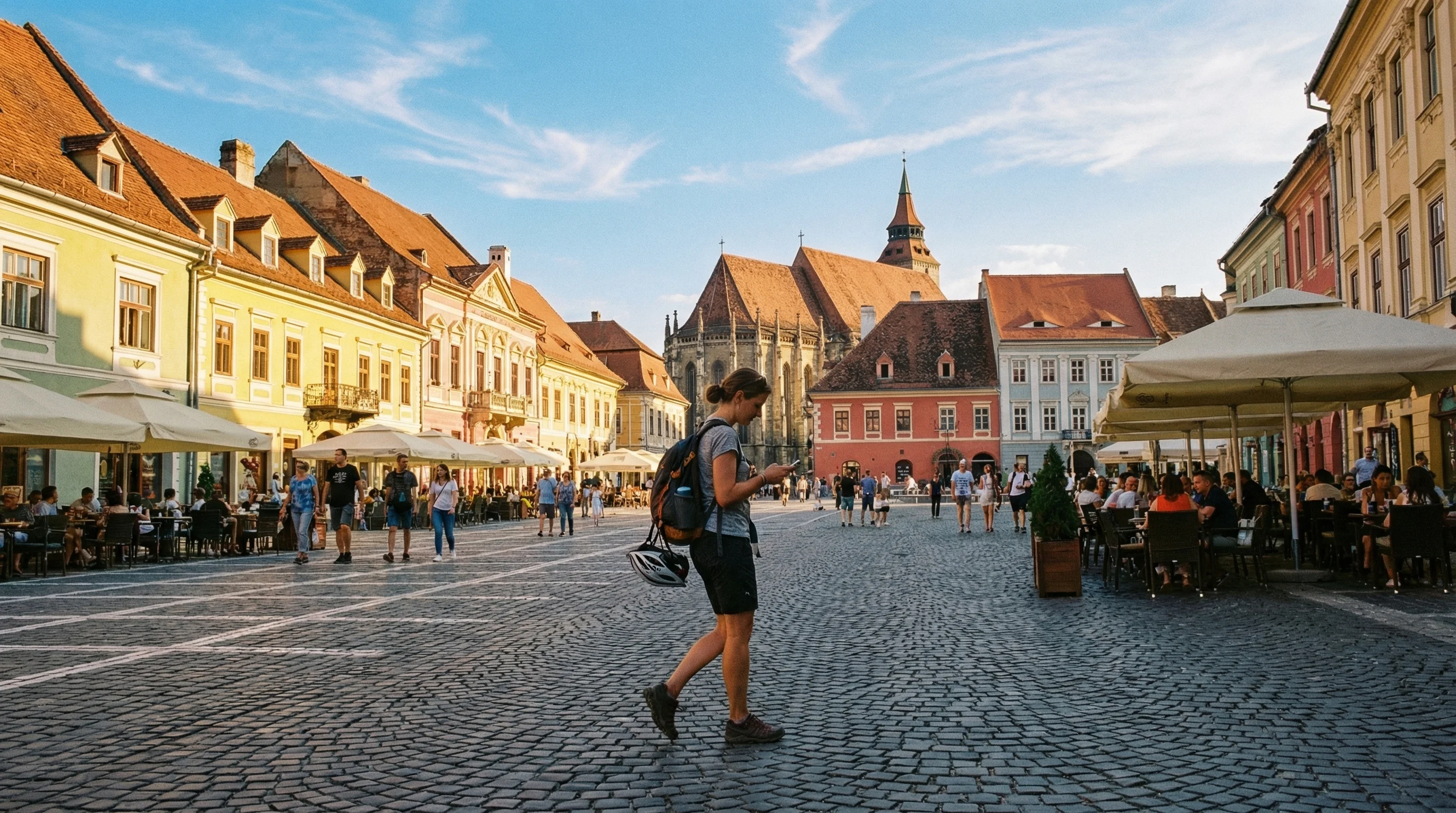
Nestled in the Carpathian Mountains, Brasov is the lifestyle pick. A beautifully preserved medieval old town, easy access to hiking and skiing, and a growing digital nomad scene make it ideal if you want to balance remote work with outdoor living. Coworking options include Kool Werk (right on the main square) and Hubba Hubba near the old town. The cost of living is lower than both Bucharest and Cluj.
Timisoara
Romania’s westernmost major city, close to the Hungarian and Serbian borders. Timisoara was a European Capital of Culture in 2023 and has a distinctly Central European character – think Viennese architecture and a relaxed pace. Workify in the old town offers coworking, and the city has a small but welcoming community of international residents. It’s the most affordable of the four cities listed here.
Healthcare
Romania’s public healthcare system is funded through social security contributions and is available to residents, but it has well-documented challenges – long waiting times, staffing shortages, and uneven quality between urban and rural areas.
For digital nomad visa holders, private health insurance is effectively a requirement, both for the visa application and for practical peace of mind. Private clinics in Bucharest and Cluj are modern, well-equipped, and staffed by English-speaking doctors. Providers like Regina Maria and MedLife operate extensive networks across the country.
International health insurance plans from providers such as SafetyWing, Allianz Care, or Cigna Global are commonly used by digital nomads and will satisfy the visa’s insurance requirement. Budget around €50–120/month depending on your age, coverage level, and whether you want outpatient care included.
Internet – Europe’s best-kept secret
This is Romania’s superpower, and it’s not an exaggeration.
Romania consistently ranks as having the fastest broadband in Europe, with average download speeds of around 230–260 Mbps. In Bucharest, average speeds top 250 Mbps. The country’s fibre-to-the-home infrastructure is extensive, and the major ISP Digi already offers 2.5 Gbps plans in larger cities, with 10 Gbps announced for Bucharest.
The cost? Plans start at around €6 per month. That’s not a typo.
Romania’s internet success story is the result of aggressive private-sector investment in fibre infrastructure combined with a light regulatory touch. Whatever the reasons, the practical result for remote workers is extraordinary – you’ll have faster, more reliable internet than in most of Western Europe, at a fraction of the price.
Mobile internet has improved significantly too, with 5G expansion pushing average speeds to around 80 Mbps. If you need to work from a cafe or park, you’ll have no trouble maintaining a video call – though you might want to read up on staying secure on public networks first.
For anyone who has ever tried to run a video call over laggy hotel wifi in a more “established” digital nomad destination, Romania’s connectivity alone makes it worth considering. And if you’re the type who prefers working from cafes, the combination of fast mobile data and widespread wifi makes that perfectly viable too.
Schengen access – the 2025 game-changer
Romania became a full Schengen member in January 2025, and this is a significant upgrade for digital nomad visa holders. Your Romanian residence permit now grants you the right to travel freely across all 29 Schengen countries for up to 90 days in any 180-day period – no additional visas required.
That means weekend trips to Vienna, Budapest, or Athens. A month working from Lisbon or Berlin. Or simply the flexibility to explore the continent without paperwork. For non-EU citizens, this kind of access from a low-cost base is hard to find elsewhere.
It also makes Romania directly comparable with Western European digital nomad visa options on the mobility front, while remaining far cheaper to live in.
How does Romania compare with other Eastern European options?
Romania isn’t the only option in the region, so how does it stack up?
| Feature | Romania | Croatia | Bulgaria | Hungary (White Card) |
|---|---|---|---|---|
| Income requirement | ~€3,700/month | ~€3,623/month | ~€2,600/month | ~€3,000/month |
| Duration | 12 months (renewable to 36) | 18 months | 12 months (renewable) | 12 months (renewable once) |
| Tax exemption | Under 183 days | Full duration | None (10% flat if resident) | None (15% flat if resident) |
| Schengen access | Yes (full member) | Yes (full member) | Yes (joined Jan 2025) | Yes (full member) |
| Internet speed | ~250 Mbps avg | ~80 Mbps avg | ~110 Mbps avg | ~150 Mbps avg |
| Cost of living | Very low | Moderate (coastal areas higher) | Very low | Low–moderate |
| Visa fee | ~€240 total | ~€130 | ~€200 | ~€110 |
Romania’s combination of full Schengen access, Europe-leading internet speeds, and very low living costs makes it uniquely competitive. The income threshold is higher than Bulgaria’s, but the infrastructure and connectivity are noticeably better. Croatia offers a longer initial stay and full tax exemption, but at a higher cost of living – particularly along the coast.
Another way Romania might be an easier base than Bulgaria is the Latin-based language and alphabet – for a softer landing and orientation, as well as ongoing bureaucratic processes and social integration, don’t overlook this practical comfort factor.
For a broader comparison of income requirements across European digital nomad visas, we’ve covered the full landscape separately.
If you’re also considering Western European options, our guide to remote work in the Netherlands provides a useful contrast – higher costs and more complex bureaucracy, but a different set of advantages.
Practical tips for making it work
Start your application early. While Romania’s processing time is fast (10–14 days), gathering documents – especially apostilled criminal records and notarised translations – can take weeks. Give yourself at least two months of lead time.
Get your documents translated. Romania requires official Romanian translations of most supporting documents. Use a certified translator, and have them notarised or apostilled as required.
Open a local bank account. Once you have your residence permit, opening a Romanian bank account is straightforward. ING, Raiffeisen, and Banca Transilvania all have English-language services. A local account makes life easier for rent, utilities, and everyday payments.
Learn some Romanian. English is widely spoken in tech hubs and among younger Romanians, but outside Bucharest and Cluj, it drops off. Even basic Romanian goes a long way – and Romanians genuinely appreciate the effort. As a Romance language, it’s more accessible than you might think if you speak any Spanish, Italian, or French.
Consider a short trial first. EU/EEA citizens can simply move and try it. Non-EU citizens can visit Romania visa-free for up to 90 days (check your nationality’s specific rules). Use that time to test a city, find an apartment, and decide if it’s right for you before committing to the visa process.
Join the community. Digital Nomads Romania is a good starting point for connecting with other remote workers in the country. Facebook groups for expats in Bucharest, Cluj, and Brasov are also active and helpful.
Frequently asked questions
Can I bring my family on a Romanian digital nomad visa?
Yes. Family members (spouse and dependent children) can apply for family reunification once you have your residence permit. They’ll need their own documentation but benefit from the same residency rights.
Do I need to be in Romania when I apply?
You apply for the D visa from outside Romania – typically at the Romanian consulate in your country of residence. Once you arrive with your D visa, you then apply for the residence permit locally.
Can I leave and re-enter Romania during my stay?
Yes. Your residence permit allows multiple entries. And with full Schengen access, you can travel freely across the zone for up to 90 days in any 180-day period.
What happens after 36 months?
The digital nomad visa pathway currently allows up to 36 months total. After that, you would need to explore other residency options – such as applying for long-term residency or a different type of work permit – if you want to stay permanently.
Is Romania safe for digital nomads?
Romania is generally very safe, particularly in urban areas. Petty crime rates are low compared to many Western European cities. The usual common-sense precautions apply, but violent crime affecting visitors is rare.
Do I need to speak Romanian?
Not strictly, especially in Bucharest, Cluj, and Brasov where English is widely spoken in professional and tourist-facing contexts. But learning basics will significantly improve your daily life and help you navigate bureaucracy.
Can I work for Romanian clients while on this visa?
No. The digital nomad visa explicitly requires that your work and income come from outside Romania. Working for Romanian companies or clients would require a different type of work authorisation.
Romania may not have the brand recognition of Portugal or the lifestyle marketing of Bali, but for remote workers who do their homework, it offers something arguably more valuable – a genuinely practical, affordable, well-connected base in the heart of Europe, with the legal framework to support you being there.
The combination of Schengen access, world-class internet, low costs, and a straightforward visa process is hard to beat. If you’re looking for somewhere to base yourself in 2026, Romania deserves a place at the top of your shortlist.
This article provides general information about Romania’s digital nomad visa. It does not constitute legal or tax advice. Immigration and tax rules depend on individual circumstances – always consult a qualified advisor for your specific situation.
Last reviewed: March 2026. Requirements and tax treatment are subject to change. Check the Romanian Immigration Inspectorate website for the latest information.