Can you actually live in Austria without speaking German? A practical answer
A British friend moved to Vienna two years ago for a job in a tech company. Her German, on arrival, was the kind that comes from school exchange trips and a bit of Duolingo. Her first six months in Vienna she described as “frictionless”; her second year she described as “lonely.” The friction that arrived around month nine was not because Vienna had stopped being English-friendly, it was because the parts of Vienna she actually wanted to belong to – not the work bubble, not the international cafe scene, but a neighbourhood she could call hers – needed German to open up.
Remote Work Europe maintains updated guides on the rules covered here, cross-referenced against official government publications.
This is the honest version of the answer to a question worth asking properly: can you actually live in Austria without speaking German?
Answer: Yes, you can. For a while, in the right places, for the right kind of life. But the answer changes the longer you stay and the more you want to integrate, and most relocators do eventually find themselves in a German class. Below is a practical map of where the language matters and where it does not, so you can plan accordingly.
The short answer
Vienna’s inner districts will absorb a fluent English-speaker indefinitely without German becoming a daily problem. But other major Austrian cities sit somewhere on a spectrum between “you’ll get by” and “you’ll feel it.” Rural Austria, small-town life, and most government interaction will require German sooner rather than later, and healthcare and tax bureaucracy are the two domains where English will fail you most consistently regardless of where you live.
The longer version is where the trade-offs live.
Inside the Gürtel: the English bubble that genuinely works
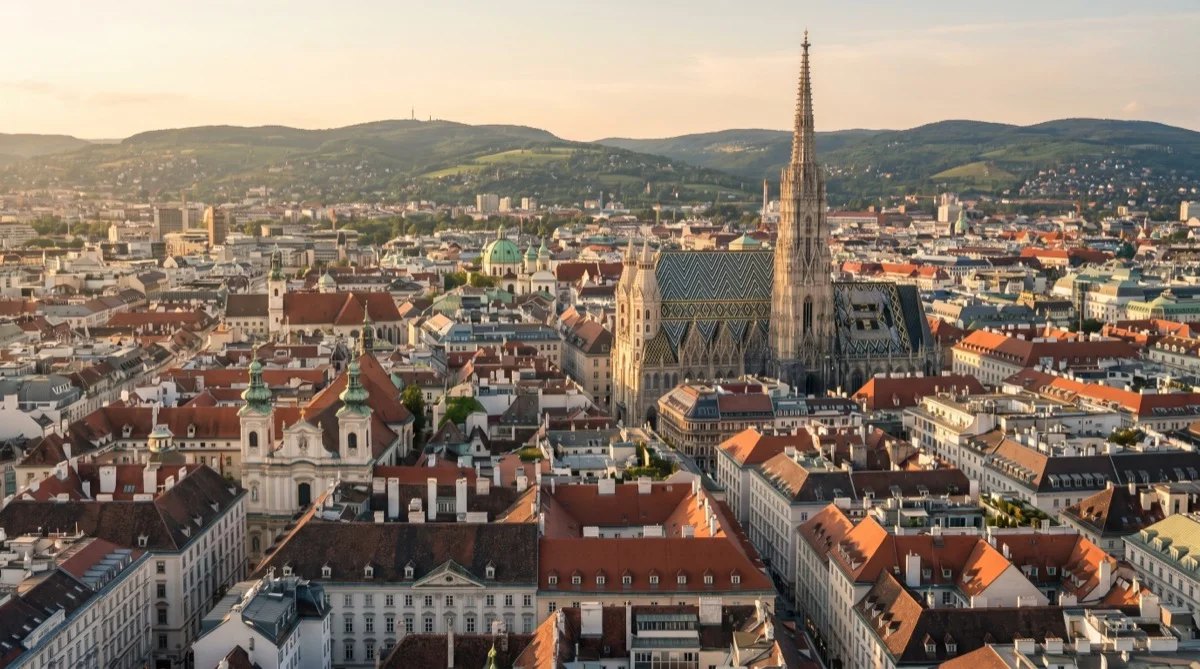
Vienna’s central districts – inside the Gürtel ring road, broadly speaking – have an English-speaking professional ecosystem that is unusual for a city of fewer than two million people. Major employers in tech, international NGOs (UN City, IAEA, OPEC headquarters all sit in Vienna), foreign banking, and the diplomatic community keep a steady inflow of expats who do not speak German. The cafes and restaurants in the seventh district know how to take an order in English. The coworking spaces operate bilingually. Doctors at the bigger central practices often speak workable English. Public transport announcements include English on the main lines.
If you are coming to Vienna for a defined posting – say two to three years for a job that pays your relocation – you can live very comfortably without committing to German. You will not be the only person in the cafe doing it.
Outside the Gürtel: the shift starts gradually
Vienna does not stop being English-friendly outside the Gürtel, but the gradient steepens. The outer districts (the 21st, 22nd, the further reaches of the 19th and 20th) are more residential and more German-speaking. The local Beisl – the neighbourhood pub – may not have an English menu. The post office clerk may not switch languages. The Pflegeheim, the local Krankenkasse office, the Hausverwaltung dealing with your apartment building are German-first environments.
This is the layer where Vienna starts to feel like a German-speaking city rather than an international one. Whether it bothers you depends on what kind of life you are trying to build.
Graz, Salzburg, Linz, Innsbruck
The other Austrian cities are more variable.
Graz, with its large student population, has surprisingly good English fluency among under-35s. The tech sector around Graz Tech operates partly in English. Day-to-day services lean German but not aggressively so.
Salzburg’s tourism economy means service-industry English is good, but the resident community is more German-speaking than the visitor footprint suggests. You can live there in English; you will feel like an outsider longer than in Vienna.
Linz is the most German-default of the four. Less tourist exposure, fewer international employers, smaller English-speaking expat community. You can manage as a remote worker if your business is entirely outside Austria, but social integration without German is harder.
Innsbruck is mixed. The university and the international-research base support an English-speaking professional layer; the alpine-sports-tourism layer supports service-industry English. Outside both layers, it is firmly German-speaking.
Rural Austria – villages, the Burgenland countryside, the Tyrolean valleys outside Innsbruck – assume German. You can charm your way through with hand gestures and a few words for a week, but not for a life.
Bureaucracy: where English will fail you
Austrian government interaction is the domain where English is least reliable, and this matters because relocators have to do a lot of government interaction during their first year.
The Magistrat (city administration), the Meldezettel registration, the Wohnsitz process, the Anmeldebescheinigung for EU citizens, the tax office (Finanzamt), the social-insurance office (SVS for self-employed, ÖGK for employees) – these are all German-first institutions. Some forms exist in English. Most do not. The staff sometimes speak English; you cannot count on it. The legal text on the forms is in German, and Austrian administrative German is its own genre – formal, dense, full of compound nouns that do not appear in conversational language.
Plan, for the first year, to either learn enough German to read these forms, or budget for help. A relocation consultant, a German-speaking friend, or a paid translation service will save you hours. Many longer-term residents who arrived in English use a Steuerberater (tax advisor), precisely because handling Austrian tax bureaucracy without German is unrealistic for anyone with any complexity in their finances.
Healthcare: a harder call than people expect
Healthcare is the other domain where the English-only assumption can fail you, and the failure mode matters because it tends to happen at the worst time.
Vienna’s central hospitals and larger clinics have English-speaking staff and you will usually find a doctor who can explain a diagnosis in English. Outside Vienna, this thins out fast. General practitioners in smaller cities and rural areas often have limited English. Specialists vary. Emergency rooms in tourist areas have some English coverage but it depends entirely on who is on shift.
The systemic issue is that even when the doctor speaks English, the documentation, the discharge papers, the prescriptions, and the insurance correspondence are all in German. Translating a discharge summary at three in the morning when something has gone wrong is the moment people most often regret not having learned more German.
If you have chronic conditions, dependent family members, or any reason to expect serious healthcare interaction, factor this into your planning. It is worth more than the social or convenience considerations.
When learning German actually becomes essential
There are three thresholds where most relocators give up the English-only life:
Six to twelve months in, if they are staying. The novelty wears off, the social isolation builds, and the cost of having every conversation be slightly transactional becomes obvious. Most people start a German course around this point. Vienna has plenty: VHS (the adult education network) offers reasonably priced classes; the OIF (Austrian Integration Fund) runs subsidised courses for residence-permit holders; private schools like ActiLingua and Innes have international-track reputations.
When you need a residence permit upgrade. Settlement permits and citizenship paths require German language proof: A1 for initial residence, A2 or B1 for upgrades, B1 (with a citizenship test) for naturalisation. If you are planning to stay long-term, the language requirement is structural.
When you have children in the school system. Austrian schools operate in German. International schools exist in Vienna and Salzburg but are expensive and parallel rather than integrated. Children pick up German quickly; parents who do not speak it find themselves unable to follow their own children’s school life.
What kind of life are you planning?
The honest summary: you can absolutely live in Austria without German for a defined window – up to a couple of years – if you are in Vienna, in a job that operates internationally, and willing to outsource the German-required parts of administration. This is a real and viable life and tens of thousands of people in Vienna are living it right now.
What does not work is staying indefinitely without ever engaging with the language. The country is bilingual on the surface but monolingual underneath, and the deeper layers – the neighbourhood, the bureaucracy, the friendship circles, the medical system, your children’s school – are where Austrians live their actual lives.
Our British friend, two years in, finally enrolled in an intensive A2 course. Six months later, her life in Vienna was different. Not because Vienna had changed, but because she had stopped being a visitor in it.
That is, in the end, the choice. You can be a long-term visitor in Austria in English. You can be a participant in Austria in German. The question is which one you came to be.
If you’re moving toward English-friendly European roles, our framework book Remote Readiness for Jobseekers covers the 5Cs that Austrian and DACH-region employers evaluate when language is not the gate – Culture, Communication, Console, Collaboration and Connection in practical detail.
Considering Austria as your base? Our Austria country guide covers the visa, tax and registration steps alongside the cultural and practical relocation work.