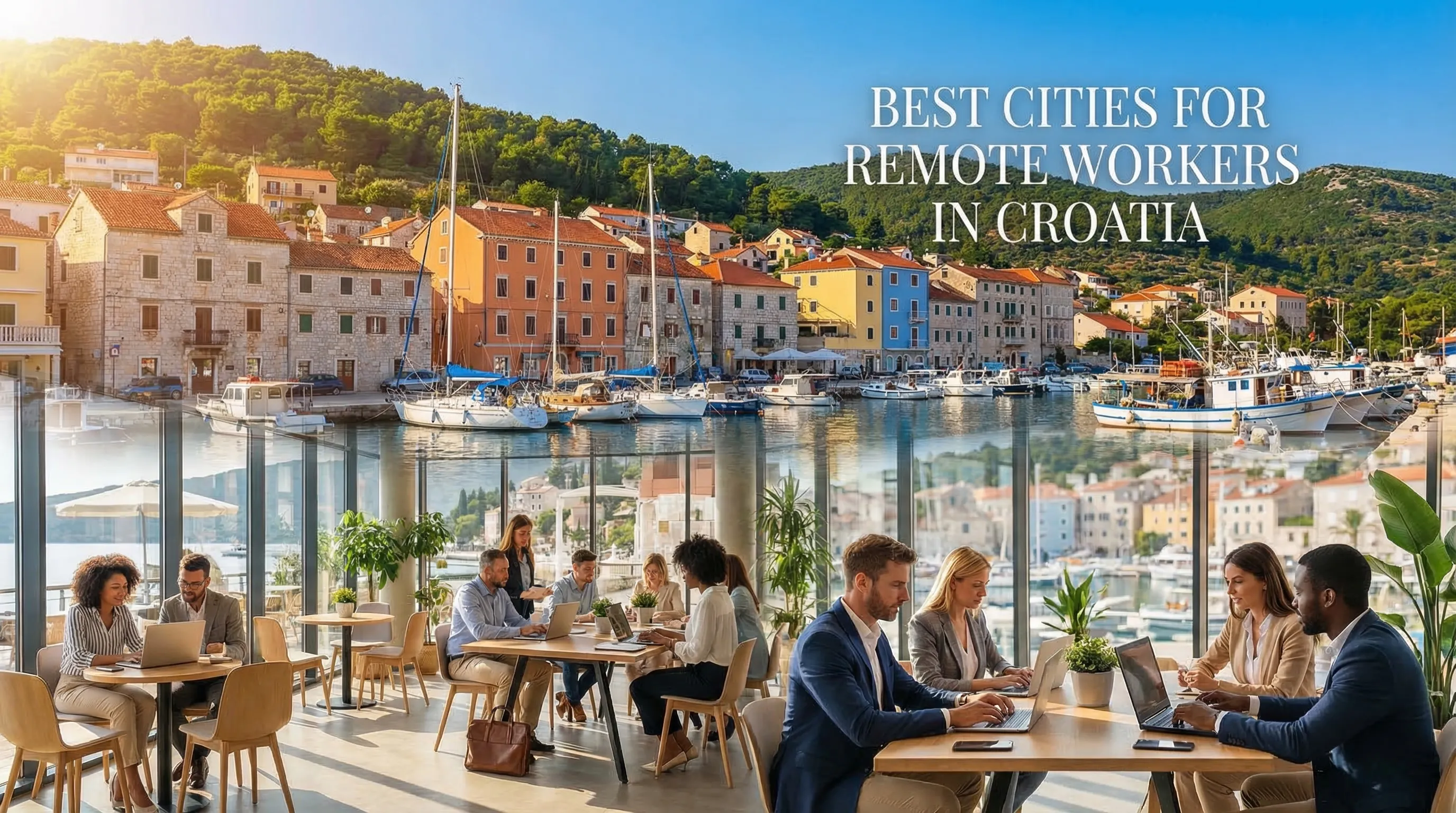
Croatia keeps coming up in conversations about where to base yourself in Europe, and for good reason. An Adriatic coastline, solid internet infrastructure, a dedicated digital nomad visa, and Eurozone membership since 2023 make it a practical choice, not just a pretty one.
But “move to Croatia” is vague advice. The country stretches from the flat, continental interior around Zagreb to over a thousand kilometres of coastline, and each city offers a very different experience for remote workers. Coastal towns can double their prices in summer and go quiet in winter. Zagreb never closes but never hits 30 degrees in the shade either. Islands are idyllic until you need to catch a ferry in a storm.
This guide breaks it down city by city, so you can figure out which version of Croatia actually fits your life.
A note on visas and tax
This is not a visa guide. If you are an EU/EEA citizen, you can live and work in Croatia without restriction. Non-EU remote workers can apply for the Croatian Digital Nomad Residence Permit, valid for up to one year and renewable, requiring proof of remote income of at least EUR 2,540 per month. Permit holders are exempt from Croatian income tax.
For full details, see our Croatia country guide.
Zagreb: the practical, year-round option
Zagreb is not the reason most people daydream about Croatia. There is no sea, no Diocletian’s Palace, no Instagram-perfect harbour. What Zagreb does offer is consistency. It functions year-round, costs less than the coast, and has the strongest coworking and tech community in the country.
The capital is a proper European city of around 800,000 people with trams, museums, a thriving cafe culture, and enough going on that you will not run out of things to do in a hurry. Unlike the coastal towns, there is no tourist season that inflates prices and overwhelms infrastructure from June to September.
Cost of living: A comfortable monthly budget sits around EUR 1,200 to 1,500 for a single person, including rent. A one-bedroom apartment in the city centre runs EUR 550 to 750 per month [VERIFY exact 2026 range]; move out to the wider neighbourhoods and you can find places for EUR 400 to 550. Zagreb is roughly 5% cheaper than Split overall.
Coworking: HUB385 is Zagreb’s most established coworking space, running since 2015, with over 100 workspaces, private offices, and conference facilities. Day passes start at around EUR 14; weekly passes around EUR 67. Other solid options include ZICER Innovation Centre, Impact Hub Zagreb, and Wespa Spaces [VERIFY current status of Wespa]. There are enough spaces that you can shop around for the right vibe.
Internet: Zagreb has the best connectivity in the country. Fixed broadband averages around 100 Mbps and fibre is widely available in the city. You will have no trouble running video calls or uploading large files.
Lifestyle: Zagreb has proper seasons. Summers are warm (occasionally hot), winters are genuinely cold with grey skies and temperatures around freezing. The cafe culture is strong, the food scene is underrated, and there is good access to hiking in the surrounding hills. Flights connect easily to most of Europe.
Best for: Remote workers who want stability, affordability, and a real city that does not shut down seasonally. Those who prioritise practical infrastructure over beach lifestyle.
Split: Mediterranean energy with substance
Split is Croatia’s second city, and it feels like it. There is a proper urban energy here, not just a tourist town with a pretty harbour. The city is built around and literally into the ancient Diocletian’s Palace, which gives the old town a layered, lived-in quality that Dubrovnik’s polished walls cannot quite match.
For remote workers, Split offers a genuine Mediterranean lifestyle combined with enough year-round population (around 180,000) that it does not empty out completely in winter the way smaller coastal towns do.
Cost of living: Budget EUR 1,300 to 1,800 per month for comfortable living. Rent for a one-bedroom in the centre runs EUR 600 to 850 [VERIFY], but this swings significantly by season. From October to April, you will find better deals and more availability. In peak summer, landlords switch to short-term tourist rentals, and what remains gets more expensive. Start your apartment search in the off-season if possible.
Coworking: Smartspace is Split’s go-to coworking space, located in the Old Town area, with hot-desking from around EUR 150 per month [VERIFY current pricing]. It doubles as an event and exhibition space, which keeps the atmosphere interesting. Coworking Split and INfactory [VERIFY these names are current] are additional options.
Internet: Solid in the city centre and established neighbourhoods. Fixed broadband is widely available and reliable for remote work. Some older buildings in the historic core may have slower connections, so check before signing a lease.
Lifestyle: Split is a walking city. Beaches are accessible, the Riva promenade is where locals gather, and the ferry port connects you to the islands. In summer, it buzzes. In winter, it quietens but does not die. The restaurant and bar scene is strong year-round. Flights from Split airport connect to major European cities, especially in summer when routes multiply.
Seasonal reality check: Summer in Split means tourist crowds, higher prices, and temperatures that can push past 35 degrees. If you are working, this can be more exhausting than romantic. Many experienced remote workers in Croatia prefer Split in spring or autumn.
Best for: Those who want coastal Mediterranean life with genuine city amenities. People who can time their stay to avoid peak summer, or who genuinely enjoy the chaos.
Zadar: compact, affordable, and the nomad village
Zadar is the dark horse of Croatian remote work destinations. Smaller than Split (around 75,000 people), it punches above its weight for digital nomads thanks to a compact, walkable old town, lower costs than its bigger neighbours, and Croatia’s first purpose-built digital nomad village.
The old town sits on a peninsula, with the famous Sea Organ and Sun Salutation installations on the waterfront. It is genuinely beautiful without being overwhelmed by tourism the way Dubrovnik can be.
Cost of living: Zadar is one of the more affordable coastal options. Budget EUR 1,100 to 1,500 per month. Rent for a one-bedroom runs EUR 450 to 700 depending on location and season [VERIFY].
Coworking: COIN Zadar is the main coworking space, located in the modern part of the city with affordable membership packages [VERIFY current pricing]. The digital nomad village (see below) also includes coworking facilities.
The Digital Nomad Valley: Located in Borik, about a 30-minute walk from the old town and right next to the beach, Digital Nomad Valley Zadar was Croatia’s first curated digital nomad village when it opened in 2021. It offers mobile homes with one to three bedrooms, equipped with WiFi (minimum 32/32 Mbps), air conditioning, kitchens, and terraces. Prices start at around EUR 130 per week with a two-week minimum stay, or roughly EUR 520 per month [VERIFY 2026 pricing]. The village organises networking events, workshops, and community activities. It is nicknamed “The Valley” by its founders, who see it as a pilot for similar communities across Croatia.
This is not luxury accommodation. It is functional, sociable, and designed for people who want to work while being near the sea without paying Split or Dubrovnik prices.
Internet: Good in the city and at the nomad village. Not quite Zagreb-level infrastructure, but reliable for standard remote work needs.
Lifestyle: Zadar is compact enough to feel manageable but has enough restaurants, bars, and cultural sites to keep you occupied. It is a good base for exploring Plitvice Lakes, Kornati Islands, and the wider Dalmatian coast. The airport has growing European connections, though fewer than Split.
Best for: Budget-conscious remote workers who want coastal life without big-city bustle. Those interested in a ready-made nomad community at the Valley. First-timers testing Croatia before committing to a bigger city.
Dubrovnik: stunning but expensive
Let us be honest. Dubrovnik is one of the most beautiful cities in Europe, and it knows it. The walled old town is extraordinary. But for remote workers planning to stay more than a week or two, the reality is more complicated than the photos suggest.
Dubrovnik is small (around 42,000 people), expensive, and heavily oriented around tourism. In summer it can feel like a theme park. In winter it is genuinely quiet, which some people love and others find isolating.
Cost of living: The most expensive option on this list. Budget EUR 1,500 to 2,200 per month minimum. Rent is high year-round because the property market is dominated by short-term tourist rentals, and finding a long-term lease requires persistence. Expect EUR 700 to 1,000+ for a one-bedroom [VERIFY], and even more in the old town or with sea views.
Coworking: Dubrovnik’s coworking scene is limited. KAWA, located in the Gruz suburb (housed in the TUP building), is the city’s first dedicated coworking space [VERIFY still operating 2026]. Beyond that, you are mostly working from cafes or your apartment. Saltwater Nomads has run a Digital Nomads-in-Residence programme in Dubrovnik with events and community activities, which helps bridge the gap.
Internet: Reliable in the city, though older buildings in the walled town can be variable. Check your specific accommodation.
Lifestyle: The old town walls, kayaking on the Adriatic, day trips to Montenegro and the Elaphiti Islands. It is undeniably special. But the social scene is thin outside summer, dining out is expensive by Croatian standards, and the airport has limited winter connections. Getting to other Croatian cities overland involves a long drive because of Dubrovnik’s geographical isolation at the country’s southern tip (you actually pass through a strip of Bosnia to get there by road).
Best for: Remote workers with higher budgets who want a dramatic setting for a defined period. Couples or those who do not need a large social scene. Writers and creatives who thrive on beauty and solitude. Not ideal as a long-term year-round base.
Rijeka: the unconventional pick
Rijeka rarely appears on digital nomad lists, and that is part of its appeal. Croatia’s third city (around 120,000 people) is a working port town on the Kvarner Gulf with a grittier, more authentic feel than the polished Dalmatian destinations. It was European Capital of Culture in 2020, which brought investment in arts and cultural infrastructure.
Cost of living: Among the most affordable urban options in coastal Croatia. Budget EUR 1,000 to 1,400 per month [VERIFY]. Rent is lower than Split or Zadar because Rijeka is not yet on the tourist circuit in the same way.
Coworking: The scene is small but growing. KIWI Creative Space focuses on arts and creative professionals, hosting exhibitions alongside desk space. Klub Mladih attracts a younger crowd with a social, cafe-style work atmosphere [VERIFY both still active]. Options are limited compared to Zagreb or Split.
Internet: Decent city-wide coverage, in line with other Croatian urban centres.
Lifestyle: Rijeka has character. It is less polished than Dubrovnik but more real. The Opatija Riviera is nearby for beach days, Istria’s hilltop towns and truffle restaurants are within easy reach, and the city itself has good restaurants, bars, and cultural events. The Carnival of Rijeka is one of the biggest in Europe. Ferry connections reach the nearby islands of Cres and Krk.
Best for: Independent-minded remote workers who prefer authenticity over Instagram appeal. Those exploring Istria and the Kvarner region. Budget-conscious workers who want coastal proximity without coastal prices.
Istria: hilltop villages and quiet focus
Istria is Croatia’s northwestern peninsula, and it feels different from the rest of the country – culturally influenced by Italy, architecturally distinct, and far quieter than the Dalmatian coast. If your image of Croatia is all Dubrovnik and island-hopping, Istria will surprise you.
The interior is the real draw for remote workers who want peace. Medieval hilltop villages like Motovun, Groznjan, and Oprtalj sit above rolling green countryside, surrounded by vineyards, olive groves, and truffle-hunting forests. In winter, it feels like being inside a Christmas card – misty valleys, stone houses, woodsmoke, and very few tourists.
The coastal towns – Rovinj, Poreč, Pula – are busier and more tourist-oriented in summer, but still calmer than Split or Dubrovnik. Pula has the strongest infrastructure, with its Roman amphitheatre, university, and year-round population of around 55,000.
Cost of living: Among the most affordable options if you go inland. Budget EUR 900 to 1,300 per month in the interior villages; coastal towns run EUR 1,100 to 1,600 [VERIFY]. Long-term rentals in hilltop villages can be remarkably good value, especially October to May.
Coworking: Limited – this is not a coworking destination. Pula has a small but growing scene. In the hilltop villages, you are working from home or from cafes. If you need a dedicated workspace daily, Istria may not be the right fit. If you are happy with a good desk, strong wifi, and absolute quiet, it is hard to beat.
Internet: Variable. Pula and the larger coastal towns have solid broadband. Inland villages are improving but can be patchy – fibre has not reached everywhere. Check connectivity before committing to a rural property. A 4G backup is essential in more remote locations.
Lifestyle: Istria is about slow living. The food is exceptional – truffles, olive oil, wine, fresh seafood on the coast, and Italian-influenced cuisine throughout. The pace is gentle. There are no crowds outside July and August on the coast, and the interior is quiet year-round. Rijeka and Trieste (Italy) are both easily accessible for city amenities, airports, and variety.
Best for: Remote workers who want countryside tranquillity and can work independently. Writers, designers, and anyone whose work benefits from deep focus and minimal distraction. Couples looking for quality of life over nightlife. People who have done the digital nomad city circuit and want something genuinely different.
The islands: beautiful but be realistic
Croatia has over a thousand islands, and working from one sounds romantic. A few are genuinely viable for remote work, others will test your patience.
Hvar has decent infrastructure for its size, with cafes, restaurants, and reasonable connectivity in Hvar Town. But it is small, expensive in summer, and very quiet in winter. Finding long-term accommodation is challenging.
Korcula and Brac offer more affordable island life with ferry connections to Split. Internet can be adequate in the main towns but unreliable in smaller villages.
Krk is connected to the mainland by bridge, which makes it more practical than most islands. It has growing infrastructure and is accessible from Rijeka.
The honest truth about island life: connectivity can drop, ferries get cancelled in bad weather, coworking spaces are essentially nonexistent, and your social circle will be very small outside summer. Islands work best as a short-term retreat, not a primary base, unless you are very self-sufficient and have flexible deadlines.
Seasonal pricing: the elephant in the room
If there is one thing that catches newcomers off guard in Croatia, it is how dramatically costs shift between seasons on the coast.
From June to September, accommodation prices along the Adriatic can double or more. Landlords convert long-term rentals to tourist lets. Restaurants raise prices. The towns fill up.
From October to April, the same apartment might cost half the summer rate, but some towns genuinely go quiet. Not just “less busy” quiet. Restaurants close. Shops reduce hours. The population of smaller coastal towns can feel like it halves.
Zagreb is the exception. Its prices and rhythms are consistent year-round, which is one reason it works so well as a base.
The sweet spot for most remote workers is April to June or September to November. You get good weather, reasonable prices, and enough people around that the towns feel alive.
Practical tips
Getting online
Croatia’s fixed broadband averages around 100 Mbps nationally, with fibre coverage expanding (39% FTTP coverage and growing, with major investment from A1 Hrvatska and other providers). In Zagreb, Split, and Zadar city centres, you should have no trouble getting reliable connections.
For mobile data, the main carriers are Hrvatski Telekom (T-Mobile network), A1, and Telemach. Prepaid SIM cards are available from around EUR 3 at carrier shops, convenience stores, and newsstands. Both Hrvatski Telekom and A1 offer tourist SIM packages with generous data allowances. You will need your passport to register a SIM.
A portable 4G/5G hotspot is a smart backup, especially if you are moving between cities or spending time in less connected areas.
The OIB number
An OIB (Osobni identifikacijski broj) is Croatia’s personal identification number, and you will need one for more than you might expect: activating a postpaid mobile plan, opening a bank account, signing a lease, even buying a long-term bus pass.
The good news: it is free and relatively painless to get. You can apply online through the Croatian tax administration website with a copy of your passport, or in person at a regional tax office. Processing takes up to eight days.
Get this sorted early in your stay. It unlocks a lot of everyday admin.
Healthcare
EU citizens can use the European Health Insurance Card (EHIC) for basic public healthcare. Non-EU digital nomad visa holders should have comprehensive health insurance as a condition of the permit. Croatia has good medical facilities in the larger cities, and private clinics with English-speaking staff are available in Zagreb, Split, and Dubrovnik. Outside major cities, options narrow.
Getting around
Croatia is well connected internally, though the geography can make journeys longer than you expect. Zagreb to Split is about 4 to 5 hours by car or bus, and there is no high-speed rail. Domestic flights exist but are limited. The coastal road (the Jadranska Magistrala) is scenic but slow in summer.
Ferries are essential for island access and run frequently in summer, less so in winter. Jadrolinija is the main operator.
For day-to-day life within cities, most are walkable and have reasonable local bus networks. Bolt operates in the larger cities.
Which Croatia is right for you?
| If you want… | Consider… |
|---|---|
| Affordable, year-round stability | Zagreb |
| Mediterranean city with substance | Split |
| Budget coastal + nomad community | Zadar |
| Dramatic beauty, higher budget | Dubrovnik |
| Authenticity off the beaten track | Rijeka |
| Countryside peace and deep focus | Istria (interior) |
| Island escape (short-term) | Hvar, Korcula, Krk |
Croatia is a genuinely good place to work remotely, but the right experience depends entirely on which version of the country you choose, and when you go. The cities that look best in photos are not always the most practical for getting work done. And the places that rarely make the listicles, like Zagreb and Rijeka, might be where you actually thrive.
Do a scouting trip if you can. Spend a week in two different places before committing to a longer stay. And if you are heading to the coast, time it outside peak summer unless you enjoy working in a sardine tin.
For more on living and working in Croatia, see our Croatia country guide. Join the Remote Work Europe community to connect with others who have made Croatia their base.