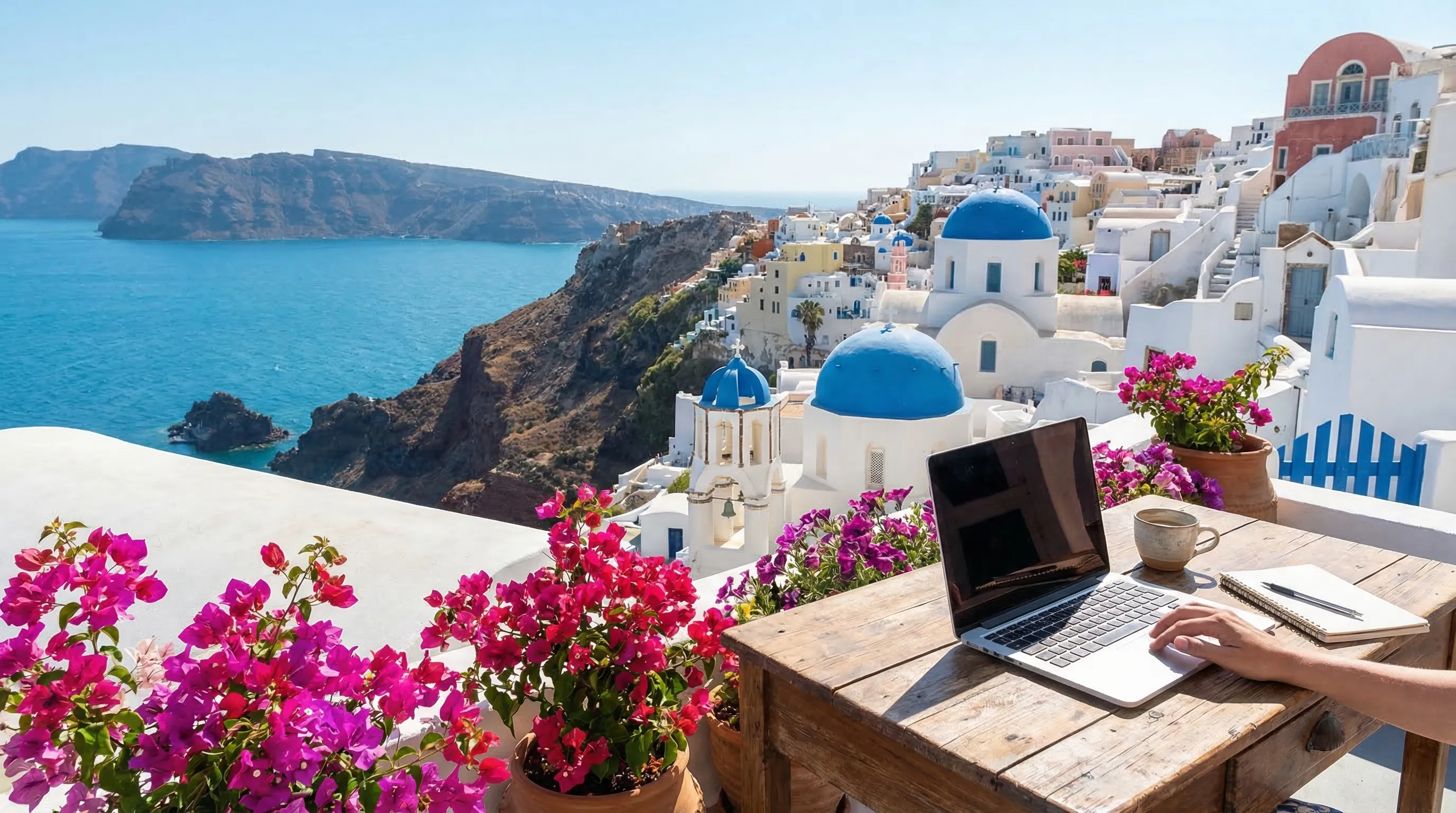
Greece has always been the dream. Blue domes, turquoise water, a laptop on a taverna table overlooking the Aegean. And to be fair, Greece genuinely has a lot going for it as a remote work destination – affordable living, improving infrastructure, generous tax incentives, and a quality of life that’s hard to beat in southern Europe.
Remote Work Europe tracks regulatory changes across 30+ European jurisdictions and reports back when the rules genuinely shift for remote workers and freelancers.
But the dream and the reality don’t always overlap. Where you choose to base yourself in Greece matters enormously for your productivity, your sanity, and your internet connection. A stunning Cycladic island might look perfect on Instagram, but try running a Zoom call on a windy Tuesday in February and you’ll quickly understand why most long-term remote workers end up on the mainland or the bigger islands.
This guide breaks down the main options – honestly – so you can pick the right Greek base for how you actually work, not just how you want your life to look on social media.
Note: This is a locations guide, not a visa guide. For visa and tax details, see our Greece country guide.
Athens: the obvious starting point
Athens is where most remote workers in Greece end up, at least initially, and for good reason. It’s the largest city, the best connected, and the place where infrastructure actually works consistently.
The case for Athens
Internet: Reliable and fast enough for daily video calls, screen sharing, and everything else remote work demands. Average speeds in Athens sit comfortably above 50 Mbps, with fibre available in many central apartments. It’s not Bucharest-fast, but it won’t let you down.
Coworking: Athens has the most developed coworking scene in Greece. Options include:
- Impact Hub Athens – in the Psyri neighbourhood, set inside a townhouse with a courtyard garden. Community-focused with regular events.
- Stone Soup – purpose-built for remote workers and entrepreneurs, with solid facilities.
- Pi55 – a four-storey space near the centre aiming for a premium experience.
Hot desk prices typically run €150-220/month, or €15-25 for a day pass. [VERIFY exact current pricing]
Cost of living: A one-bedroom apartment in central Athens runs €700-1,200/month; outside the centre, €500-900. Total monthly budget for a single remote worker: €1,400-2,000 for a comfortable life, more if you want a modern flat in Kolonaki or Koukaki.
Community: Athens has the strongest digital nomad community in Greece. The Digital Nomads Athens Facebook group is active, and the coworking spaces host regular networking events. You won’t struggle to meet people here.
Transport links: Athens International Airport has direct flights to most European capitals, plus good domestic connections to the islands. The metro is modern and efficient. You can get to Piraeus port in under an hour from most parts of the city for island trips.
The downsides
Athens is loud, chaotic, and can be brutally hot from June to September (regularly exceeding 40 degrees C). Air pollution is real. The bureaucratic experience of dealing with Greek administration – getting a tax number (AFM), registering for anything – is legendarily slow. And the city doesn’t have the coastal lifestyle that many people come to Greece for. You’re in a proper city, with all that entails, even though the beach is a short tram ride away.
Best for
Remote workers who need reliable infrastructure, an active social scene, and good flight connections. People who treat Greece as a working base first and an island holiday destination second.
Thessaloniki: the underrated choice
Greece’s second city doesn’t get the attention it deserves from the remote work community, and that’s partly what makes it appealing.
The case for Thessaloniki
Cost of living: This is Thessaloniki’s strongest card. Living costs run roughly 15-25% lower than Athens. A one-bedroom apartment in the city centre costs €350-600/month – significantly cheaper than the capital. Eating out at a traditional taverna runs €10-15 per person. Your money goes meaningfully further here.
Vibe: Thessaloniki has a large university population, which gives it a youthful, creative energy. The waterfront promenade is genuinely lovely. The food scene is arguably better than Athens (locals will tell you this at length). It’s a real, liveable city with a slower pace than the capital – more cafe culture, less traffic chaos.
Coworking: The scene is smaller but growing. Options include The Cube (from around €100/month for a hot desk) and Impact Hub Thessaloniki in the Ladadika neighbourhood (from around €150/month). [VERIFY current availability and pricing]
Internet: Average speeds around 47 Mbps – not blazing, but adequate for most remote work. Cafes and coworking spaces generally have reliable Wi-Fi.
Location: Thessaloniki is well-positioned for exploring northern Greece and the Balkans. Sofia, Skopje, and Istanbul are all reachable. The airport has decent European connections, though fewer direct routes than Athens.
The downsides
Winters are colder than you might expect for Greece – Thessaloniki can be grey and chilly from November to March. The digital nomad community is smaller, so you’ll need to be more proactive about meeting people. Flight connections are more limited than Athens. And while the waterfront is beautiful, this isn’t a beach destination.
Best for
Budget-conscious remote workers who want an authentic Greek city experience without Athens prices. People who prioritise food, culture, and a relaxed pace over nightlife and networking events. A good choice if you’re working European hours and don’t need to fly internationally every other week.
Crete: the island that actually works
If you want island life but also need to get work done, Crete is the answer. It’s Greece’s largest island, with proper cities, reliable infrastructure, and enough year-round population to avoid the ghost-town effect that hits smaller islands in winter.
Heraklion: the practical choice
Heraklion is Crete’s capital and its most connected city. It’s not the prettiest place on the island – it’s a working city, not a postcard – but that’s partly the point.
Internet: Broadband speeds can reach around 75 Mbps in Heraklion, and 5G coverage is expanding. The city has the most reliable connectivity on the island.
Coworking: Office12 Coworking is open 24/7 with ergonomic furniture and networking events. Pom and Comeet offer additional options. [VERIFY all still operating]
Cost of living: Lower than Athens. A one-bedroom apartment runs €400-700/month. Total monthly costs for a single person: €1,000-1,500.
Transport: Heraklion has an international airport with direct flights to many European cities (especially in summer). Ferries to Athens take around 8-9 hours overnight.
Vibe: Functional rather than charming. Good restaurants, a lively market area, and the Venetian harbour is worth a wander. But you come to Heraklion for access to the rest of Crete, not for Heraklion itself.
Chania: the lifestyle choice
If Heraklion is the practical choice, Chania is the beautiful one. The Venetian harbour, the old town, the backdrop of the White Mountains – Chania is genuinely stunning.
Coworking: WorkHub was Chania’s first dedicated coworking space, with high-speed Wi-Fi, backup internet lines, and proper workspace setup. Stone Soup Coworking offers a quieter, community-based alternative.
Internet: Good in town, with speeds comparable to Heraklion’s. More variable outside the city proper.
Cost of living: Similar to Heraklion, though prices climb in the old town and near the harbour, especially in summer. Budget €1,000-1,500/month outside of peak season.
Coliving: Greek Escape in nearby Gerani offers a combined coliving and coworking setup specifically for digital nomads – a good landing pad if you’re new to Crete.
Vibe: Chania has a genuine year-round community, including a solid cohort of expats and remote workers. It’s walkable, beautiful, and has that Mediterranean rhythm of life that drew you to Greece in the first place. Winter is quieter but not dead.
Best for
Remote workers who want a Mediterranean island lifestyle with mainland-level infrastructure. Crete works for longer stays – this isn’t a quick stop. People who want to combine serious work with hiking, beaches, and excellent food on weekends.
Rhodes: the surprise contender
Rhodes doesn’t appear on most digital nomad lists, but it’s worth considering – especially if you want island life with better infrastructure than most Greek islands offer.
The case for Rhodes
Rhodes Town has around 50,000 residents, which means it stays lively even outside tourist season. English is widely spoken. There’s an established expat community, and the medieval Old Town is genuinely extraordinary to live near.
Internet: Generally good throughout Rhodes Town. More variable in the south of the island or in smaller villages.
Community: Rhodes Digital Nomads organises regular meetups, pop-up coworking days, dinners, and networking events – impressive for an island this size.
Cost of living: Budget €1,000-1,500/month for a modest lifestyle. Accommodation prices swing dramatically between summer and winter – you can pay half the rent in the off-season.
Best months: April, May, June, September, and October. Avoid July and August unless you enjoy tourist crowds and peak pricing.
The downsides
Limited coworking infrastructure compared to the mainland cities – you’ll mostly be working from home or cafes. Flight connections are seasonal (many direct European routes only operate May-October). Winter can feel isolated despite the year-round population.
Best for
Remote workers who want a smaller, more community-oriented island experience with enough infrastructure to be viable. People who can structure their year around the seasons – Rhodes in spring and autumn is glorious.
The island question: fantasy vs reality
Now for the conversation nobody wants to have. Can you actually work remotely from a small Greek island?
The honest answer: maybe, for a while, with caveats.
What works
Larger islands (Crete, Rhodes, Corfu, and to some extent Naxos and Paros) have adequate internet in their main towns, enough amenities to live comfortably, and some degree of year-round community. If you base yourself in the island’s capital and have a backup internet solution, you can make it work.
Short stays (a month or two in summer) can be wonderful. Your accommodation will have Wi-Fi, most cafes have decent connections, and the lifestyle trade-off is worth it if your work is flexible.
What doesn’t work
Small islands (the Cycladic darlings, the tiny Dodecanese, anything with a population under 5,000) are genuinely risky for remote work. Internet can drop to 5-15 Mbps or worse on remote islands. Mobile coverage can be intermittent – some areas have no signal at all. Power outages happen. If your work involves regular video calls with clients, this is a professional risk you should take seriously.
Winter on most islands means many businesses close, ferry schedules become unreliable (weather cancellations are common), and you may find yourself effectively stranded in a beautiful but very quiet place with limited social contact. Some people love this. Many find it lonely after the first month.
Seasonal pricing swings are extreme. An Airbnb that costs €600/month in January can cost €3,000/month in August. Planning your budget around peak season pricing is essential if you want summer island time.
The realistic approach
Most experienced remote workers in Greece use a hybrid strategy: a mainland base (Athens or Thessaloniki) or a large island base (Crete), with shorter island trips when the weather and workload allow. This gives you the infrastructure you need for serious work, with the island experience as a bonus rather than a daily gamble.
Starlink has been available in Greece since 2023 (around €40/month) and can deliver 50-200 Mbps even in remote locations. If island living is non-negotiable, a Starlink connection is the closest thing to a guarantee you’ll get.
Vodafone’s fibre investment is bringing up to 1 Gbps speeds to at least ten islands, via 670 km of subsea cable. [VERIFY which islands and current status] This is a game-changer for island connectivity, but the rollout is ongoing and coverage varies.
Practical tips for remote work in Greece
SIM cards and connectivity
Cosmote has the best overall coverage in Greece, particularly on the islands – it’s the only provider with signal in some smaller villages. Packages start at around €14 for 15 GB, with unlimited data at €50. [VERIFY current pricing]
Vodafone often matches Cosmote on the islands and can be better value. Plans range from €18-27 for 25 GB to unlimited data.
Nova (formerly Wind) is the budget option but has weaker island coverage.
You’ll need your passport to buy a prepaid SIM. All three providers have stores at Athens airport and in city centres. All Greek prepaid plans include free EU roaming.
Pro tip: Get a Cosmote SIM for island coverage reliability, and keep your home-country eSIM active as a backup. Dual-SIM phones earn their keep in Greece.
Healthcare
EU citizens can use their EHIC/GHIC card for public healthcare, but the public system can involve long waits and variable quality outside major cities. Most expats and long-term remote workers use private clinics, where English-speaking staff are common in Athens and Thessaloniki.
If you’re on a Digital Nomad Visa, private health insurance is mandatory as part of your application. Even if you don’t need the visa, private cover is strongly recommended – a basic policy covering Greece costs from around €300-600/year. [VERIFY current insurance costs]
Banking and money
Greece uses the euro, which simplifies life enormously if you’re coming from elsewhere in the eurozone. Opening a Greek bank account requires a tax number (AFM), which requires… patience. Many remote workers skip the local bank entirely and use Wise or Revolut for day-to-day spending, which works fine for most purposes.
Bureaucracy
Let’s be direct: Greek bureaucracy is slow, paper-heavy, and can be bewildering even for Greeks. Getting your AFM, registering your address, dealing with any official process – budget time and expect multiple visits. A local accountant or relocation service is worth the investment if you’re staying long-term.
The heat factor
Do not underestimate Greek summers. Athens regularly hits 40 degrees C+ in July and August. Even on the islands, midday heat makes outdoor work impossible. Air conditioning isn’t universal in older apartments, and electricity costs spike if you’re running it constantly. Many remote workers in Greece adopt a siesta schedule in summer: work early, rest midday, work again in the evening.
Which city suits which worker?
Athens – You need reliable infrastructure, good flights, and a social scene. You’re treating Greece as a work base, not a permanent holiday. You don’t mind city noise and chaos.
Thessaloniki – You’re budget-conscious and want authentic Greek life. You value food and culture over beaches. You’re comfortable being more self-sufficient socially.
Crete (Heraklion) – You want island-adjacent living with city infrastructure. You’re practical and don’t need things to be pretty – you need them to work.
Crete (Chania) – You want the best of both worlds: genuine beauty plus functioning internet and coworking. You’re planning a longer stay and want community.
Rhodes – You want a smaller, community-oriented island experience and can work around seasonal limitations. You don’t need a huge coworking scene.
Small islands – You work asynchronously, don’t rely on video calls, have flexible deadlines, and genuinely enjoy solitude. Bring a Starlink dish.
The seasonal question
Greece is fundamentally a seasonal country, and your experience will vary enormously depending on when you’re there.
October to April: Lower costs, fewer tourists, manageable temperatures (except January-February which can be surprisingly cold). Many island businesses close. Athens and Thessaloniki are at their most liveable. Crete stays mild.
May to June and September: The sweet spot. Warm but not unbearable. Tourist season starting or winding down. Good availability, reasonable prices, everything open.
July to August: Peak everything – peak heat, peak prices, peak crowds. Athens becomes an oven. Islands are rammed. If you’re working full-time, this is the hardest season to enjoy Greece. Many long-term residents leave for cooler parts of Europe and return in September.
The smartest remote workers in Greece plan their year around these rhythms rather than fighting them.
Greece is a genuinely excellent remote work destination – but only if you choose the right base for your needs and go in with realistic expectations. The Instagram fantasy of the clifftop laptop is real for about twenty minutes before the glare makes your screen unreadable and the wind blows your notes into the caldera. The actual working reality is a fast-internet apartment in Athens or a coworking desk in Chania, with island weekends when the mood strikes.
And honestly? That’s still a pretty good life.
For visa and tax details, see our Greece country guide. Looking for remote-friendly roles based in Europe? Check our job feed for current opportunities.