TL;DR: Germany’s setup process is sequential and bureaucratic – each step unlocks the next. Do it in this order: (1) find housing and get the Wohnungsgeberbestätigung, (2) Anmeldung within 14 days, (3) open a bank account, (4) arrange health insurance, (5) register with the Finanzamt. Budget 4–8 weeks for the full process. N26 or Revolut can bridge the bank account gap while you wait for traditional banking. Travel insurance won’t satisfy the health insurance requirement.
The Setup Sequence: Order Matters
Remote Work Europe maintains updated guides on the rules covered here, cross-referenced against official government publications.
Germany runs on paperwork, and that paperwork follows a strict dependency chain. You can’t open a traditional bank account without an Anmeldung. You can’t register for taxes without a bank account and health insurance proof. You can’t complete your Anmeldung without a Wohnungsgeberbestätigung from your landlord.
Understanding this chain before you arrive saves weeks of frustration. Here’s the complete sequence, in the order that actually works.
Step 1: Secure Housing (Before or Immediately After Arrival)
Everything starts with having an address. Not just any address – you need a place where the landlord will provide a Wohnungsgeberbestätigung (landlord confirmation of residence).
The Wohnungsgeberbestätigung Problem
This is the first bureaucratic hurdle that catches newcomers. The Wohnungsgeberbestätigung is a signed form from your landlord confirming you live at a specific address. You need it for the Anmeldung, and you have 14 days from moving in to complete the registration.
The problem: many temporary accommodation options – Airbnb hosts, short-term sublets, hostels – won’t provide this document. Some will, but you need to ask explicitly before booking.
Options that typically provide the confirmation:
- Long-term rental contracts (obviously)
- Some serviced apartments (ask before booking)
- Some Airbnb hosts (specifically ask about Wohnungsgeberbestätigung – spell it out)
- WG (shared flat) where the main tenant agrees
Options that typically don’t:
- Hotels and hostels
- Most short-term Airbnb listings
- Couch-surfing arrangements
Practical approach: If you can’t secure permanent housing before arrival, book a serviced apartment or cooperative Airbnb for your first month and confirm in advance that they’ll provide the document. Use that time to flat-hunt for permanent accommodation.
Finding Long-Term Housing
The German rental market is competitive, especially in Berlin and Munich. Key platforms:
- WG-Gesucht (wg-gesucht.de) – shared flats, the standard platform
- Immobilienscout24 (immobilienscout24.de) – apartments, both furnished and unfurnished
- eBay Kleinanzeigen – increasingly popular for sublets and furnished flats
- Local Facebook groups – “Wohnung/Flat in [City]” groups are active
Budget EUR 600–900/month for a one-bedroom in most cities (more in Munich, less in Leipzig/Dresden). Expect to provide a Schufa (credit check) document – you can request this online for free or via some banks.
For a city-by-city breakdown, see our guide to the best cities in Germany for remote workers.
Step 2: Anmeldung (Address Registration) – Within 14 Days
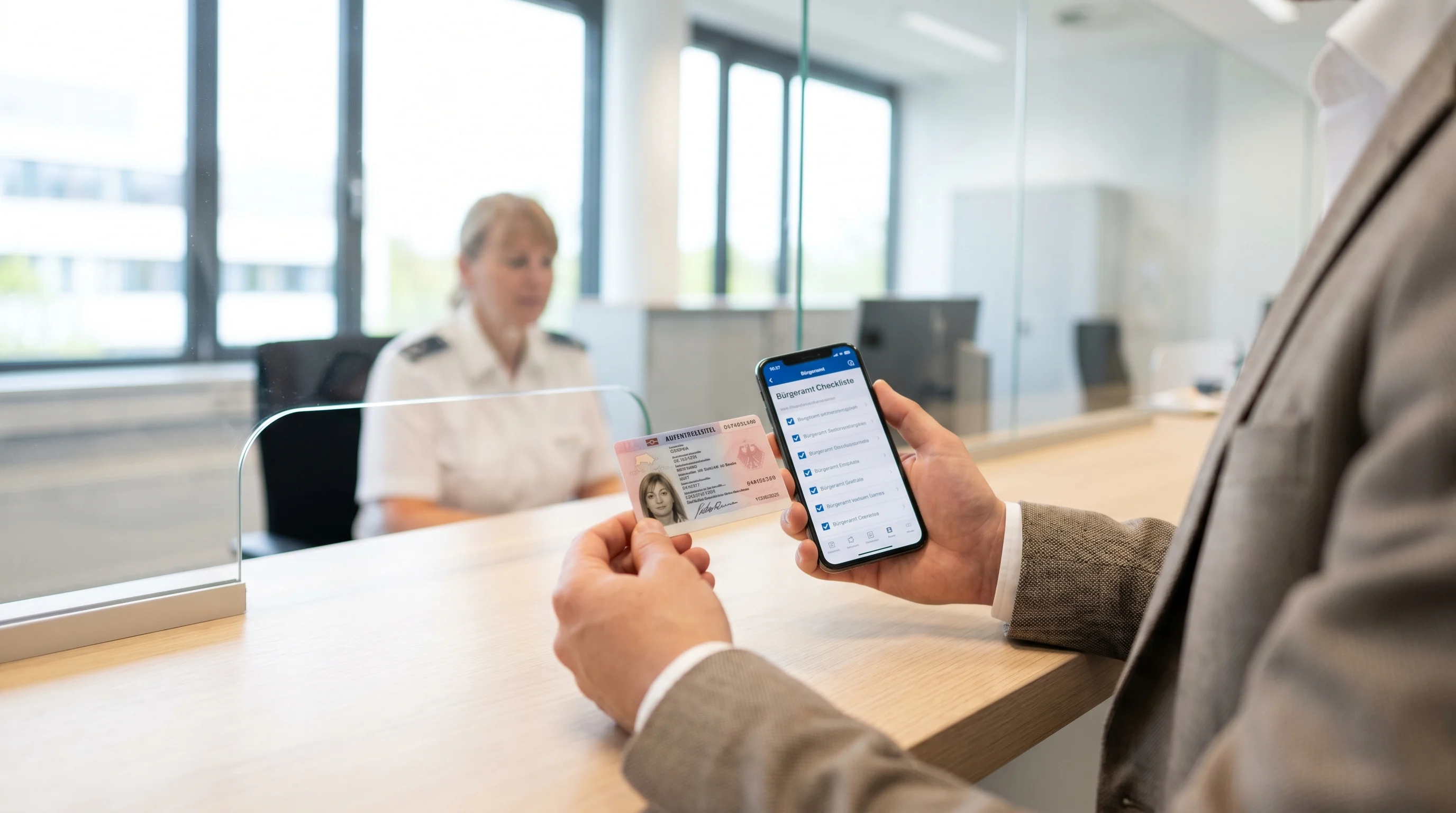
The Anmeldung is Germany’s address registration – and it’s your golden ticket. Without it, almost nothing else is possible. You are legally required to register within 14 days of moving into your accommodation.
What You Need
- Passport or national ID
- Wohnungsgeberbestätigung (landlord’s confirmation – signed and dated)
- Completed Anmeldung form (Anmeldeformular – downloadable from your city’s Bürgeramt website)
- Appointment at the Bürgeramt (citizens’ office)
The Appointment Problem
In larger cities – Berlin especially – Bürgeramt appointments can be booked weeks in advance. Start refreshing the online booking system the day you arrive. Some tips:
- Check for cancellations early in the morning (7–8am)
- Some offices accept walk-ins if you arrive before opening
- Try offices in outer districts – they’re less overwhelmed than central ones
- Some cities have dedicated appointment systems for new registrations
What You Receive
After the Anmeldung, you’ll get:
- Meldebestätigung (registration confirmation) – your proof of address. Guard this document. You’ll need it for everything that follows.
- Tax ID (Steueridentifikationsnummer) – mailed to your registered address within 2–4 weeks. If you’ve been registered in Germany before, you already have one – it stays the same for life.
If You Move Within Germany
You must re-register (Ummeldung) at your new address within 14 days. Same process, same documents. Failure to register carries potential fines, though enforcement varies.
Step 3: Open a Bank Account
You need a German bank account (or at least an IBAN-based Euro account) for freelancing, paying rent, receiving payments, and registering with the tax office.
The Chicken-and-Egg Problem
Traditional German banks – Sparkasse, Commerzbank, Deutsche Bank – require an Anmeldung (and sometimes a tax ID) to open an account. But you might need a bank account to secure housing, set up direct debits, or receive initial payments.
The Solution: Digital Banks First
N26 and Revolut both offer Euro IBAN accounts that you can open without a German Anmeldung. They accept passport verification and a non-German address initially.
This gives you a working Euro account from day one. Use it for initial expenses, rent payments, and receiving freelance income while you complete the Anmeldung and open a traditional bank account.
Traditional Bank Account (Recommended Eventually)
Once you have your Anmeldung and Meldebestätigung, open an account at one of:
- Sparkasse – the local savings bank, present everywhere. Excellent for dealing with German bureaucracy because everyone knows Sparkasse. Good for standing orders, direct debits, and dealing with utilities.
- Commerzbank – solid traditional bank, reasonable online banking.
- DKB – online-first, free current account, popular with freelancers. Excellent app, low fees.
- ING – another good online option with a free current account.
Why bother with a traditional bank? Some landlords, insurance companies, and government offices still prefer or require a German bank account specifically – not just a Euro IBAN. Some direct debit mandates (Lastschrift) work more smoothly with German banks. And if you ever need a mortgage or credit, a German banking relationship matters.
Business Account
For freelancing, you don’t legally need a separate business account in Germany – unlike in some countries. However, keeping personal and business finances separate is strongly recommended for tax clarity. Many freelancers use their N26 or DKB account for business and a second account for personal spending.
If you want a dedicated business account, Kontist, Holvi, and Fyrst are popular with German freelancers and offer features like automatic VAT set-aside.
Step 4: Arrange Health Insurance
Health insurance is mandatory in Germany – you cannot register with the tax office without proof of coverage.
Your Options
GKV (Public): Income-based contributions (~21% of gross). Covers the whole family. No health screening. Safe long-term choice. Major providers: TK, AOK, Barmer, DAK.
PKV (Private): Risk-based premiums. Cheaper when young, expensive with age. Better access to specialists. Virtually impossible to switch back to GKV after age 55.
KSK (Künstlersozialkasse): If you’re a writer, artist, journalist, or creative professional, the KSK covers roughly 50% of your health insurance and pension contributions. Apply as early as possible.
We cover this decision in detail – including costs, a decision framework, and the critical PKV trap – in our complete health insurance guide for freelancers in Germany.
What Doesn’t Count
Travel insurance, international nomad insurance, and budget expat policies almost certainly won’t satisfy Germany’s health insurance requirement. The Finanzamt and Ausländerbehörde expect recognised GKV or PKV coverage. Don’t assume your existing international policy will work – check explicitly before relying on it.
For broader European context, see our guide to healthcare for digital nomads in Europe.
Step 5: Register with the Finanzamt (Tax Office)
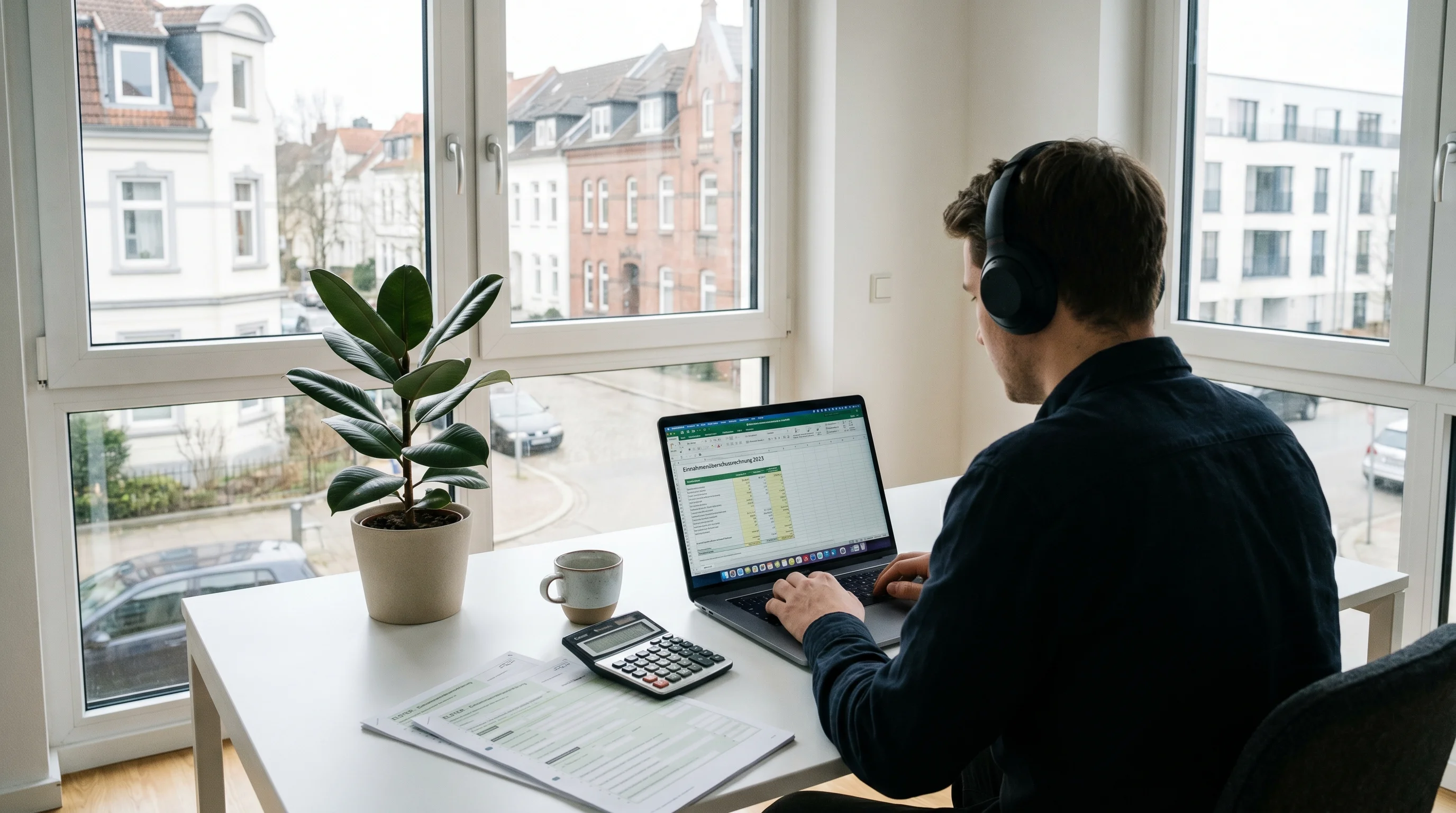
Once you have your Anmeldung, bank account, and health insurance sorted, you can register your freelance activity with the Finanzamt.
The Fragebogen zur steuerlichen Erfassung
This is the tax registration questionnaire – a multi-page form (available in German, with unofficial English translations online) that the Finanzamt uses to set up your tax file.
Key information you’ll provide:
- Personal details and address (matching your Anmeldung)
- Type of activity – this is where you declare whether you’re Freiberufler (liberal professional) or Gewerbetreibender (trade business). This classification matters enormously for your tax obligations. See our Freiberufler vs Gewerbe guide.
- Estimated income – the Finanzamt uses this to set your quarterly tax prepayments. Be realistic but conservative – overestimating means larger prepayments that you’ll get back later.
- VAT status – whether you’re registering for standard VAT or using the Kleinunternehmerregelung (small business exemption). If your revenue will stay below EUR 25K (previous year threshold) / EUR 100K (current year hard cutoff), the exemption saves you from filing VAT returns.
- Bank details – your German bank account for tax payments and refunds.
- Health insurance confirmation – proof of your GKV or PKV membership.
Submitting the Form
You can submit the Fragebogen via ELSTER (elster.de) – Germany’s online tax portal. You’ll need to register for ELSTER first, which involves receiving an activation code by post (1–2 weeks). Alternatively, submit a paper form directly to your local Finanzamt.
What You Receive
After processing (typically 2–6 weeks), the Finanzamt will issue:
- Steuernummer (tax number) – required on all your invoices. Different from your Steueridentifikationsnummer (personal tax ID received after Anmeldung).
- USt-IdNr (VAT number, if applicable) – your EU VAT identification number for cross-border B2B transactions. Issued separately, sometimes takes longer.
- Prepayment schedule – quarterly income tax prepayments based on your estimated income.
For a detailed breakdown of what you’ll owe, see our guide to remote worker taxes in Germany.
Step 6: Get Your Invoicing Right
Germany has strict invoicing requirements. Non-compliant invoices can cause problems with clients (who can’t deduct VAT from improperly formatted invoices) and with the Finanzamt.
Mandatory Invoice Elements
Every invoice (Rechnung) must include:
- Your full name and address (as registered with the Finanzamt)
- Client’s full name and address
- Your Steuernummer or USt-IdNr (tax number or VAT ID)
- Invoice date
- Sequential invoice number – must be unique and sequential. Germany takes this seriously. Gaps in numbering can trigger audit questions.
- Description of services – specific enough that the Finanzamt can understand what was provided
- Date of service delivery (or period for ongoing work)
- Net amount
- VAT rate and amount (or statement of Kleinunternehmer exemption: “Gemäß § 19 UStG wird keine Umsatzsteuer berechnet”)
- Gross amount
Invoicing Tools
Popular options for German freelancers:
- SevDesk – German-made, tax-advisor-friendly, handles all compliance requirements
- Lexoffice (by Lexware) – similar to SevDesk, integrates with ELSTER
- Fastbill – lightweight, good for freelancers with simpler needs
- SumUp Invoices – budget-friendly option
All of these generate compliant German invoices and can connect to your Steuerberater for year-end filing.
Step 7: Additional Practical Setup
Schufa (Credit Check)
The Schufa is Germany’s credit scoring system. Landlords, banks, and some service providers will ask for a Schufa-Auskunft (credit report). As a newcomer, you won’t have one – which can actually work in your favour (no negative marks).
Request a free Datenkopie (data copy) from meineschufa.de – this is the free version intended for personal use. The paid Schufa-BonitätsAuskunft (EUR 30) is formatted for landlords and looks more professional.
Internet and Phone
Set up home internet as early as possible – installation appointments can take 2–4 weeks.
- Major providers: Telekom, Vodafone, O2, 1&1
- Typical speeds: 50–250 Mbps cable/DSL in cities; fibre (1 Gbps) expanding but not universal
- Cost: EUR 30–50/month for decent broadband
- Contract terms: Many plans lock you in for 24 months. Look for monthly-cancellable options (monatlich kündbar) from providers like O2 or Freenet.
For mobile, prepaid SIMs from Aldi Talk, Lidl Connect, or Congstar are cheap (EUR 8–15/month) and sufficient for data backup. Post-paid contracts offer better speeds and coverage but again lock you in.
Important note: Germany’s internet infrastructure, while generally reliable in city centres, can be surprisingly patchy in suburbs and smaller towns. If reliable connectivity is essential for your work – and as a remote worker, it is – check actual availability at your specific address before signing a lease. Use the providers’ coverage checkers and ask current residents if possible.
Cash
Germany is still more cash-dependent than most Western European countries. While card acceptance has expanded significantly since 2020, you’ll encounter cash-only situations:
- Many independent restaurants and cafés
- Flea markets and weekly markets
- Some bakeries and small shops
- Doctor’s offices (for co-payments)
- Some public services and parking
Always carry EUR 50–100. This is changing gradually, but “only cash” (nur Bargeld) signs are still common. Berlin is the most card-friendly city; smaller cities and rural areas are more cash-reliant.
Public Transport
Germany’s public transport is excellent in cities and between major urban centres.
- Deutschlandticket: EUR 63/month for all local and regional transport nationwide. Exceptional value – covers buses, trams, U-Bahn, S-Bahn, and regional trains. Does not cover ICE (high-speed) or IC (intercity) trains.
- BahnCard: 25% or 50% discount on long-distance trains. The BahnCard 50 (EUR 244/year) pays for itself quickly if you travel between cities regularly.
Residence Permit (Non-EU Nationals)
If you’re from outside the EU/EEA, you’ll need a residence permit that allows freelancing. Germany offers several options:
- Freelance visa (Aufenthaltserlaubnis zur Ausübung einer freiberuflichen Tätigkeit) – for recognised Freiberufler professions
- Self-employment visa (Aufenthaltserlaubnis zur Ausübung einer selbständigen Tätigkeit) – for trade businesses
- The new remote work framework – still evolving in 2026
See our detailed guides on Germany’s freelance visa for non-EU citizens and the 2026 remote work visa developments.
The Complete Checklist
Here’s your setup sequence as a printable checklist:
Before Arrival:
- Research cities and neighbourhoods
- Book initial accommodation that provides Wohnungsgeberbestätigung
- Open N26 or Revolut account for initial Euro banking
- Research health insurance options (GKV vs PKV)
- Gather documents: passport, qualification certificates, client contracts
Week 1–2:
- Move into accommodation
- Get Wohnungsgeberbestätigung from landlord
- Book Bürgeramt appointment for Anmeldung
- Complete Anmeldung (receive Meldebestätigung)
- Register for ELSTER (online tax portal)
- Apply for Schufa report
Week 2–4:
- Open German bank account (DKB, Sparkasse, or similar)
- Sign up for health insurance (GKV or PKV)
- Apply to KSK if eligible (creative professionals)
- Start the Fragebogen zur steuerlichen Erfassung on ELSTER
- Set up home internet
Week 4–8:
- Receive Steueridentifikationsnummer by post
- Submit Fragebogen to Finanzamt
- Receive Steuernummer and VAT number (if applicable)
- Set up invoicing software
- Find a Steuerberater (tax advisor)
- Get Deutschlandticket for public transport
Ongoing:
- File monthly/quarterly VAT returns (if not Kleinunternehmer)
- Make quarterly income tax prepayments
- Keep all receipts and invoices organised
- File annual tax return by 31 July (or end of February with Steuerberater)
Frequently Asked Questions
How long does the full setup process take?
Budget 4–8 weeks from arrival to having your Steuernummer and being fully operational. The bottlenecks are usually the Bürgeramt appointment (days to weeks) and the Finanzamt processing time (2–6 weeks).
Can I start working before I have my Steuernummer?
Technically yes – you can invoice clients using your Steueridentifikationsnummer (personal tax ID) temporarily while waiting for your Steuernummer. Some clients may accept this; others may insist on a proper Steuernummer. Check with a Steuerberater.
Do I need to speak German for the setup process?
Having basic German helps enormously but isn’t strictly required. The Anmeldung form is available in German only, but templates with English translations exist online. The Fragebogen can be completed on ELSTER, which has some English support. Many Finanzamt offices in larger cities have staff who speak English. If in doubt, bring a German-speaking friend or hire a relocation service for the initial setup.
What if my landlord won’t provide the Wohnungsgeberbestätigung?
This is a legal requirement for landlords – they can be fined for refusing. However, enforcement is inconsistent. If your accommodation provider genuinely won’t issue the document, you’ll need to find alternative housing. Some relocation agencies specialise in arranging accommodation that includes this confirmation.
Can I use a virtual address for Anmeldung?
No. The Anmeldung requires a physical residential address where you actually live. Virtual offices and mailbox addresses don’t qualify. This is a real residential registration, not a business address.
How much should I budget for the setup period?
Beyond your regular living costs, budget approximately:
- Serviced apartment (1 month): EUR 1,200–2,000
- Deposit on permanent housing: Typically 2–3 months’ cold rent
- First month’s rent: EUR 500–1,500 depending on city
- Health insurance (first month): EUR 220–1,000
- Miscellaneous (Schufa, transport, admin): EUR 200–300
- Buffer for delays: EUR 1,000–2,000
Total initial setup budget: EUR 3,000–8,000 depending on city and housing costs. Have this available in cash or in your Euro account before arriving.
Where can I get help with the process?
- Relocation agencies: Handle the entire process for EUR 500–2,000. Worth considering if you’re unfamiliar with German bureaucracy.
- Steuerberater (tax advisor): Essential for the Fragebogen and ongoing tax compliance. Fees are regulated and tax-deductible.
- Expat Facebook groups: City-specific groups are excellent for practical tips and recent experiences.
- Welcome centres: Some cities (Berlin, Munich, Hamburg) have official welcome centres for international newcomers with English-speaking staff.