The Canary Islands sit 100km off the coast of Africa, but they’re fully part of Spain, and the EU. This geographic quirk creates a unique proposition for remote workers: year-round warm weather, Spanish legal frameworks, EU rights, and special tax incentives that don’t exist on the mainland.
Remote Work Europe tracks regulatory changes across 30+ European jurisdictions and reports back when the rules genuinely shift for remote workers and freelancers.
Las Palmas de Gran Canaria, in particular, has been on the digital nomad map for years. It consistently ranks among the top remote work destinations globally, and for good reason – the climate barely varies between seasons, the coworking scene is mature, and the international community is large and well-organised. Tenerife, the larger island, offers a different flavour – more varied landscapes, a split between the touristic south and the more local north, and a growing remote worker scene of its own.
The Canaries aren’t for everyone. Island life means limited space, repetitive scenery for some tastes, and a distance from mainland Europe that can feel isolating. Flights to the peninsula take 2.5–3 hours, and you’re in a different time zone (one hour behind mainland Spain). But if year-round warmth, tax advantages, and an established nomad community are priorities, the Canaries make a strong case.
Why the Canary Islands for remote work
The climate is the headline. Average temperatures range from 18°C in winter to 25°C in summer, with sea temperatures comfortable enough for swimming year-round. There’s no European winter to endure, no 40°C summer to survive. For remote workers whose productivity crashes in cold, dark months, this consistency is transformative.
Then there’s the ZEC (Zona Especial Canaria) – a special economic zone offering a corporate tax rate of just 4% for qualifying businesses. If you’re running a company (not freelancing as an individual), the ZEC can be a significant financial incentive. The requirements include creating at least one local job and making a minimum investment, but for established businesses, the savings are substantial. This isn’t a grey area – it’s an official EU-approved incentive.
The IGIC (the Canary Islands’ equivalent of VAT) is also lower than mainland Spain’s IVA – 7% versus 21%. This makes daily living measurably cheaper in some categories.
When you are empadronar in the Canaries, you also get significant discounts on travel to and from the mainland, and between the different islands.
Las Palmas has one of Europe’s most developed digital nomad ecosystems. Coworking spaces, nomad-friendly cafes, regular meetups, and a deep international community mean you can hit the ground running. Tenerife’s scene is smaller but growing, particularly in the north around La Laguna and Puerto de la Cruz.
Cost of living
The Canaries are moderately priced – cheaper than Barcelona or Madrid, roughly comparable to Valencia, and slightly more expensive than interior mainland cities. The lower IGIC rate helps offset some costs.
| Item | Typical monthly cost |
|---|---|
| 1-bed apartment (Las Palmas centre) | EUR 750–1,000 |
| 1-bed apartment (outside centre) | EUR 550–750 |
| 1-bed apartment (Tenerife North) | EUR 550–800 |
| 1-bed apartment (Tenerife South) | EUR 650–900 |
| Coworking desk | EUR 150–250/month |
| Coffee | EUR 1.30–1.80 |
| Meal out (mid-range) | EUR 10–16 |
| Monthly transport pass | EUR 35–45 |
| Estimated monthly budget (single) | EUR 1,500–2,100 |
Rental prices have increased significantly in Las Palmas, driven by demand from remote workers and limited housing stock. Tenerife North tends to be slightly cheaper. In both cases, looking slightly outside the most popular areas yields much better deals. Platforms like Flatio can help – they specialise in deposit-free furnished rentals for one to six months, which avoids tying up a large deposit in a competitive market.
If you’re earning in non-euro currencies, Wise is essential – the savings on conversion fees are meaningful when applied to monthly living costs.
Connectivity and coworking
Internet infrastructure on the main islands is good. Fibre is available in urban areas of both Las Palmas and Tenerife’s main cities, with speeds of 300–600 Mbps. Mobile 4G coverage is strong in populated areas; 5G is rolling out in the main cities.
Gran Canaria (Las Palmas):
- Restation – the original Las Palmas coworking space, strong community, coliving option.
- The House – stylish space in Triana, professional atmosphere.
- Coworking Canarias – multiple locations, flexible pricing.
- Surf Office (various locations) – combines workspace with the surfing lifestyle.
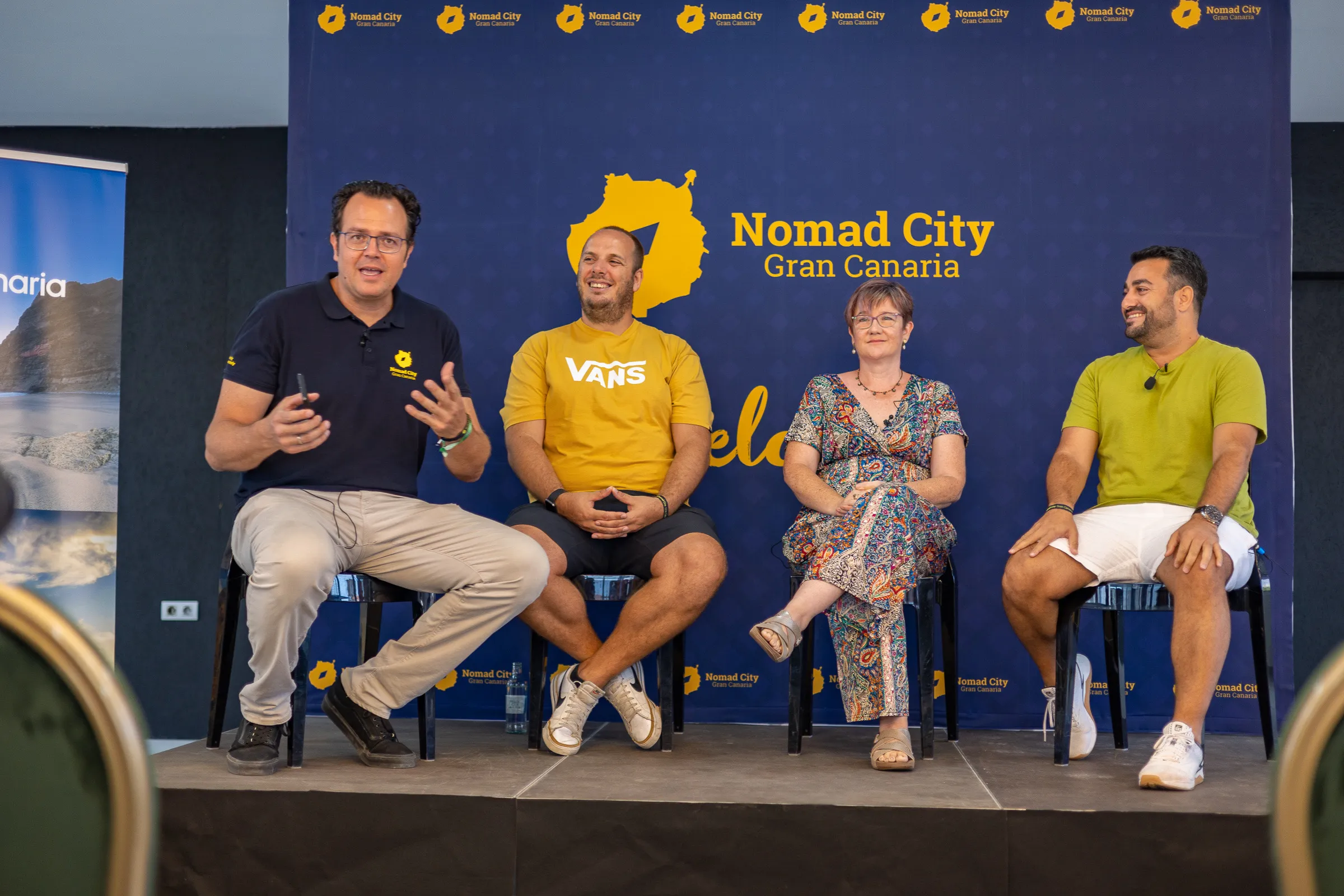
- Nomad City (Las Palmas and Agaete) – coliving and coworking in real Canarian style.
Cafe culture in Las Palmas is excellent and largely nomad-friendly. The Triana district and the area around Las Canteras beach have numerous spots where laptops are welcome.
Tenerife:
- Coworking La Laguna – in the university city of San Cristóbal de La Laguna, affordable and community-focused.
- Coworking spaces in Santa Cruz – the island capital has growing options.
- Various spaces in the south – Costa Adeje and Los Cristianos have coworking catering to the winter sun crowd.
Be aware that internet in more rural or mountainous areas can be unreliable. Stick to urban centres for guaranteed connectivity.
Community and networking
Las Palmas has arguably the best digital nomad community in Spain. It’s been building for nearly a decade, and the infrastructure is mature.
Nomad meetups happen weekly. The Las Palmas Digital Nomads group on Facebook has thousands of members. Slack groups, WhatsApp communities, and regular social events make connecting effortless. If you’ve struggled to find your people in other destinations, Las Palmas makes it easy.
Tenerife’s community is smaller but growing, particularly in the north. La Laguna (a UNESCO World Heritage university city) is developing a scene that appeals to remote workers who want something less party-oriented than the south.
The communities on both islands skew international – a mix of European, North American, and increasingly Latin American remote workers. English is widely spoken in expat circles, though learning Spanish significantly enriches the experience.
It’s worth noting that due to limited housing resources and land space on the islands themselves and the recent increased visibility of remote workers and digital nomads there has been a perceptible backlash. This is noticeable online and some graffiti etc., So if this bothers you, you might want to take it into consideration when choosing where to live.
Co-living options are well-established on both islands, offering a shortcut to social connections alongside workspace.
Visa and legal considerations
As part of Spain, all standard visa routes apply:
-
The Digital Nomad Visa (DNV) – the primary route for non-EU remote workers. Full details in our DNV guide.
-
Autonomo registration – for freelancers. Our autonomo guide covers the process, and Xolo handles the admin.
-
The Non-Lucrative Visa – for passive income holders. See our NLV guide.
The ZEC tax incentive deserves specific attention if you’re running a business. Qualifying companies pay just 4% corporate tax (compared to 25% on the mainland). You’ll need to incorporate in the Canaries, create at least one job within six months (five for service companies), and invest a minimum of EUR 50,000 in Gran Canaria/Tenerife (EUR 25,000 in other islands) within two years. Professional tax advice is essential here – this is not a DIY setup.
For visa guidance, Richelle de Wit specialises in helping remote workers with Spanish immigration.
Climate and lifestyle
The Canary Islands have a subtropical climate – mild, stable, and without the extremes of mainland Spain. Each island has micro-climates depending on altitude and orientation.
Gran Canaria – Las Palmas sits on the northeast coast, with average temperatures of 18–25°C year-round. It gets some cloud and occasional rain in winter, particularly in the north. The south (Maspalomas, Playa del Inglés) is sunnier and drier but more touristic.
Tenerife – the north (La Laguna, Puerto de la Cruz) is greener and cloudier, with a more European feel. The south (Costa Adeje, Los Cristianos) is drier and sunnier. The Teide volcano (Spain’s highest peak) creates dramatic weather differences between coasts.
Lanzarote and Fuerteventura – popular tourist destinations with beautiful beaches and landscapes, both attracting year-round long-stay professional visitors in increasing numbers now. The architecture of César Manrique gives Lanzarote a unique cultural heritage and appearance.
La Palma, La Gomera, El Hierro, La Graciosa - the Canary Island Archipelago includes many smaller islands and indeed uninhabited islets. Each has its own unique culture and landscapes and if you truly want to work very remotely the possibilities continue to open up
Whichever island you choose, the outdoor lifestyle is the big draw. Surfing, hiking, diving, sailing – the islands offer all of this within short distances. Las Canteras beach in Las Palmas is one of the best urban beaches in Europe. Tenerife’s Anaga mountains and the Teide national park provide world-class hiking.
Healthcare is available through the Spanish public system. Both main islands have well-equipped hospitals. Private healthcare is also accessible.
The time zone (GMT/UTC in winter, GMT+1 in summer) is one hour behind mainland Spain and one hour behind CET. This can be an advantage for working with UK clients or splitting the difference with US time zones.
Getting started
Here’s your practical guide to landing in the Canaries:
-
Choose your island first. Las Palmas for the established nomad scene, easy socialising, and urban beach life. Tenerife North for more variety, lower costs, and a quieter pace. Tenerife South for guaranteed sunshine and a more resort-like atmosphere.
-
Sort your visa before arrival. Richelle can advise on whether the DNV, autonomo, or NLV route suits your situation.
-
Register on the padrón at your island’s municipal office.
-
Get your NIE/TIE – book appointments early, as island offices can have limited availability.
-
Explore before you sign a lease. In Las Palmas, the areas around Las Canteras and Triana are most popular with nomads, but Vegueta (the old town) and Guanarteme offer alternatives. In Tenerife, compare La Laguna, Santa Cruz, Puerto de la Cruz, and the southern resorts before committing.
For curated remote job leads suited to European time zones, RWE Connected saves you hours of searching and weeds out the scams.
The Canary Islands offer a unique package – EU membership, Spanish legal frameworks, year-round warmth, potential tax advantages, and established nomad communities. The distance from mainland Europe and island-scale limitations are the trade-offs. For many remote workers, particularly those who’ve tried the mainland and want something different, the Canaries hit a genuine sweet spot.