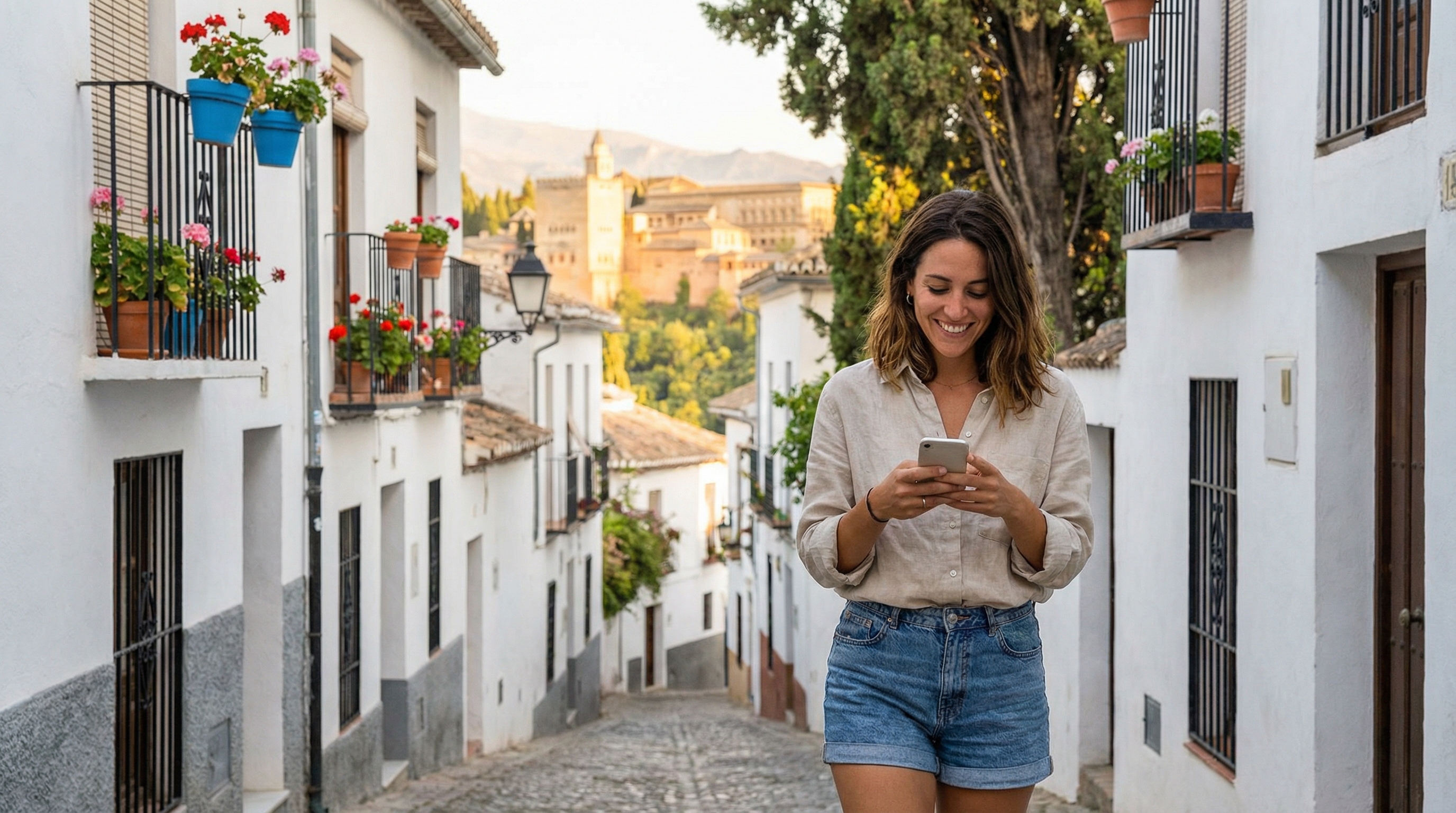
Granada is the kind of city that people visit for a weekend, and then start quietly researching rental prices. The Alhambra gets all the headlines, but it’s the everyday reality of living here that hooks remote workers – genuinely affordable costs, a vibrant university atmosphere, and the surreal backdrop of the Sierra Nevada rising above the rooftops.
Remote Work Europe maintains updated guides on the rules covered here, cross-referenced against official government publications.
It’s a smaller city than Valencia or Malaga, and that comes with trade-offs. The coworking scene is more limited, the international community is smaller, and you’ll need decent Spanish to navigate daily life comfortably. The airport is modest, with fewer direct international routes. But if you’re looking for authenticity over convenience, Granada delivers in ways that more obvious digital nomad hubs simply can’t.
Why Granada for remote work
Granada is affordable – genuinely, not just by Western European techie standards. It’s one of Spain’s cheapest provincial capitals, partly because the economy is driven by the university and tourism rather than high-paying industry. Your money stretches further here than in almost any other Spanish city of comparable beauty.
The lifestyle is extraordinary for the cost. Free tapas culture is still alive – order a drink and food arrives, no charge. The Sierra Nevada ski resort is 45 minutes away. The Alpujarra villages are an hour’s drive for hiking, and the beach at Salobreña is 75 minutes in the other direction. Granada sits at a crossroads of mountains, coast, and history.
The university (one of Spain’s largest) keeps the city young, lively, and surprisingly international. There’s a constant flow of Erasmus students and visiting academics, which means language exchanges, cultural events, live music, and a cosmopolitan energy that belies the city’s size.
Cost of living
Granada is one of the most affordable cities in this entire guide series. If budget is a primary concern, this should be high on your list.
| Item | Typical monthly cost |
|---|---|
| 1-bed apartment (centre) | EUR 550–800 |
| 1-bed apartment (outside centre) | EUR 400–600 |
| Coworking desk | EUR 100–180/month |
| Coffee | EUR 1.20–1.80 |
| Meal out (mid-range) | EUR 10–15 |
| Monthly transport pass | EUR 35 |
| Estimated monthly budget (single) | EUR 1,200–1,700 |
The free tapas tradition means your food budget can be remarkably low if you embrace the local rhythm – a caña (small beer) with a generous tapa at each stop adds up to a full meal for a few euros.
If you’d rather avoid the deposit and furnishing hassle of a traditional Spanish lease, Flatio offers deposit-free furnished rentals for stays of one to six months – a practical option while you get your bearings.
If you’re earning in a stronger currency, Wise helps you maximise the exchange rate advantage rather than losing it to bank fees.
Connectivity and coworking
Fibre broadband is available in most of central Granada, with speeds of 300–600 Mbps standard. Mobile coverage is solid in the city, though signal can be patchy in the Albaicín’s narrow streets and older buildings.
The coworking scene is smaller than in larger cities but growing:
- Ático Coworking – centrally located, friendly community, good for freelancers.
- Coworking Granada – professional space with meeting rooms and event programming.
- La Madraza Coworking – near the university, affordable and popular with younger professionals.
Cafe culture is strong, and many bars and cafes tolerate laptop workers – though Granada is more traditional than Valencia or Barcelona in this respect. The university area (around Calle Pedro Antonio de Alarcón) has the most laptop-friendly options.
Community and networking
Granada’s remote worker community is emerging rather than established. You won’t find the same density of digital nomad events as in Malaga or Lisbon, but there is a growing international presence.
The Erasmus and language exchange scene provides a natural entry point. Facebook groups like Expats in Granada and various language exchange meetups are the easiest way to connect. The university regularly hosts open lectures and cultural events.
Granada’s city council has stepped in too: the Ayuntamiento runs an official digital nomads initiative, and its digital guide for remote workers pulls together the practicalities from the municipal side – a useful official complement to the community groups above.
There are a few co-living options that have started to appear, catering to remote workers looking for a ready-made community. The scene is smaller and more intimate – if you prefer knowing everyone at the meetup rather than networking in a crowd of 200, Granada might suit you better.
Spanish is essential here. Granada is not as English-friendly as the coastal cities. This is actually a plus if you’re serious about learning the language – full immersion is the fastest path, and granadinos are generally warm and patient with learners.
Visa and legal considerations
Standard Spanish visa options apply:
-
The Digital Nomad Visa (DNV) works well for non-EU remote workers. See our full DNV guide for eligibility and application details.
-
Autonomo registration is necessary for anyone freelancing within Spain. It’s worth understanding the obligations before committing – our autonomo guide breaks it down, and Xolo can manage the administrative burden.
-
The Non-Lucrative Visa is an option for those with passive income. Our NLV overview explains the requirements.
Whatever your visa path, specialist support makes the process dramatically less painful. Richelle de Wit knows the Spanish immigration system inside out and works specifically with remote workers.
Climate and lifestyle
Granada has a more continental climate than coastal Andalusia. Summers are seriously hot – 35–40°C is normal in July and August, and the city bakes without a sea breeze to relieve it. Winters are cooler than the coast, with temperatures occasionally dipping near freezing and occasional light snow. Spring (March–May) and autumn (September–November) are magnificent.
The Sierra Nevada is Granada’s trump card for lifestyle. From November to April, you can ski in the morning and have tapas in the city by evening. In summer, the same mountains offer hiking trails, mountain biking, and escape from the heat at altitude.
Healthcare follows the standard Spanish system. Register at your local centro de salud with your padrón certificate. The Hospital Universitario San Cecilio is the main public hospital. Private healthcare options are more limited than in larger cities but adequate for routine care.
The airport (Federico Garcia Lorca) has limited direct international flights – mostly budget carriers to UK and European destinations. For a wider range of connections, Malaga airport is about 1.5 hours by car or bus.
Getting started
Planning your move to Granada? Here’s the practical sequence:
-
Arrange your visa well in advance. Processing times vary, and you don’t want to be waiting on paperwork while paying for temporary accommodation. Richelle can advise on the best route and timeline.
-
Register on the padrón at the Ayuntamiento (city hall) or a district office. Essential for everything that follows.
-
Get your NIE/TIE – your tax identification and residency card. Book the appointment online as soon as you have an address.
-
Register for healthcare at your assigned centro de salud.
-
Choose your neighbourhood carefully. The Albaicín is magical but has steep hills, limited parking, and sometimes unreliable internet in older buildings. Centro is convenient and lively. Realejo is charming and walkable. The area around Camino de Ronda is more residential, modern, and affordable. If you want more space, consider the Zaidín – a genuine local neighbourhood with excellent tapas bars and lower rents.
Need remote work leads that fit European life? RWE Connected hand-picks verified roles from employers who genuinely support remote working across time zones.
Granada won’t suit everyone. The smaller scene, language barrier, and summer heat are real considerations. But for the cost of living, quality of life, and sheer beauty of the place, it offers something that money can’t buy in the more saturated nomad destinations.